

By All in Maritime News | June 2025
Northern Territory, Australia — In the vast waters north of Darwin, a new frontier of natural gas development is taking shape. The Barossa Gas Project, operated by Santos Ltd, is one of Australia’s largest and most technically demanding offshore developments—poised to become the primary supply source for the Darwin LNG export terminal after the depletion of the nearby Bayu-Undan field.
With more than 67% of construction now complete, the Barossa development is on track to begin production in late 2025, reinforcing Australia’s role as a top-three global LNG exporter and delivering a vital energy bridge to Asia amid deepening geopolitical realignments.
Project Snapshot
- Operator: Santos Ltd (50%) with partners SK E&S (37.5%) and JERA (12.5%)
- Location: 285 km north of Darwin, offshore Northern Territory
- Resource Estimate: ~4.5 trillion cubic feet of dry gas
- Infrastructure:
- Subsea wells and manifold
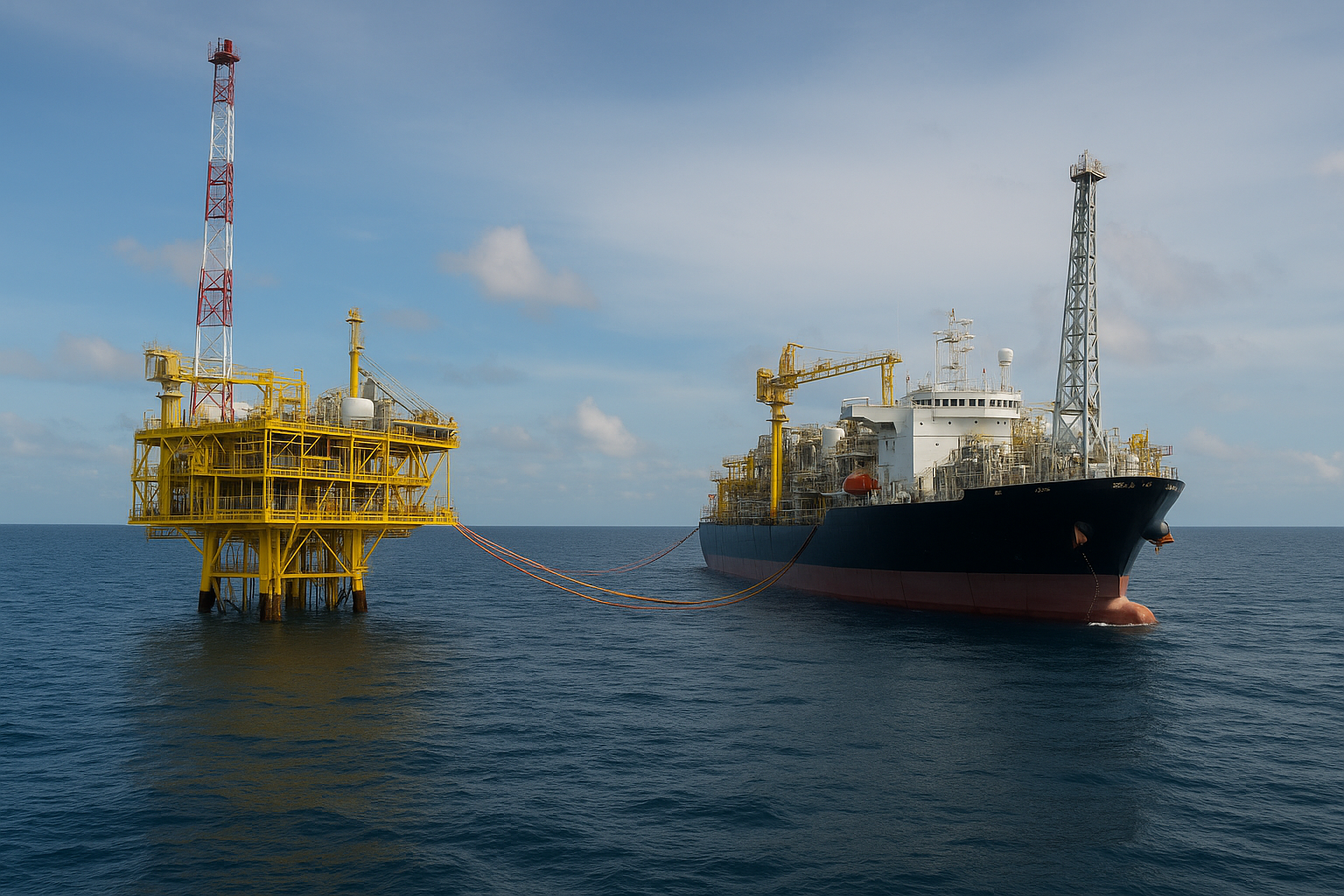
- Floating Production Storage and Offloading (FPSO) vessel
- 262 km pipeline linking to the Darwin LNG facility
- 10+ support vessels and pipelay barges operating simultaneously
- Investment: AUD 4.7 billion (USD ~3.1 billion)
Strategic Importance
The Barossa field replaces Bayu-Undan, which ceased production in 2023. Its role is critical in keeping the Darwin LNG terminal operational, safeguarding Australia’s export capacity of around 3.7 million tonnes per annum (mtpa) to key buyers in Japan, South Korea, and China.
With East Asian nations seeking secure, lower-carbon LNG alternatives to Russian supply, Barossa is viewed as a pivotal stabilizer in regional energy security.
Engineering and Offshore Activity
The centerpiece of the project is a newbuild FPSO, constructed in South Korea and set to arrive on site in Q4 2025. Equipped with low-emission turbines and high-efficiency processing units, the vessel will handle gas dehydration, compression, and export via risers and subsea tiebacks.
Subsea installation work—including riser bases, manifold skids, and deepwater pipeline anchoring—is being executed with support from vessels such as the Allseas Audacia and Normand Clipper.
Barossa’s pipeline alone, laid at depths of over 300 meters, represents one of Australia’s longest and most complex shallow-to-deepwater transitions.
Environmental and Legal Challenges
Despite its technical progress, the project has faced legal and social challenges:
- In 2022–23, the Federal Court of Australia ordered a temporary suspension of offshore construction following complaints from Indigenous communities on the Tiwi Islands, citing inadequate consultation.
- In 2024, Santos revised its environmental management plan and resumed activity after receiving fresh regulatory approvals and community engagement agreements.
Critics have also targeted the field’s high CO₂ content (18%), arguing that it undermines Australia’s climate commitments. Santos has responded by committing to carbon capture initiatives and offset programs, although specifics remain under scrutiny.
Industry Insight
“Barossa is a high-risk, high-reward development,” said Anna Lydon, an energy analyst at the Perth-based Institute for Offshore Strategy. “Its timing is strategic—just as Asian buyers diversify away from Russian gas and LNG spot prices remain volatile. But its environmental footprint is being watched closely.”
“It’s a flagship for Australia’s offshore engineering muscle,” added Captain Farhan Roos, a Darwin-based marine surveyor. “The scale of coordinated vessel deployment, from heavy pipelay ships to dynamic positioning drill rigs, is unmatched in the region right now.”
Economic Impact
- Jobs: Over 1,000 construction and marine roles supported across Darwin, Singapore, and South Korea
- Supply Chain: Major fabrication yards in Asia and logistics operations in Northern Australia
- Export Revenue: Estimated at AUD 1.3 billion annually once operational
Santos is also exploring potential tiebacks to nearby Caldita and Poseidon gas fields, which could extend the project’s life into the 2040s.
Conclusion
The Barossa Gas Project is more than just a resource extraction effort—it is a geopolitical lever, an offshore engineering showcase, and a litmus test for energy development in the era of climate accountability. As Santos and its partners race toward first gas in 2025, the project remains a focal point for investors, governments, and environmentalists alike.
All in Maritime News will continue monitoring Barossa’s progress as it moves from construction to commissioning—tracking how this offshore giant may shape the Indo-Pacific’s energy landscape for decades to come.
