

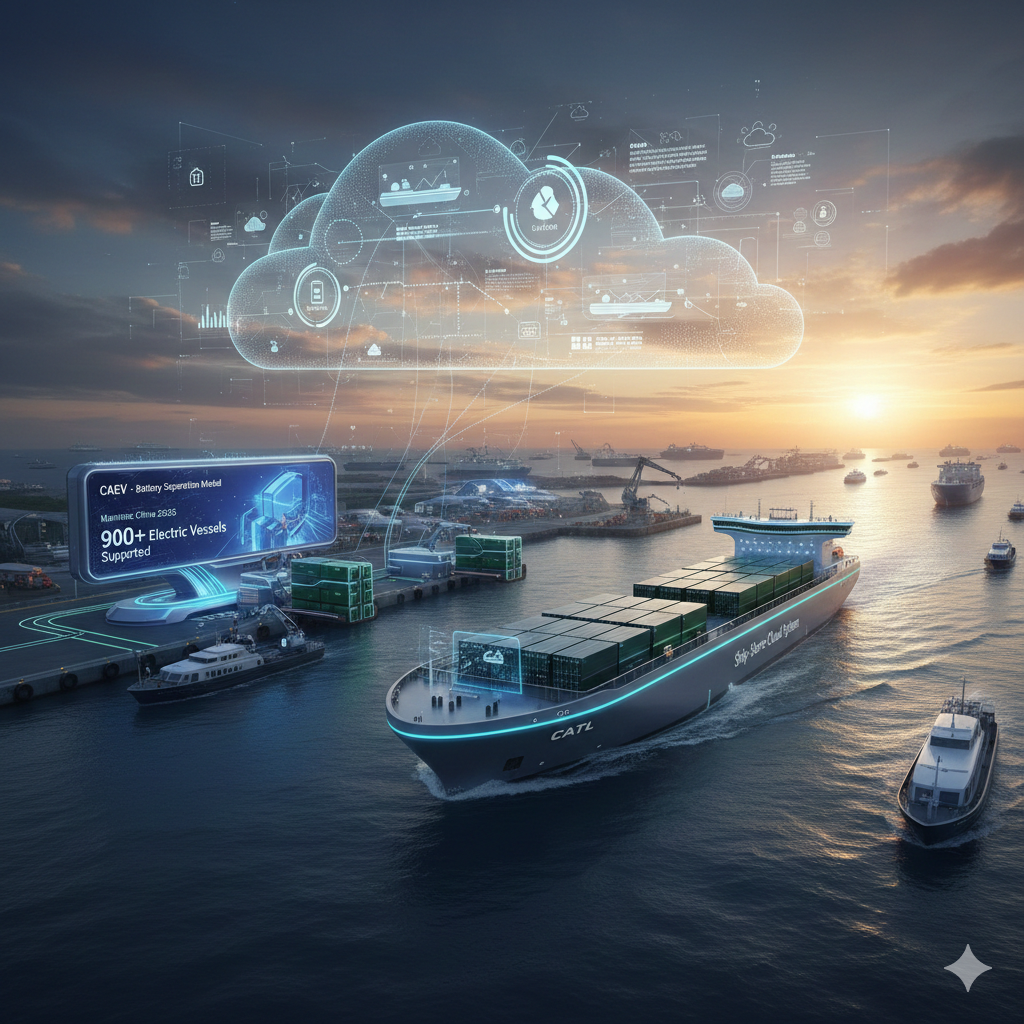
00CATL, the world’s largest manufacturer of electric-vehicle batteries, has taken a decisive step toward large-scale zero-carbon shipping with the launch of its new Ship-Shore-Cloud system, showcased through subsidiary CAEV at Marintec China 2025. The platform marks one of the most comprehensive attempts yet to unify vessel-side energy storage, shoreside charging and swapping infrastructure, and real-time cloud monitoring—elements that have historically been fragmented across multiple suppliers.
A Fully Integrated Architecture for Electric Shipping
At the core of CATL’s system is an integration of three critical components:
• Ship:
Advanced onboard batteries paired with navigation-linked power management enable vessels to optimize energy use throughout a voyage. The system is engineered to endure maritime environments—humidity, seawater exposure, temperature swings—while maintaining consistent performance across a ship’s 30-year life cycle.
• Shore:
CAEV’s battery separation model allows ships to exchange or recharge energy modules landside. This eliminates the need for shipowners to carry long-term battery ownership costs and reduces capital expenditure—an issue that has slowed electric vessel adoption, especially for operators with large fleets or variable trading patterns.
• Cloud:
CATL’s Yunfan and Beichen digital platforms provide continuous monitoring of vessel health, battery performance, route planning, and predictive energy demand. Remote diagnostics and real-time operation optimization offer operators significantly better control over range, efficiency, and maintenance cycles.
Dismantling Range Anxiety in Maritime Electrification
Electric shipping has traditionally been limited to inland waterways and short-sea segments due to constraints in battery density, charging standardization, and infrastructure compatibility. CATL’s Ship-Shore-Cloud system is designed to break those boundaries by synchronizing vessel energy needs with a network of intelligent shore stations, effectively extending the achievable voyage distance for electric ships.
The company’s integrated approach aims to minimize operational uncertainties—particularly “range anxiety”—by ensuring that both vessel and shore systems communicate continuously and adapt in real time. This positions the technology not merely as a battery product, but as a full lifecycle ecosystem.
Scaling Up: 900 Electric Vessels and Counting
Backed by China’s rapidly expanding electric marine sector, CATL has already supported the delivery of almost 900 electric vessels, ranging from ferries and workboats to cargo units. This fleet scale demonstrates momentum that few global battery or shipyard players have matched.
Notably, CATL has outlined an ambition to enable fully electric ocean-going vessels within the next three years—a goal that, if reached, would represent a transformative milestone for the global maritime industry, where long-distance deep-sea shipping remains the hardest segment to decarbonize.
A Response to Shipping’s 1-Billion-Tonne Carbon Footprint
International Maritime Organization (IMO) data places global shipping emissions at roughly 1 billion tonnes of CO₂ annually, accounting for about 3% of total anthropogenic emissions. With regulatory pressure mounting and customers demanding greener supply chains, the sector is accelerating efforts to replace fossil fuel-dependent systems.
CATL’s ship-shore-cloud architecture supports the transition away from diesel and heavy fuel oil by offering:
- Lower lifecycle emissions
- Reduced fuel costs
- Improved safety through digital oversight
- Standardization opportunities across ports and ship types
If widely adopted, the system could become a foundational layer for the next generation of electric maritime fleets.
A New Era for Zero-Carbon Maritime Operations
CATL’s unveiling at Marintec China signals a broader shift: electric propulsion is moving from experimental pilot projects to scalable commercial reality. By merging energy storage, port infrastructure, and digital intelligence under one unified framework, the Ship-Shore-Cloud system sets a new benchmark for how the industry can pursue deep decarbonization.
As manufacturers, shipowners, and ports seek integrated solutions, CATL’s approach may well become the model driving the next frontier of maritime innovation—one in which fully electric ocean-going vessels are no longer a distant aspiration, but an impending reality.
Tell us What is Happening in Your Area: Contact Maritime Context at: news@maritimecontext.com
