

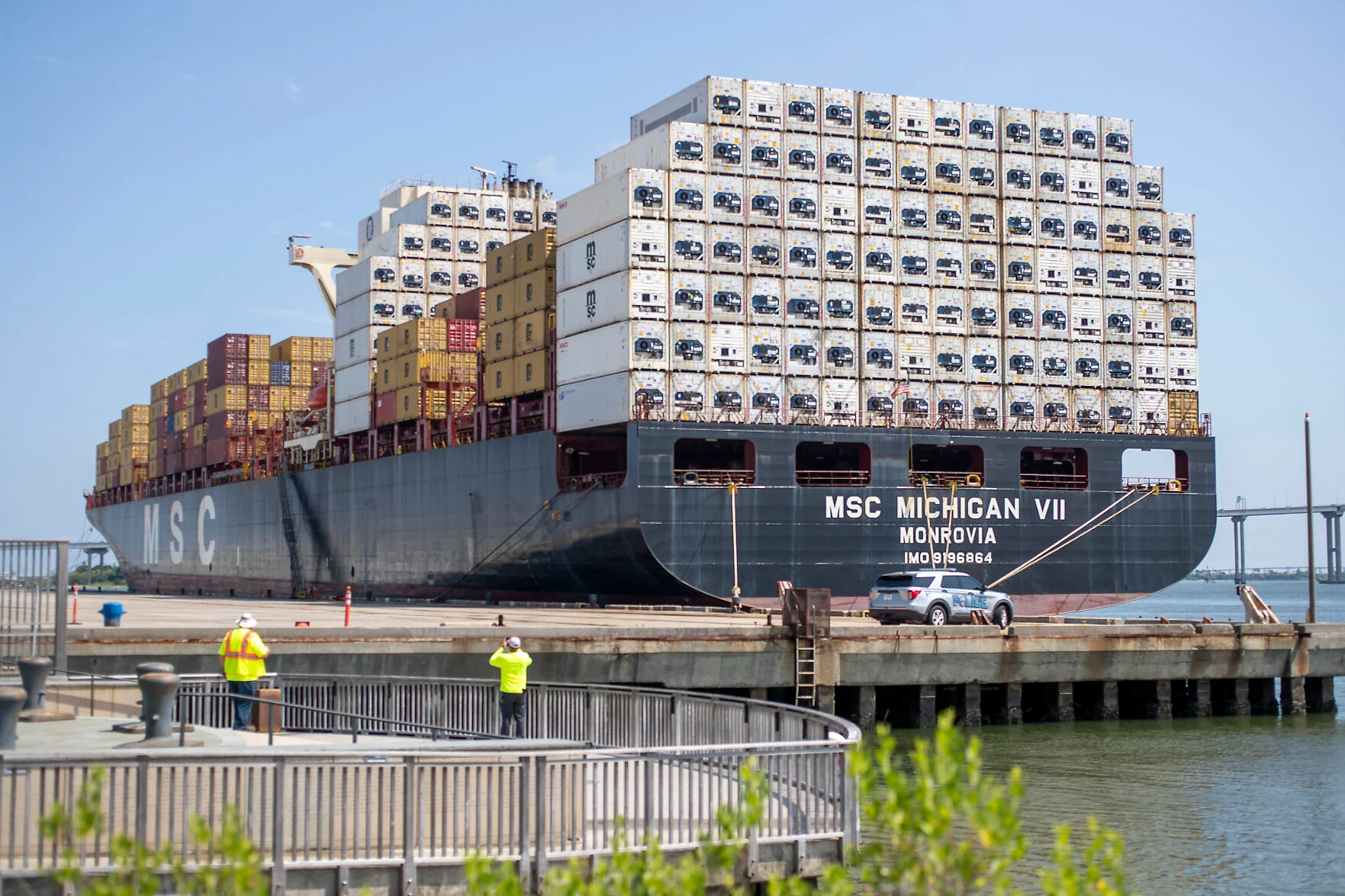
Charleston, South Carolina – September 23, 2025 — The chief engineer of the MSC Michigan VII, the container ship at the center of the dramatic “runaway” incident in Charleston Harbor last year, has pleaded guilty in U.S. federal court to failing to report hazardous conditions and obstructing a federal investigation.
Federal prosecutors confirmed that Fernando San Diego San Juan, 61, a Filipino national, entered the plea agreement last week, admitting to his role in one of the most serious shipping safety cases in recent U.S. maritime history. The plea follows months of investigation by the U.S. Coast Guard (USCG) and the National Transportation Safety Board (NTSB).
The 2024 Charleston Runaway Incident
The case stems from events on June 5, 2024, when the MSC Michigan VII lost control while departing Charleston. A failure in the vessel’s main engine governor system caused the linkage rod between the governor and the fuel rack to disconnect, leaving crew unable to regulate the ship’s propulsion.
As a result, the 984-foot vessel accelerated uncontrollably, reaching speeds of 16–17 knots in a waterway restricted to less than half that speed. The ship’s trajectory raised fears of a possible strike on the Arthur Ravenel Jr. Bridge, prompting authorities to close the bridge and evacuate local beaches.
While the vessel narrowly avoided catastrophic impact, it caused shoreline damage estimated at over $500,000. The MSC Michigan VII was subsequently detained for 44 days as federal authorities carried out a detailed inspection and investigation.
Engineering Failures and Safety Gaps
Court filings reveal that Chief Engineer San Juan had identified numerous mechanical deficiencies after joining the ship in April 2024 but failed to report them to U.S. authorities. Among the problems were:
- Malfunctioning compressors — one operating at just 60% capacity.
- Leaks in crankcase safety valves, freshwater cooling systems, and lube oil circuits.
- Unreliable generators, occasionally unable to meet power demand, limiting use of the bow thruster during maneuvers.
- Fuel injector malfunctions when operating on low-sulfur fuel, leading to greater mechanical strain.
Investigators concluded that these unresolved issues contributed to the severity of the governor linkage failure that triggered the runaway incident.
Obstruction of the Federal Investigation
Prosecutors also accused San Juan of deliberately obstructing investigators. According to the plea documents, he provided false statements about whether the governor linkage rod had ever been adjusted and instructed another engineer not to disclose key details to investigators.
“The defendant’s actions deprived investigators of timely, accurate information at a critical moment,” prosecutors argued. “This was not simply a technical failure — it was compounded by a failure of duty and candor.”
Legal Proceedings and Possible Penalties
Under the plea agreement, San Juan admitted to:
- Failure to report a hazardous condition, which carries a maximum penalty of six years in prison, a $250,000 fine, and up to three years supervised release.
- Obstruction of a federal investigation, punishable by up to five years imprisonment, a similar fine, and supervised release.
A sentencing date has not yet been announced.
Industry Implications
The Charleston incident has become a case study in the risks of deferred maintenance, inadequate handovers, and insufficient reporting culture aboard large vessels. San Juan reportedly received only five hours of handover briefing when he assumed duties on board — a period federal authorities described as “grossly insufficient” given the scale and complexity of the ship’s machinery.
The case has also sparked debate about corporate responsibility, as the operator and management company of the MSC Michigan VII have not faced charges. Observers in maritime safety circles note that the incident underscores gaps in compliance and reporting procedures that could have far-reaching consequences if left unaddressed.
A Narrow Escape
Though no lives were lost and the bridge was spared, the Charleston runaway remains one of the closest near-misses in recent U.S. port history. The guilty plea now shifts the focus from the facts of the incident to accountability and sentencing — and to the lessons global carriers must draw about transparency, maintenance, and crew support.
As Charleston residents recall the day a massive containership nearly barreled into their bridge, the industry is left to confront a sobering reminder: in shipping, small lapses in reporting and maintenance can snowball into near-disasters with international repercussions.
Tell us What is Happening in Your Area: Contact Maritime Context at: news@maritimecontext.com
