

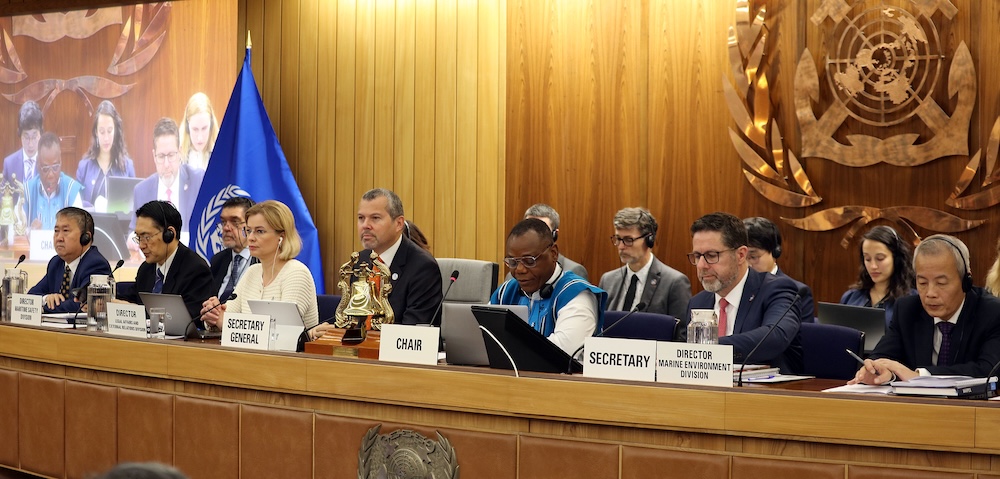
The maritime world reacted with a mix of disappointment and resignation last week as the International Maritime Organization’s (IMO) Marine Environment Protection Committee (MEPC) once again deferred decisive action on its Net-Zero Framework (NZF) — the proposed amendments to MARPOL Annex VI that would anchor the shipping industry’s commitment to reach net-zero emissions by 2050.
The highly anticipated meeting, viewed as a pivotal opportunity to turn ambition into enforceable regulation, ended with delegates agreeing to postpone adoption until 2026 — a move that, while frustrating, had been widely anticipated given the deep-seated political and technical divisions among member states.
Fractures Beneath the Surface
Although many stakeholders had hoped for progress, few were genuinely surprised by the stalemate. The global shipping community had been watching a growing rift within the IMO for months.
A coalition of progressive nations — including the European Union, Pacific Island states, and several Latin American countries — pushed for binding interim targets and a global carbon levy on marine fuels. Their proposals called for cuts of 37% by 2030 and 96% by 2040, supported by financial mechanisms to help developing economies transition.
Conversely, China, India, Saudi Arabia, Brazil, and the United States opposed what they viewed as premature and potentially inequitable regulation, arguing that such measures could hinder trade competitiveness and disproportionately burden developing states.
This ideological and economic divide ultimately prevented the formation of consensus — a necessary condition under IMO decision-making rules.
Procedural Hurdles and Policy Ambiguity
Beyond geopolitics, procedural and technical challenges further complicated negotiations. Several delegations questioned whether the proposed amendments were sufficiently technically mature to be adopted.
Unresolved issues included:
- The legal standing of the Net-Zero Framework — whether it should function as a binding regulation or a strategic guideline.
- The scope of emissions measurement, particularly the dispute between tank-to-wake and well-to-wake accounting methodologies.
- The timeline and design of market-based measures (MBMs), such as the global carbon levy or emissions trading mechanisms.
Faced with these outstanding questions, the committee opted for deferral rather than risking a collapse of talks.
Industry Reaction: Disappointed, but Not Surprised
The global shipping community responded with a tone of weary acceptance. The International Chamber of Shipping (ICS), BIMCO, and other leading organizations described the outcome as a “missed opportunity” — though most acknowledged it was a foreseeable one.
Shipowners have long sought a uniform global framework to prevent a patchwork of regional regulations. With the IMO deadlocked, however, regional initiatives like the EU Emissions Trading System (ETS) and FuelEU Maritime will continue to define the regulatory landscape in the near term.
For some operators, the delay offers short-term relief from uncertainty and costs. For others — particularly those investing heavily in green fuels and vessel retrofits — it raises concerns about the lack of regulatory clarity needed to justify further investment.
The Road to 2026: A Test of Resolve
The MEPC’s decision effectively resets the clock. In the next two years, IMO working groups will be tasked with refining market-based mechanisms, clarifying lifecycle emission assessments, and designing equitable funding frameworks to support developing countries.
Meanwhile, industry and governments are pressing ahead through Green Corridor initiatives, Clean Energy Marine Hubs, and bilateral partnerships to keep decarbonisation momentum alive outside the IMO process.
When the committee reconvenes in 2026, it will face a transformed landscape — one where regional regimes, corporate pressure, and technological innovation may have already set new benchmarks for climate accountability.
A Predictable Delay, Not the End of the Voyage
The MEPC’s failure to adopt the Net-Zero Framework is disappointing but not unexpected. It reflects the complex interplay of politics, economics, and technical uncertainty that has long shaped maritime climate policy.
While critics decry the lack of urgency, others argue that the postponement allows for a more thorough and equitable foundation to be built — one capable of uniting all flag states under a single, enforceable standard.
For now, the IMO remains adrift in its decarbonisation voyage — but the tide of climate ambition continues to rise, and when delegates meet again in 2026, the cost of inaction may be even harder to ignore.
Tell us What is Happening in Your Area: Contact Maritime Context at: news@maritimecontext.com
