

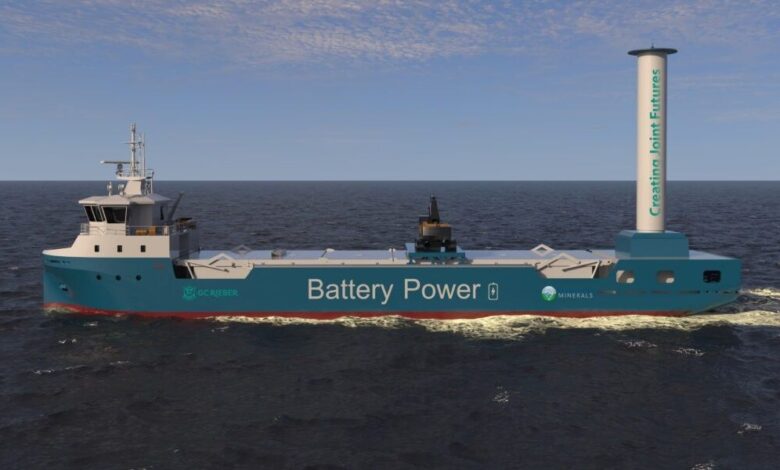
The United Kingdom is set to launch its first electric shipping route, marking a major step in the country’s efforts to decarbonize maritime transport. The milestone project, led by NatPower Marine in partnership with Peel Ports Group, will introduce shore power infrastructure at the Port of Heysham, Lancashire, enabling vessels to connect directly to the national grid while docked.
The system is scheduled to go live in September 2025, with all berths at Heysham expected to be fully equipped by 2026. The £100 million investment forms part of a broader initiative to establish a national network of electric ship charging stations across Great Britain and Ireland.
From Shore Power to Green Corridors
Under the agreement, NatPower Marine will finance and deliver high-voltage shore connections across Peel Ports’ UK and Irish network, creating what is being described as the foundation for the region’s first “electric shipping routes.” The infrastructure will support both existing hybrid vessels and the next generation of fully battery-powered ships, reducing emissions at berth and on shorter sea legs.
The project will also dovetail with the UK–Ireland green shipping corridor programme, which aims to create low- and zero-emission routes between key ports. According to the partners, Heysham’s installation will serve as a blueprint for replication across other ports including Liverpool, Dublin, and Glasgow.
Industry Response
Peel Ports Chief Executive Officer Claudio Veritiero said the partnership underscores the group’s commitment to sustainable port operations:
“Shore power is no longer a future concept — it is here and now. By working with NatPower Marine, we are ensuring our ports are ready to support the transition to clean shipping while delivering immediate air quality improvements for surrounding communities.”
NatPower Marine Chief Executive Stefano Sommadossi added that the investment aligns with the UK’s wider net-zero agenda:
“This initiative places the UK at the forefront of maritime electrification. It is not only about retrofitting ports, but about enabling a complete ecosystem for electric shipping routes across Britain and Ireland.”
Wider Electrification Efforts
The Heysham development comes as operators prepare to introduce battery-powered ferries and e-foiling passenger vessels on UK routes. DFDS has already committed €1 billion to deploy fully electric ferries on the Dover–France corridor by 2030, while Red Funnel is set to debut an Artemis EF-24 electric hydrofoil ferry between Southampton and the Isle of Wight in late 2025.
Analysts note that the convergence of port electrification, vessel technology, and cross-border policy support will be critical in scaling up electric shipping. The UK’s pilot route at Heysham could therefore play a pivotal role in demonstrating commercial viability and accelerating adoption.
Strategic Outlook
With global shipping under pressure to decarbonize, the UK’s debut of an electric shipping route signals both industrial readiness and political will to advance green corridors. By combining infrastructure deployment with operator investment, the country is positioning itself as an early mover in Europe’s maritime energy transition.
If fully realized, the network could cut thousands of tonnes of CO₂ annually, while also reducing noise and particulate emissions in port communities. The industry will now be watching closely to see whether the Heysham model can be expanded into a nationwide standard for electric shipping.
Tell us What is Happening in Your Area: Contact Maritime Context at: news@maritimecontext.com
