

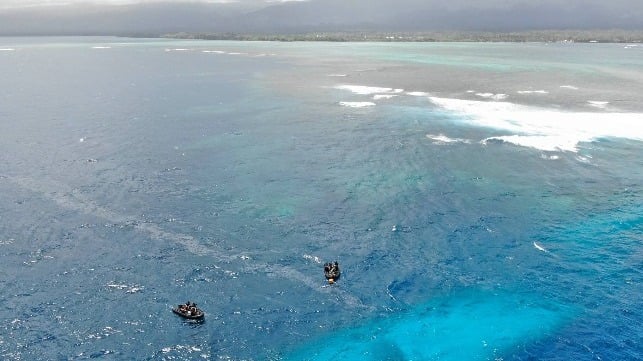
When HMNZS Manawanui ran aground and later sank off the coast of Samoa in October 2024, the fallout was immediate: lives were spared, but the reef and coastal communities were not. Now, a year later, New Zealand has agreed to pay 10 million Samoan tala in compensation. The sum, approximately USD 3.6 million (or NZD 6 million), may settle one chapter — but it also exposes weaknesses in preparedness, diplomacy, and environmental stewardship that should concern us all.
Accountability vs. Rectification
On paper, the compensation decision is rightly framed as “responding in full and with good faith” to Samoa’s request. New Zealand’s Foreign Minister, Winston Peters, has said that “doing the right thing” was its guiding principle.
Yet “doing the right thing” must go beyond writing a cheque. An official Court of Inquiry has already identified systemic failures: human error; the crew’s failure to recognize autopilot being engaged; gaps in training, supervision, and risk-assessment processes. These are not small or isolated mistakes — they reflect institutions stretched thin, or insufficiently rigorous in their safety cultures.
Real accountability should involve firm commitments to reforms. We must ask: has the New Zealand Defence Force (NZDF) made meaningful changes in its training, oversight, and operational risk evaluation? Transparency about disciplinary outcomes is also critical—not only for moral reasons but so that public trust is maintained.
Compensation: Necessary but Possibly Insufficient
For affected Samoan communities, the damage has been both ecological and economic. Fishers say their catches have diminished; local tourism and small-businesses by the coast have suffered from precautionary fishing bans. The reef is deeply intertwined with local survival, identity, and wellbeing. It’s not clear how the 10 million tala will be shared: whether directly to the communities hardest hit, or via national budget lines.
Also, environmental remedial work continues: fuel, oil, ammunition, containers have been removed; water testing has shown that hydrocarbons are no longer elevated; parts of the fishing ban have been lifted. These are important steps. But with the wreck still in place, there remains concern about long-term ecological impact, tourism potential, and the loss of reef health which can take decades to restore. The reef is resilient, but only if damage is minimized quickly and thoroughly. Delays or lack of clarity over removal or restoration may compound the harm.
Diplomatic Relations and Soft Power
This incident highlights something more than an environmental accident: it’s a stress test of New Zealand’s role in the Pacific. For many Pacific nations, what matters isn’t just that compensation is paid, but that neighbours act responsibly, transparently, and with humility. New Zealand’s swift admission of fault, court of inquiry, and compensation offer are positive signs. But public confidence in its commitment will hinge on how it treats Samoa (and comparable cases) going forward.
Samoan leaders and villagers have called for ongoing involvement: in decisions over whether to remove the wreck, how, at what cost, and what remediation should look like. These aren’t peripheral matters—they strike at questions of sovereignty, trust, and fairness. If Samoa’s government or local leaders feel sidelined or under-informed, then the goodwill afforded by compensation may be eroded.
The Lessons for New Zealand (and Others)
1. Risk Management and Training Must Be Prioritized
Naval missions, even those categorized as survey or research, involve significant risk. Personnel need to be properly trained, systems tested, and oversight enforced. Autopilot should not be a mystery to bridge crews; human factors must be front and center in vessel design, procedures, and training. The Manawanui tragedy is a cautionary tale.
2. Environmental Preparedness is Not Optional
Ships operating near coral reefs or sensitive marine environments must anticipate worst-case scenarios: leaks, sinking, fuel and pollutant containment. Salvage plans, insurance, and swift response capacity are not extras—they are essentials. Decisions that delay removal of pollutants or leave wrecks in place merit intense scrutiny.
3. Community Engagement is Essential
Coastal communities in Samoa were among the first to feel the harm: lost catch, closed fisheries, missed earnings. Their knowledge of the reef, fishing practices, and local environment gives them unique insight into damage and repair. Including them in the process isn’t just ethical—it leads to better outcomes.
4. Compensation Alone Doesn’t Equal Closure
Restoring reef health, trust, livelihoods, and safety culture takes time. Monitoring, transparent reporting, and follow-through are needed. There should be clarity on whether the compensation addresses long-term losses (e.g. reef decline, future income losses, tourism damage), not just immediate damage.
Conclusion: A Step, Not the Destination
New Zealand’s payment to Samoa is necessary, welcome, and morally proper. It operates in the space of what nations ought to do when their actions (or mistakes) negatively impact others. But it should not be seen as an endpoint. Rather, this is a waypoint on a longer journey toward improved operational safety, environmental protection, and respectful diplomacy.
For Samoa, the compensation may bring relief. For New Zealand, this is an opportunity to learn deeply, to invest in stronger training and environmental protocols, and to rebuild trust—especially with Pacific neighbours who must rely on both good faith and high standards in such matters.
If these lessons are taken seriously, perhaps future incidents can be prevented. If they are ignored, then compensation becomes less a sign of responsibility, and more a paper-soothing balm over deeper wounds.
Tell us What is Happening in Your Area: Contact Maritime Context at: news@maritimecontext.com
