

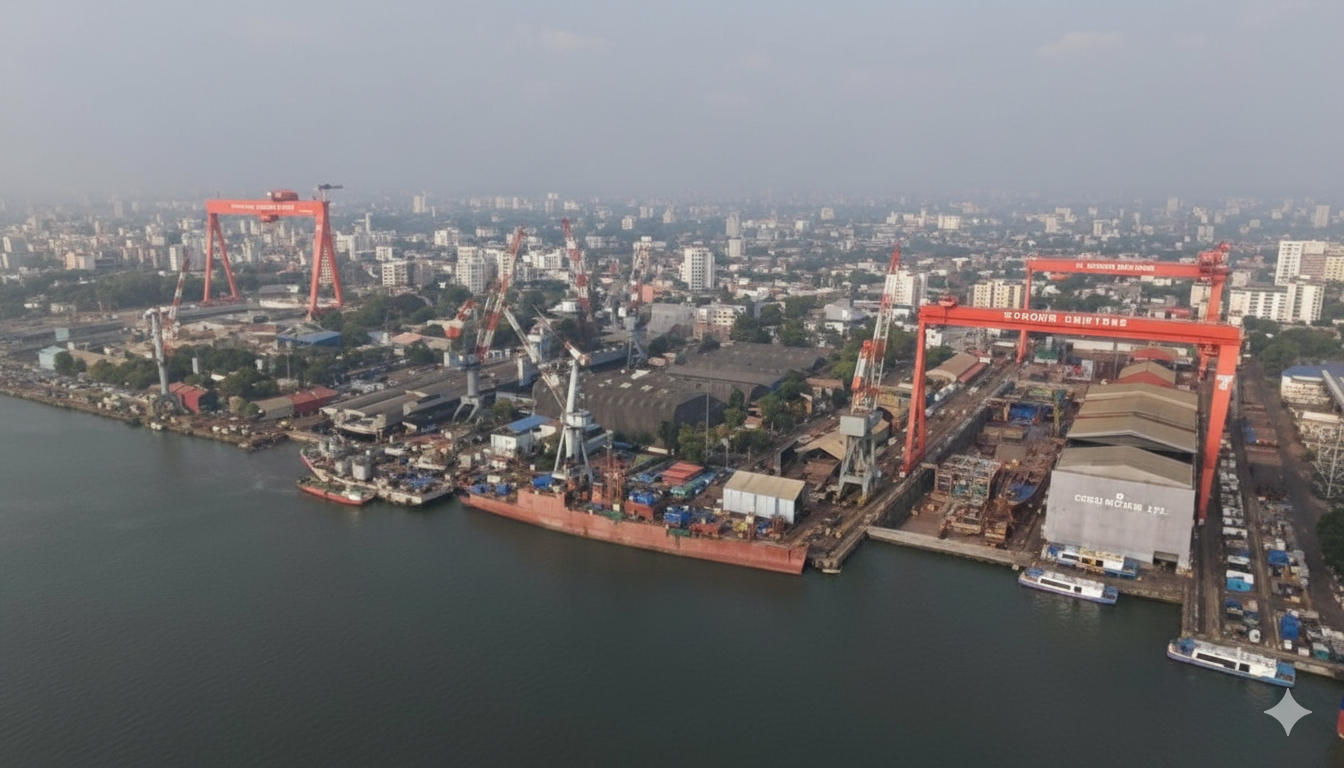
India has announced a landmark $8 billion investment package to accelerate the growth of its shipbuilding industry, a bold step aimed at securing a place among the world’s top five shipbuilding nations. The initiative, part of New Delhi’s wider Maritime India Vision 2030, signals the country’s determination to expand its industrial capacity, strengthen maritime security, and reduce reliance on foreign-built vessels.
Scaling Up Capacity and Technology
The $8 billion program will be directed towards:
- Establishing new shipyards along the eastern and western coasts.
- Modernizing existing facilities, with automation, robotics, and digital design systems.
- Supporting the construction of larger commercial vessels—including container ships, tankers, and LNG carriers—where India has so far lacked competitive presence.
- Driving the adoption of green shipbuilding technologies, with incentives for vessels powered by LNG, methanol, ammonia, and hydrogen.
Government officials highlighted that the initiative is expected to generate tens of thousands of jobs, boost exports, and create opportunities for partnerships with international shipowners and technology providers.
Global Shipbuilding Landscape
The global shipbuilding industry is currently dominated by a small group of countries:
- China leads with more than 50% of global orderbook share, driven by vast state-backed capacity and aggressive financing.
- South Korea maintains a strong position in high-value ship types, particularly LNG carriers and ultra-large container ships.
- Japan, though no longer at its peak, remains a significant player with expertise in energy-efficient bulkers and niche segments.
Together, these three nations account for nearly 90% of all global shipbuilding output, leaving little space for new entrants. By contrast, India’s current global market share is below 1%, largely focused on defense contracts, offshore support vessels, and smaller commercial ships.
India’s Strategic Positioning
India’s push into large-scale shipbuilding is not only an economic strategy but also a geopolitical one. By developing domestic capacity, the country aims to:
- Reduce dependence on imports for merchant and naval fleets.
- Offer alternative shipbuilding hubs for foreign shipowners, diversifying supply chains that are currently heavily dependent on China.
- Strengthen its position as a regional maritime hub, complementing its fast-growing ports and logistics network.
Analysts suggest that if India can leverage its low-cost labor advantage, improving productivity and technology, it could capture orders in niche segments such as mid-sized bulk carriers, coastal vessels, and green newbuilds, where demand is expected to grow.
Challenges Ahead
Despite the optimism, industry experts caution that India faces significant hurdles:
- High financing costs compared to China and South Korea.
- A need for skilled manpower and technical expertise in advanced shipbuilding.
- Long lead times to build up scale and reputation with global shipowners.
- Pressure to meet increasingly stringent IMO decarbonization targets.
Without strong public-private collaboration, India risks falling short of its ambitious targets.
Outlook
If the $8 billion initiative is successfully implemented, India could emerge as a competitive alternative in the global shipbuilding landscape, particularly in green shipping technologies. While overtaking established giants such as China, Korea, and Japan remains a long-term goal, India’s entry into the top five global shipbuilders would represent a significant shift in the maritime order.
For global shipowners, the expansion of Indian shipyards offers a potential fourth pillar of supply, injecting diversity into a market that has long been dominated by East Asia.
Tell us What is Happening in Your Area: Contact Maritime Context at: news@maritimecontext.com
