

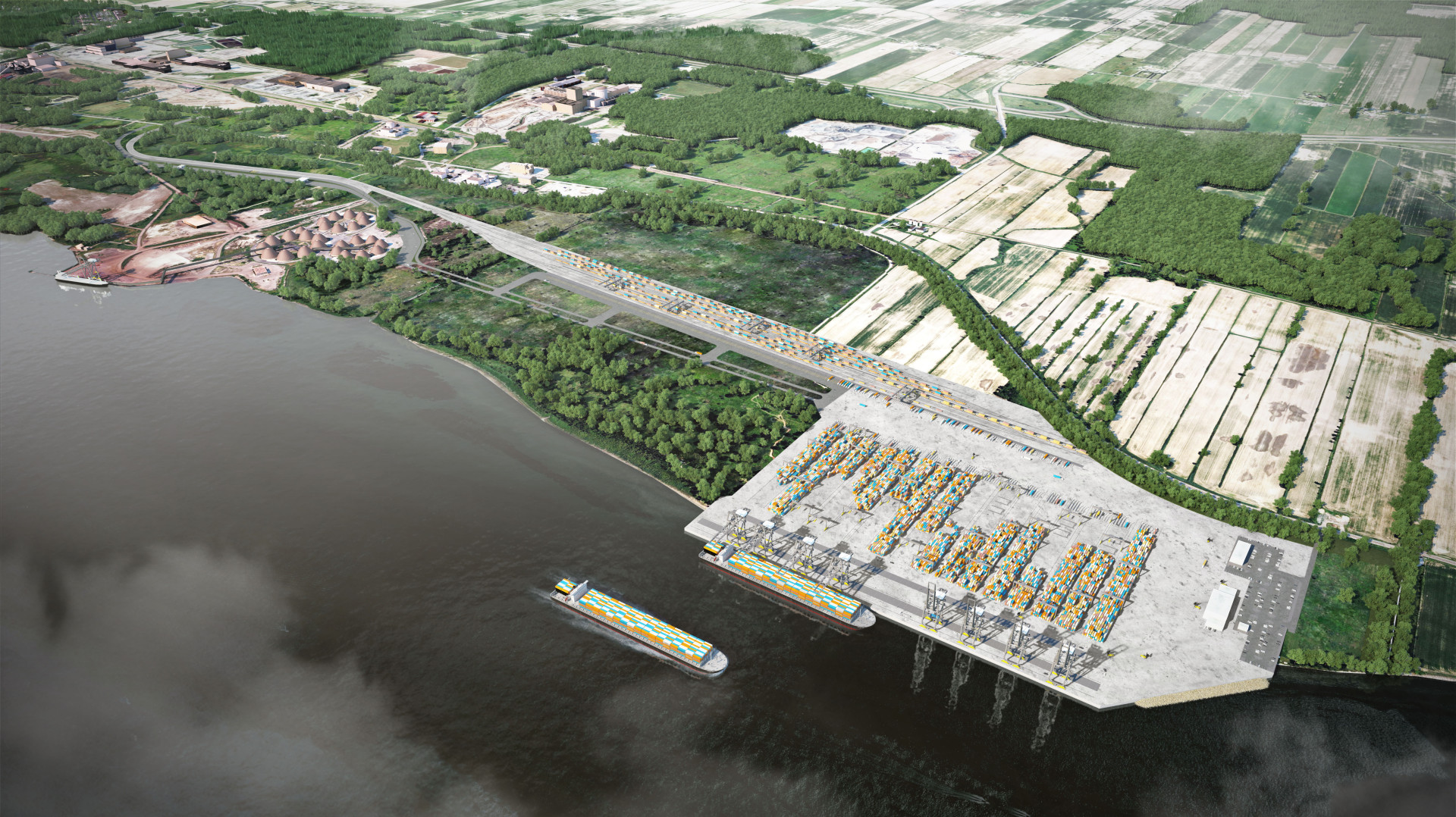
Montreal, 16 September 2025 — The Montreal Port Authority (MPA) and DP World in Canada have formally signed a Joint Development Agreement (JDA) that hands responsibility for the design, construction and long-term operation (40 years) of the land-based elements of the Contrecœur container terminal to DP World’s Canadian unit. The agreement marks a decisive milestone for the long-planned Port of Montreal expansion on the south shore of the St. Lawrence River.
What the agreement covers
Under the JDA, DP World in Canada — a joint venture between global terminal operator DP World and institutional investor La Caisse — will lead the land-works design and implementation for the new terminal. That scope includes the container yard, buildings and service infrastructure (utilities, roads), the intermodal marshalling yard and rail connections, truck gate and the operational systems necessary to run a modern container terminal. The MPA will retain responsibility for in-water works, which are being planned under a collaborative design-build approach with the CTCGP consortium (Pomerleau and Aecon).
DP World will also assume long-term operation and maintenance of the land-side terminal for approximately 40 years, positioning the project as a public–private partnership with a multi-decade concession-style arrangement.
Capacity, layout and timeline
When fully commissioned, the Contrecœur terminal will add roughly 1.15 million TEU of annual capacity — an increase that industry reporting equates to roughly a 60% uplift in the Port of Montreal’s container-handling capacity versus its current throughput. The terminal design calls for two ship berths, an expanded container handling and storage yard, a dedicated intermodal rail yard linked to the national rail network, and full road and gate infrastructure to support heavy truck flows.
Key timeline milestones published by the MPA and reported in the trade press are:
- 2025 — Start of site preparation work (subject to required approvals).
- 2026 — Commencement of in-water works organised by the MPA and its contractors.
- 2027 — Start of land-based construction under DP World’s responsibility.
- 2030 — Target for full commissioning and operations ramp-up.
Strategic and economic rationale
MPA and federal/provincial stakeholders frame Contrecœur as a generational project intended to:
- Relieve capacity constraints on existing Montreal terminals as container volumes grow;
- Improve intermodal connectivity by integrating rail marshalling yards to shift more freight by rail inland rather than rely solely on truck; and
- Support regional economic development, with government and industry estimates forecasting thousands of construction-phase jobs and significant long-term operating employment and economic spin-offs.
Julie Gascon, President and CEO of the Montreal Port Authority, described the JDA as “a decisive step in realising the Port of Montreal expansion project in Contrecœur,” highlighting the partnership’s emphasis on innovation, sustainability and strengthening economic sovereignty. Doug Smith, CEO of DP World in Canada, said the terminal will be “a true economic engine for Quebec and Eastern Canada.”
Cost, financing and public support
Project cost estimates have evolved as the planning proceeded. Earlier costings cited by the MPA and industry varied; more recent reporting places the total project at around C$1.6–2.3 billion depending on scope, financing structure and compensation/mitigation measures required. The federal and Quebec governments have previously committed targeted support to the Contrecœur project (for example, earlier provincial contributions and federal programs to speed major projects), while the Port will borrow against future revenues and secure private capital contributions to cover the balance. Details of DP World/La Caisse’s financial commitments and the final funding package for land vs in-water works will be clarified as the construction and operating agreements are finalized.
Environmental approvals, mitigation and Indigenous / community engagement
Contrecœur has undergone multi-year environmental assessment and public consultation processes. The MPA has said it will continue to implement compensation plans, monitoring programs and mitigation measures required under favorable decisions previously received, and will coordinate with federal authorities (including Fisheries and Oceans Canada and other regulators) as well as provincial agencies. The timing of site preparation and in-water works remains subject to obtaining the remaining regulatory approvals and permits. Public open houses and engagement sessions have been part of the project timetable.
Operational considerations and risks
Analysts and industry stakeholders flag several operational and commercial considerations:
- Intermodal performance — the value of the terminal hinges on efficient rail and road interfaces to move boxes inland; execution of planned rail connections and gate logistics is therefore critical.
- Environmental & regulatory risk — in-water dredging, shoreline works and habitat compensation are complex, and permitting can affect schedules and costs.
- Market dynamics — global trade patterns, shipping alliances, and carrier routing decisions will determine how quickly the terminal reaches projected throughput levels. DP World’s global network and existing Canadian footprint are strategic advantages, but commercial ramp-up will require win-back of services and lines.
Why DP World was selected
DP World in Canada brings a mix of operational experience (DP World’s global terminal portfolio exceeds 60 ports), private sector capital (La Caisse) and demonstrated capability on integrated terminal projects in North America. The MPA cited DP World’s “operational excellence, technological innovation and sustainable development” credentials in announcing the JDA. The arrangement allows the MPA to focus on its core public mandate (notably the more complex in-water engineering and environmental compliance) while leveraging a private operator for landside delivery and long-term operations.
What’s next
Over the coming months the partners will:
- Finalize the detailed terminal design and select project designers/contractors for landside works.
- Secure remaining regulatory permits and environmental authorizations (including any federal fisheries approvals).
- Finalize the construction and long-term operating agreement, and sequence site preparation to allow in-water and land works to proceed as planned.
Tell us What is Happening in Your Area: Contact Maritime Context at: news@maritimecontext.com
