

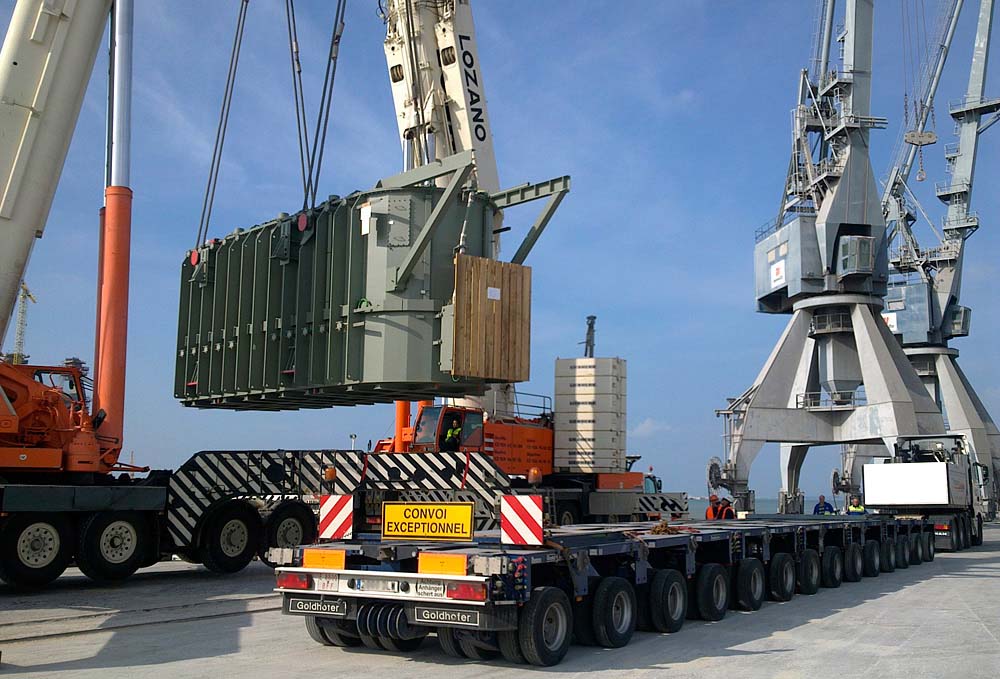
Doraleh, Djibouti / Afar Region, Ethiopia — In a display of East Africa’s expanding capability in industrial logistics, a high-stakes heavy-lift operation has successfully transported three large-scale power transformers from Djibouti’s Doraleh Multipurpose Port to Ethiopia’s Afar region. The cargo—two units weighing approximately 99 tonnes and a third at 56 tonnes—was delivered intact after traversing more than 1,100 kilometers of challenging terrain and infrastructure.
The operation, completed over the course of two weeks in May, is being described by logistics experts as a defining moment for inland project cargo handling in the Horn of Africa.
A Route Defined by Precision
The journey began with the arrival of the transformers at Doraleh between May 5 and 7, where precision tandem-lift discharges were executed using mobile shore cranes. Cradled and secured onto modular hydraulic trailers, the equipment was then transported by road—via Djibouti’s RN‑1 and the Galafi border—into Ethiopia, continuing along the A1 corridor to the Dallol power installation site.
The haul, conducted between May 8 and 18, required around-the-clock monitoring, staged rest points, and constant route management through semi-arid zones, escarpments, and multiple critical bridge crossings.
Logistics and Technical Oversight
Project execution was led by Steder Group, a regional logistics specialist with experience in oversized and critical infrastructure cargo. The transport demanded extensive pre-surveys, reinforced road planning, and escort coordination from both Djiboutian and Ethiopian authorities.
To ensure the structural integrity of the cargo and road infrastructure, independent marine warranty surveyors and engineering consultants provided technical oversight throughout the operation.
Among the participating specialists was a team from Observater Surveys & Services Ltd, whose role included verification of lifting procedures, inspection of load restraints, and real-time monitoring during the overland transit.
“For a move like this, small details matter,” said Eng. Ruth Mutua, Marine Warranty Surveyor with Observater. “We assess not only the immediate handling but how each phase—discharge, lashing, route gradient—affects the equipment’s integrity. These transformers are vital infrastructure. Ensuring their safety is both a technical duty and a regional responsibility.”
Corridor Confidence
The Djibouti–Ethiopia corridor, long regarded as a container trade lifeline, is now proving its reliability for high-value, non-containerized freight. The success of this operation confirms the region’s growing logistics maturity and infrastructure resilience.
With key route reinforcements completed along RN‑1 and sections of the A1 highway, and with Ethiopia’s border clearance policies increasingly harmonized with multimodal transit protocols, the region is setting itself apart as a dependable gateway for project cargo.
Strategic Value to Ethiopia
The transformers are central to the expansion of Ethiopia’s energy transmission infrastructure in the north and northeast—regions crucial for future mining, agriculture processing, and industrial development. The Dallol-based grid node is part of a broader initiative aimed at closing power gaps and integrating renewable and conventional generation systems into the national grid.
The operation also reflects a strategic shift: reliance on foreign-led logistics is giving way to regionally executed heavy-lift solutions, backed by local engineering, survey, and planning capacity.
Lessons in Preparedness
According to engineers familiar with the project, the success hinged not just on equipment and trucks—but on planning discipline.
“A transformer of this scale cannot tolerate vibration beyond a narrow threshold. Route grading, axle displacement models, and even convoy speed were calibrated down to the decimal,” said a technical lead on the project. “The real accomplishment here is invisible to the public—it’s the thousands of data points calculated in advance.”
Conclusion
This transformer haul is more than a logistics win—it’s a strategic signal. It demonstrates that East Africa now possesses the operational, infrastructural, and technical confidence to handle some of the world’s most demanding cargo under real-world conditions.
With continued coordination between port authorities, regional logistics specialists, and independent surveyors, the continent is increasingly shaping its own heavy-industry future—on its own routes, with its own capabilities.
For more stories on project cargo, port logistics, and industrial infrastructure in Africa, visit allinmaritime.com
Contact editorial: news@allinmaritime.com
