

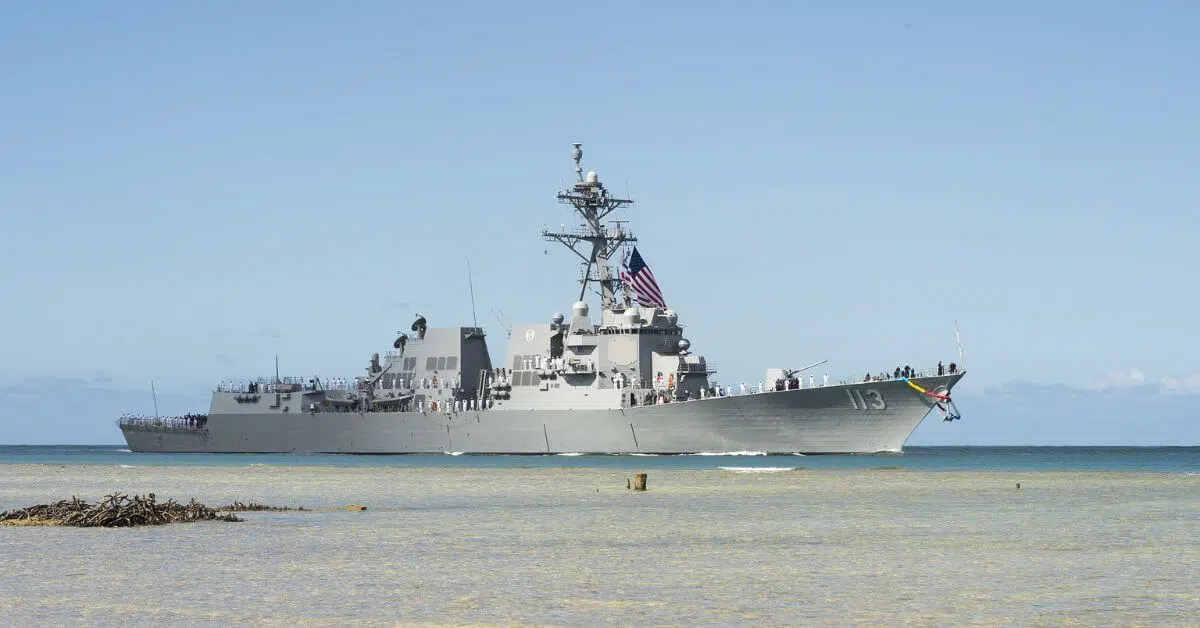
The recent transit of two U.S. Navy vessels — the guided-missile destroyer USS John Finn and the oceanographic survey ship USNS Mary Sears — through the Taiwan Strait has once again brought the delicate balance of power in the Indo-Pacific into sharp focus. According to Chinese authorities, the People’s Liberation Army (PLA) closely tracked the ships and kept its forces on high alert, underscoring Beijing’s continued sensitivity to foreign naval operations near Taiwan.
On the surface, these transits are routine exercises in freedom of navigation, conducted in international waters beyond any country’s territorial seas. From Washington’s perspective, such operations reaffirm the U.S. commitment to international maritime law and signal to allies in the region that the Indo-Pacific remains open and secure. Yet, to Beijing, every passage represents a challenge to sovereignty, a reminder of what it perceives as encroachment into its sphere of influence.
This tension highlights a central dilemma: how to assert international norms without inadvertently escalating military conflict. Routine transits can quickly be reframed as provocations, especially when amplified by strategic messaging and heightened alert postures on both sides. For policymakers, the key question is whether the long-term benefits of signaling freedom of navigation outweigh the immediate risks of miscalculation.
From a strategic standpoint, repeated transits may strengthen deterrence by demonstrating that the U.S. can operate near sensitive areas without obstruction. However, they also require careful coordination, robust communication channels, and transparency to avoid accidents. Any misstep — a misidentified maneuver, a mechanical failure, or an unanticipated military exercise — could rapidly escalate tensions in one of the world’s most militarized waterways.
The Taiwan Strait is more than a narrow channel of water; it is a geopolitical litmus test. Every transit reflects broader questions about the rules governing international seas, the credibility of alliances, and the balance between principle and pragmatism. For regional actors, including Japan, South Korea, and Southeast Asian states, these operations serve as signals of commitment, risk, and potential avenues for diplomatic mediation.
Ultimately, the path forward requires nuance. Freedom of navigation operations are essential to uphold international law, but they must be conducted with a clear understanding of the geopolitical context, communication protocols, and potential escalation triggers. Failure to do so risks transforming routine naval exercises into strategic flashpoints with consequences far beyond the waters of the Taiwan Strait.
In short: asserting rights and demonstrating resolve must be balanced with restraint and foresight. The Taiwan Strait will continue to test the limits of naval diplomacy, and the decisions made today will reverberate across the Indo-Pacific for years to come.
Tell us What is Happening in Your Area: Contact Maritime Context at: news@maritimecontext.com
