

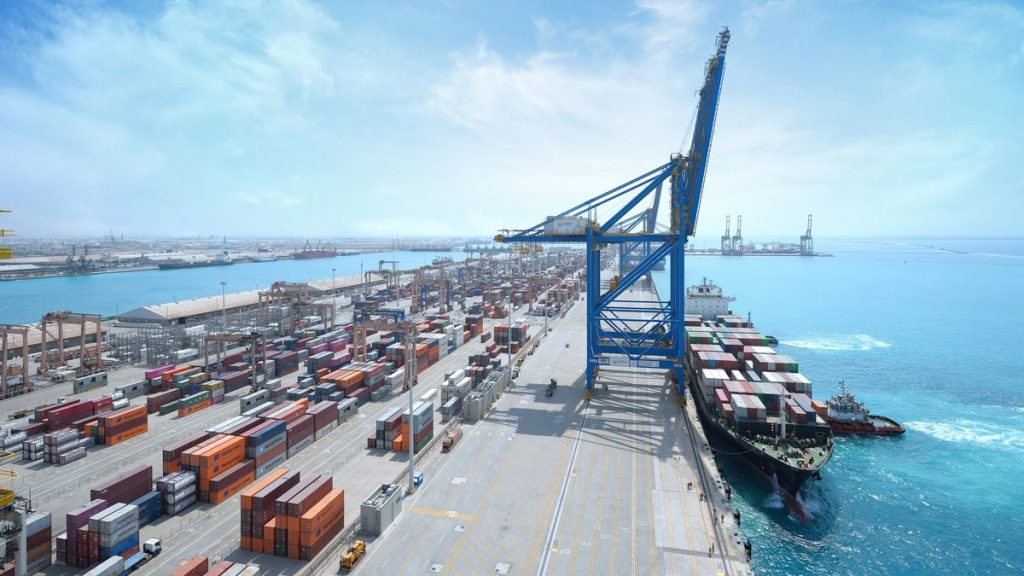
The announced headline that CMA CGM Group is plotting a major expansion in Saudi Arabia via a US$450 million joint-venture terminal at Jeddah Islamic Port marks a significant milestone — not only for the carrier, but also for the Kingdom’s maritime-logistics ambitions.
What this move signals
Firstly, the sheer scale of the investment (US$450 m) underscores CMA CGM’s long-term commitment to the Red Sea/Arab region. While earlier reports highlight a US$130 m investment for an integrated logistics platform at Jeddah (over 20 years) by CMA CGM and the Saudi Ports Authority (MAWANI), this new JV appears to represent a bold scaling-up of that earlier initiative.
Secondly, the move dovetails directly with Saudi Arabia’s broader maritime and supply-chain ambitions under its Vision 2030 programme — to build a logistics and transport ecosystem that reduces dependence on hydrocarbons, captures more value in-country, and positions the Kingdom as a regional hub linking Asia, Africa and Europe. Jeddah, which handles roughly 75 % of Saudi Arabia’s inbound maritime trade and trans-shipments, sits at the heart of that transformation.
Thirdly, for CMA CGM this is not just a port call or service expansion — it is an infrastructure play. Terminal ownership changes the game: control over capacity, prioritisation of flows, and influence over hinterland logistics give CMA CGM stronger strategic leverage in the region and beyond.
Why the timing matters
The Middle East/Red Sea corridor is becoming increasingly critical to global trade. Disruptions in other major lanes, coupled with the growth of larger container vessels and the need for integrated logistics, have created incentives for both carriers and ports to reposition.
For Saudi Arabia, competition is intensifying. King Abdullah Port, King Salman Port, and others are vying for regional flows and trans-shipment dominance. CMA CGM’s newly announced terminal at Jeddah strengthens its footprint in this contest and could catalyse further foreign investment into the Kingdom’s logistics ecosystem.
Potential benefits & risks
Benefits for Saudi Arabia
- Enhanced terminal capacity and modernised port infrastructure.
- Attraction of top-tier global shipping investment and expertise.
- Reinforcement of Jeddah’s role as a regional trade hub.
- Creation of skilled jobs and growth in value-added logistics services.
Benefits for CMA CGM
- Greater operational control and efficiency.
- Improved service reliability and cost management.
- Strategic alignment with Vision 2030’s logistics diversification goals.
- Stronger competitive positioning across the Red Sea and Gulf corridors.
Risks and caveats
- Terminal ventures require long-term commitment; market volatility or shifting trade routes could test the investment’s resilience.
- The Red Sea’s geopolitical sensitivity poses security and insurance challenges.
- Successful execution will depend on transparent governance and operational excellence within the JV framework.
Conclusion
From a maritime-context standpoint, CMA CGM’s move is both strategically sound and symbolically powerful. It signals confidence in Saudi Arabia’s transformation and cements Jeddah’s growing prominence on the Red Sea trade map.
If executed with efficiency, the new terminal could emerge as a benchmark for public-private port partnerships in the Middle East. If not, it risks joining a long list of ambitious port projects that promised much but delivered little.
Either way, the investment affirms one truth: the Red Sea is no longer a peripheral route — it is becoming the frontline of global maritime strategy.
Tell us What is Happening in Your Area: Contact Maritime Context at: news@maritimecontext.com
