

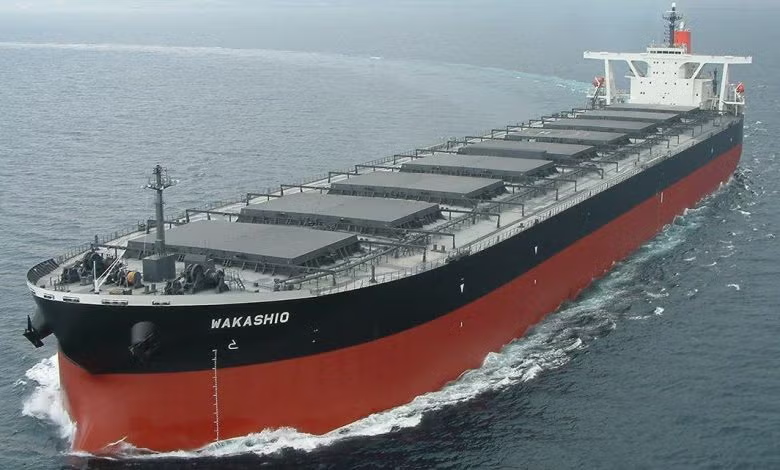
Five years after the Japanese-owned bulk carrier MV Wakashio struck a coral reef off Mauritius and spilled more than 1,000 tonnes of fuel oil into its fragile lagoon, a long-awaited investigation has laid bare a web of failures that turned a preventable grounding into the island nation’s worst maritime environmental disaster.
The inquiry paints a picture of negligence, poor oversight, and slow responses that left Mauritius exposed to devastating ecological, economic, and social consequences — lessons that resonate far beyond the Indian Ocean.
Environmental Fallout: A Lagoon Scarred for Generations
The Wakashio spill in July 2020 blackened mangroves, suffocated corals, and devastated marine life across the south-east coastline. The report confirms what scientists feared at the time: many ecosystems may take decades to recover, with some coral and seagrass beds unlikely to return to their pre-spill state.
The lagoon, once a sanctuary for biodiversity and a source of livelihood for fishing communities, remains under stress. Recovery programmes have helped restore some areas, but researchers warn of lingering hydrocarbon traces and reduced fish stocks.
“This wasn’t just an oil spill — it was an ecological trauma,” said Dr. Kavisha Ramasamy, a Mauritian marine biologist. “Our reefs, mangroves, and lagoons form part of the nation’s identity, and their destruction carries both emotional and economic weight.”
Community and Livelihoods: Fisherfolk Still Struggling
For fishing families in villages like Mahébourg and Pointe d’Esny, the spill was not just an environmental disaster but an economic catastrophe. Many lost their income overnight as fishing was banned in contaminated waters.
The government and international donors provided short-term relief and compensation, but the report highlights gaps in long-term rehabilitation and the absence of structured livelihood transition plans.
“Five years later, many of us are still struggling,” said a local fisherman quoted in the report. “The sea we depend on has not healed, and neither have our lives.”
Operational Failures: Negligence on the High Seas
The investigation found multiple operational lapses by the vessel’s operator, charterer, and crew. Among the most striking revelations:
- Negligent navigation practices: The ship deviated dangerously close to shore to secure mobile phone signals for crew members.
- Poor voyage planning: Key safety protocols were overlooked, with insufficient attention to Mauritius’s hazardous reef system.
- Inadequate oversight: Both ship managers and flag state regulators failed to enforce robust monitoring of navigation practices.
The report concludes that the grounding was avoidable had internationally accepted safety measures been followed.
Government and International Response: Delays and Missteps
While Mauritius mounted a massive emergency response with limited resources, the report criticises coordination gaps and delays in deploying spill containment booms and requesting foreign assistance.
International aid — particularly from France, Japan, and India — eventually arrived, but crucial days were lost. Local NGOs and volunteers were forced to improvise, fashioning makeshift booms from human hair and sugarcane leaves, a scene that captured global headlines.
The inquiry underscores the need for small island states to strengthen maritime surveillance, emergency preparedness, and international cooperation mechanisms.
Legal and Compensation Battles: Accountability in Question
The Wakashio spill triggered a wave of lawsuits and insurance claims. The ship’s owner, Nagashiki Shipping, and charterer, Mitsui O.S.K. Lines, pledged compensation, but victims argue payouts have been slow and inadequate.
Several crew members were prosecuted in Mauritius, with the captain sentenced for endangering safe navigation. Yet, campaigners say broader corporate accountability remains elusive.
“Justice cannot stop at individual crew,” said an environmental lawyer in Port Louis. “Corporate and regulatory actors higher up the chain must be held responsible.”
Global Shipping Lessons: Wake-Up Call for Industry
For the maritime sector, the Wakashio disaster has become a case study in the catastrophic costs of complacency. Insurers, regulators, and ship operators face renewed pressure to tighten monitoring, enforce safe navigation standards, and improve rapid-response readiness.
The report’s findings echo calls within the IMO for stronger accountability mechanisms, especially in regions where small island states face disproportionate risks from large transiting vessels.
A Lasting Reminder
For Mauritius, the Wakashio disaster remains a living memory: of oil-blackened shores, dead dolphins washing up in lagoons, and an island rallying in desperation and unity.
Five years on, the scars are still visible — not only on the reefs and mangroves but in the lives of coastal communities. The investigation has laid bare how negligence, both at sea and on land, compounded the tragedy.
Whether its lessons will reshape global shipping practices remains to be seen.
Tell us What is Happening in Your Area: Contact Maritime Context at: news@maritimecontext.com
