

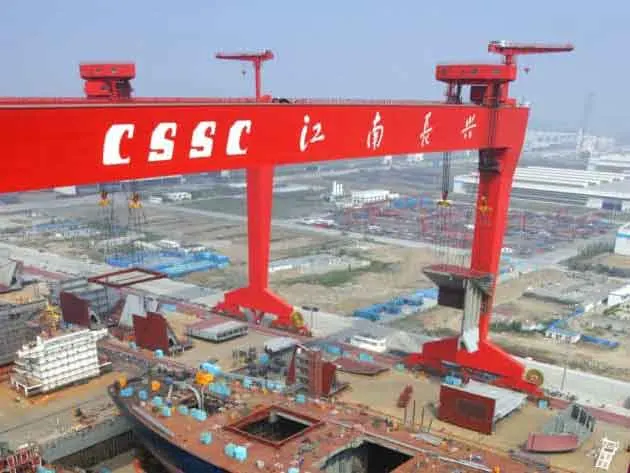
When Shanghai announced its audacious plan to transform Changxing Island into the world’s most advanced shipbuilding complex by 2027, few in the global maritime industry were surprised. After all, China has been rewriting the shipbuilding playbook for the better part of a decade. But this latest move—backed by the China State Shipbuilding Corporation (CSSC)—is more than just industrial policy. It’s a geopolitical and economic statement that deserves close scrutiny.
A Mega Hub with Military Overtones
Let’s not pretend this is only about tankers and container ships.
Changxing Island, now home to Jiangnan Shipyard and Hudong-Zhonghua, has rapidly become China’s most strategically important maritime production base. These aren’t your average yards. They’re building Type 055 destroyers, amphibious assault ships, and next-generation LNG carriers—sometimes in parallel. China’s shipbuilding output is already outpacing that of the U.S. Navy by a staggering margin, with plans to expand to 435 vessels by 2030.
And yet, the infrastructure is branded as a “green, dual-use commercial platform.” It may be both. But make no mistake: Changxing Island is now central to China’s maritime rise—civilian and military alike.
Innovation—Or Controlled Advantage?
On paper, the innovation is impressive. CSSC has unveiled the world’s largest methanol dual-fuel engine, capable of reducing CO₂ emissions by 7.5%. LNG, ammonia, digital twins, autonomous vessels—they’re all part of the blueprint.
But unlike Korea’s more open market strategy, China’s shipbuilding success is heavily state-directed. Local financing, controlled supply chains, and government procurement programs heavily influence order books.
In 2024 alone, CSSC delivered 69 vessels and booked 128 new orders, primarily high-value types like LNG carriers and Aframax tankers. Their deal with Seaspan for six 10,000 TEU containerships earlier this year shows how international customers are increasingly willing to buy from Chinese yards—even amid rising geopolitical tensions.
Global Consequences: Pressure on Korea, Japan, and Europe
China’s rise is putting intense pressure on traditional shipbuilding powers.
South Korean giants like Samsung Heavy Industries and Hyundai now face fierce competition not only on price but also on delivery speed and financing ease. Meanwhile, European yards, once dominant in high-end segments like cruise and offshore, are increasingly retreating to niche markets or relying on subsidies.
Even the U.S., where domestic shipbuilding is often linked to naval production, appears outpaced. Chinese shipyards are now producing more naval tonnage in one year than the U.S. manages in half a decade.
Is this sustainable growth—or industrial overcapacity in the making?
Sustainability or Maritime Nationalism?
Shanghai officials frame the mega shipyard as a model of sustainability, smart logistics, and green fuels. The plan includes a future-ready “digital twin port” and AI-enabled logistics platforms.
But many maritime stakeholders wonder if the environmental message masks a more assertive industrial strategy. Green goals are welcome—but when bundled with state-aligned finance, dual-use production, and export dominance, they can quickly shift from policy virtue to competitive weapon.
What Should the Maritime World Do?
One thing is certain: ignoring China’s transformation in Changxing Island is no longer an option.
- Operators need to evaluate their sourcing strategies. Chinese yards are increasingly delivering faster, cheaper, and at higher quality.
- Policymakers in Europe, North America, and Southeast Asia must weigh the implications of such concentrated industrial power in one political system.
- Shipbuilders outside China must focus on technology differentiation, specialization, and alliances to remain competitive.
- And finally, the IMO and global trade regulators must ask whether the global playing field is still level.
Final Thought
Shanghai’s mega shipbuilding plan is more than a logistics or infrastructure play—it’s a manifestation of China’s maritime intent on the global stage. It’s a story of ambition, statecraft, and industrial might wrapped in the green ribbon of innovation.
For the rest of the world, the question is no longer “can we compete with China?” It’s: how do we respond strategically—before the wake becomes a wave too big to navigate?
