

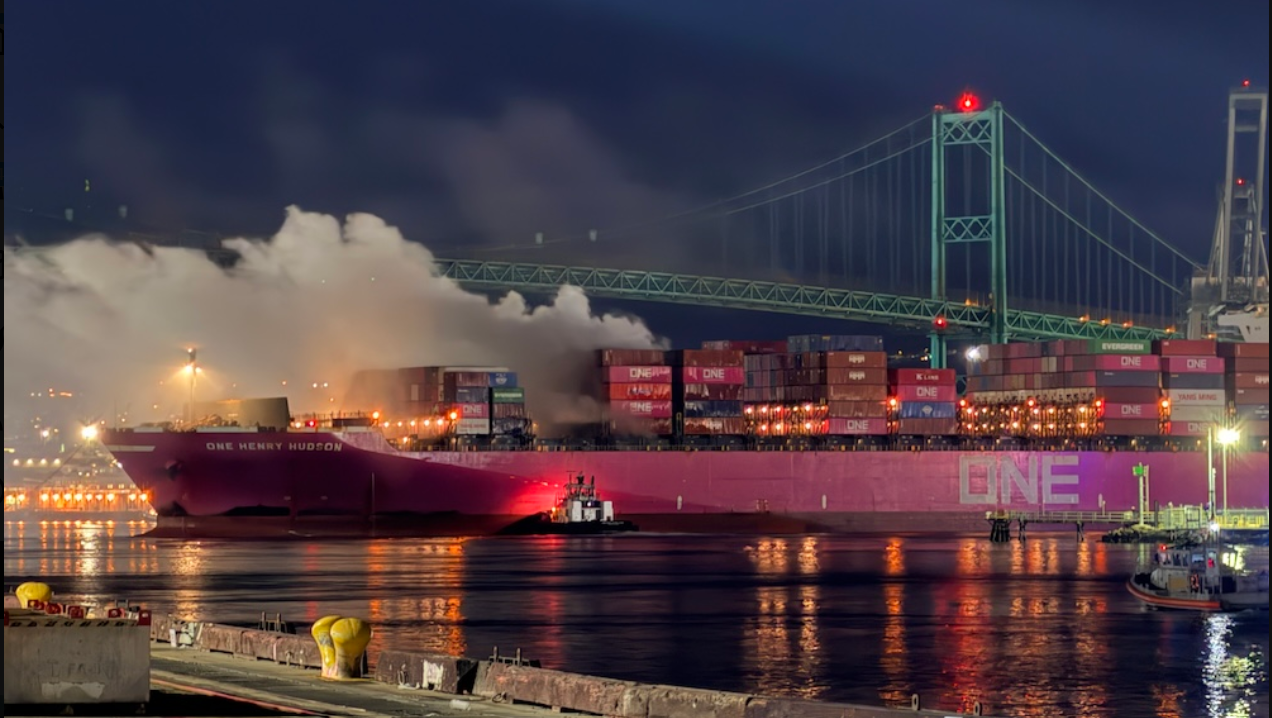
Los Angeles, CA — A large and hazardous fire broke out aboard the container ship ONE Henry Hudson on the evening of Friday, November 21, 2025, while the vessel was docked at the Port of Los Angeles. The incident prompted a multi-agency emergency response, widespread safety precautions, and temporary suspension of port operations.
Fire Breaks Out Below Deck
The fire was first reported at approximately 6:38 p.m., believed to have originated from an electrical malfunction below deck. The Los Angeles Fire Department (LAFD) dispatched nearly 200 firefighters and specialist units, including HazMat, Urban Search & Rescue, Heavy Rescue, fireboats, and helicopter support.
A unified command was quickly established, involving the U.S. Coast Guard, Los Angeles Port Police, and the Long Beach Fire Department as efforts intensified to contain the growing blaze.
Explosion and Hazardous Materials Concern
Shortly before 8:00 p.m., an explosion occurred on the ship’s mid-deck, knocking out onboard power systems, including lighting and gantry crane operations. This heightened risk due to the presence of hazardous materials documented in the ship’s cargo manifests.
Hazardous materials teams carried out continuous atmospheric monitoring throughout the night. Although smoke rose heavily from the vessel, early readings remained within acceptable air-quality ranges.
Crew Evacuation and Public Safety Measures
All 23 crew members aboard the ONE Henry Hudson were successfully evacuated without injury. Due to the potential threat from toxic smoke, authorities issued shelter-in-place orders for San Pedro and Wilmington residents. People were advised to stay indoors, secure windows, and switch off ventilation systems until the situation stabilized.
A marine safety zone was established around the vessel, while portions of State Route 47 and the Vincent Thomas Bridge were temporarily closed due to reduced visibility and safety risks.
Firefighting Efforts and Ship Relocation
As onboard conditions worsened, firefighters withdrew from interior spaces for safety reasons. Suppression efforts continued from a distance using high-capacity water streams from fire engines, aerial ladder trucks, and port fireboats. Aerial thermal imaging from emergency aircraft provided continuous assessment of heat signatures and structural stability.
In the early hours of Saturday, November 22, coordinated tug and fireboat operations succeeded in undocking and relocating the vessel out to sea. By around 4:43 a.m., the ship was anchored roughly one mile offshore near Angels Gate Lighthouse, where firefighters continued cooling and suppression work.
Operational Disruptions
The fire forced the temporary closure of four container terminals at the Port of Los Angeles, disrupting vessel movements and cargo operations. Road closures around the port further slowed logistics, and the U.S. Coast Guard implemented a temporary flight restriction and maintained a half-nautical-mile exclusion zone around the ship.
Containment and Lifting of Restrictions
By Saturday morning, fire officials reported that the blaze was substantially contained. Shelter-in-place orders were lifted, port restrictions eased, and key roadways were reopened as conditions improved. Firefighting crews remained on scene to manage residual hotspots and monitor the vessel’s stability.
Investigation Underway
Authorities have launched a full investigation into the cause of the fire. While the leading theory points to an electrical failure, experts are assessing the possible role that hazardous cargo may have played in the explosion and fire progression. Environmental teams are monitoring both air and water quality for any signs of contamination.
Official Statements
City leaders and port authorities emphasized that the safety of residents and port workers remains the top priority. They praised the coordinated efforts of emergency responders, noting that swift action prevented injuries and minimized broader environmental impact.
Tell us What is Happening in Your Area: Contact Maritime Context at: news@maritimecontext.com
