

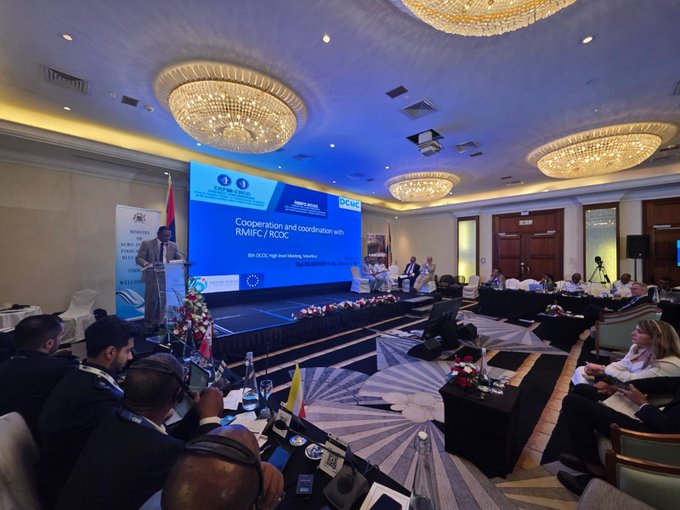
Leaders and senior officials from across the Western Indian Ocean, the Gulf of Aden, and the Red Sea region gathered in Mauritius this week for the 8th High-Level Meeting on the Implementation of the Jeddah Amendment to the Djibouti Code of Conduct (DCoC/JA). The three-day event marked another milestone in the region’s collective effort to enhance maritime security, operational cooperation, and governance across some of the world’s most strategically vital sea lanes.
The conference, convened under the auspices of the International Maritime Organization (IMO), brought together ministers, heads of maritime administrations, naval representatives, and international partners to evaluate progress made since the last high-level session held in Dar es Salaam in 2024. The focus this year was on translating policy into coordinated maritime action through the implementation of Working Group 3 (WG3) — the body tasked with strengthening operational cooperation and coordination at sea.
Key Agenda and Discussions
The 2025 high-level meeting centered on several critical themes shaping the maritime landscape of the Western Indian Ocean and Gulf of Aden region:
- Operationalising Regional Cooperation:
Delegates reviewed the progress of Resolution 1, which established Working Group 3 on Operational Cooperation and Coordination. The group’s objective is to ensure that regional maritime security strategies are effectively translated into on-water collaboration, including joint patrols, shared protocols, and coordinated incident response. - Maritime Domain Awareness (MDA):
Enhancing information-sharing between national maritime operations centers remained a key priority. Participants discussed the integration of regional information-sharing networks, improved inter-agency coordination, and the use of emerging technologies to track and deter maritime crimes. - Combating Transnational Maritime Crimes:
In line with the Jeddah Amendment’s broadened mandate, the conference addressed a range of challenges beyond piracy — including illegal, unreported, and unregulated (IUU) fishing, human and arms trafficking, smuggling, and environmental violations such as illegal dumping. - Capacity Building and Whole-of-Government Approach:
Delegates highlighted the importance of developing national maritime strategies that unite military, law enforcement, customs, fisheries, and environmental agencies under a common security framework. Discussions also focused on expanding training programs and technical assistance for member states to build self-sustaining maritime capabilities. - Implementation Progress and Regional Solidarity:
The meeting underscored the continued relevance of the Djibouti Code of Conduct and its Jeddah Amendment as the backbone of regional maritime cooperation. Member states reaffirmed their commitment to maintaining secure sea routes that are critical for global trade, regional stability, and blue economy growth.
Strategic Relevance
The Western Indian Ocean and Gulf of Aden remain vital arteries of international shipping, connecting Asia, Africa, and Europe through the Suez Canal and Indian Ocean trade corridors. Recent geopolitical tensions, renewed piracy attempts, and the growing impact of IUU fishing have underscored the need for collective maritime vigilance.
By focusing on operational coordination at sea, the 8th High-Level Meeting represents a decisive step towards a more integrated regional security framework, capable of responding swiftly and collaboratively to emerging maritime threats.
A Regional Commitment to Safer Seas
In his closing remarks, Mauritius’ Minister of Blue Economy and Fisheries emphasized the importance of regional unity, stating that “the strength of our collective response defines the safety of our shared waters.”
The conference concluded with a joint communiqué reaffirming the signatories’ commitment to strengthening operational cooperation, enhancing information exchange, and upholding the principles of the Djibouti Code of Conduct and its Jeddah Amendment.
The 8th High-Level Meeting in Mauritius stands as a testament to the region’s ongoing determination to maintain secure and sustainable maritime spaces — ensuring that the Western Indian Ocean remains a zone of peace, prosperity, and coordinated governance.
Tell us What is Happening in Your Area: Contact Maritime Context at: news@maritimecontext.com
