

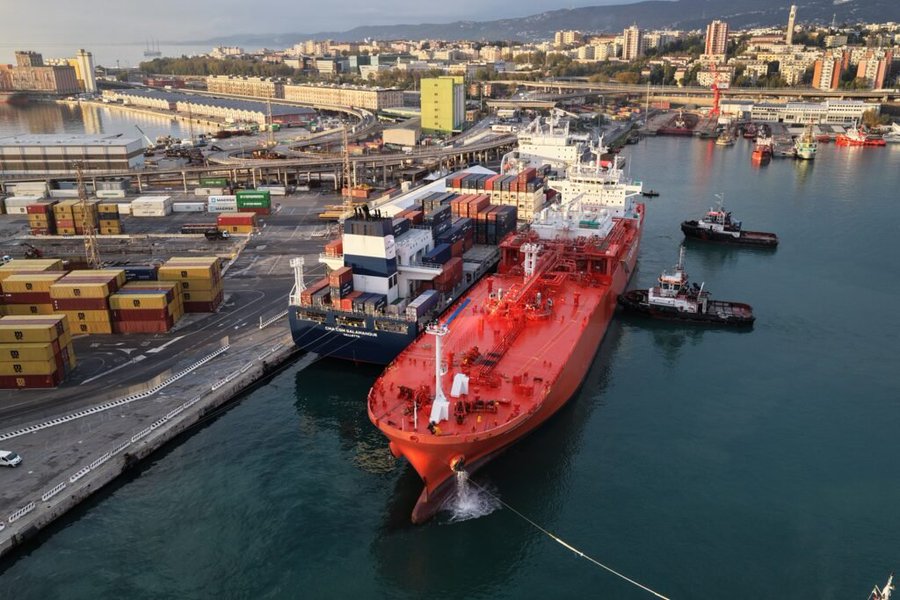
Trieste, 6 November 2025 — In a significant step towards decarbonising Mediterranean shipping operations, Italy’s Edison and French shipping heavyweight CMA CGM have completed the first ever ship-to-ship (STS) liquefied natural gas (LNG) bunkering of a container vessel in Italy.
The operation took place in the Port of Trieste, where Edison’s chartered LNG carrier, the 30,000 cubic-metre capacity Ravenna Knutsen, delivered LNG to the CMA CGM vessel CMA CGM Salamanque, a dual-fuel LNG-powered containership operating in the Mediterranean.
A milestone for maritime decarbonisation
LNG bunkering represents a tangible shift away from conventional marine fuels such as heavy fuel oil and marine gas oil, toward lower-carbon alternatives. While LNG still emits CO₂ and methane, it significantly reduces sulphur oxides (SOₓ), particulate matter and nitrogen oxides (NOₓ) compared to traditional fuels.
For CMA CGM, the use of LNG aligns with its broader low-carbon strategy, which has already shown emissions reductions of up to 85 % for vessels operating in LNG-fuel mode. For Edison, this milestone expands its bunkering activities following earlier operations in the Adriatic Sea for cruise vessels using the same carrier.
Operational details and collaboration
The bunkering was executed ship-to-ship in the Port of Trieste, enabling direct transfer of LNG between vessels without reliance on fixed shore infrastructure. Edison’s Vice President for Gas Assets, Fabrizio Mattana, emphasised that this milestone demonstrates the company’s “extreme operational flexibility” and ability to open new market segments in Italy’s maritime sector.
The Ravenna Knutsen, chartered by Edison since 2021, was purpose-built for flexible bunkering and small-scale LNG delivery, featuring advanced manifold configurations to support a variety of vessels.
Strengthening Italy’s maritime ecosystem
Italy has been preparing for LNG bunkering to meet both road-transport and maritime demands, with Edison operating coastal depots such as the one in Ravenna. Extending this capability to container-ship bunkering marks a major leap toward supporting deep-sea shipping segments.
As the Mediterranean faces increasing regulatory pressure to cut emissions, ports like Trieste are becoming more attractive to LNG-fuelled and dual-fuel vessels. Reliable bunkering infrastructure is now a key enabler for shipowners seeking to transition their fleets to cleaner fuels.
The road ahead
While LNG serves as a viable transitional fuel, the industry is also turning its focus to BioLNG (biomethane) and other next-generation fuels such as methanol, ammonia, and hydrogen. Edison has already announced plans to integrate BioLNG into future bunkering operations.
To achieve full-scale adoption, further development of infrastructure, port regulations, and supply chains will be essential. The cooperation among the Port of Trieste, Edison, and CMA CGM sets a strong precedent for future clean-fuel collaborations in the region.
Monitoring methane slip and improving fuel efficiency will remain priorities to ensure LNG continues to deliver genuine environmental benefits.
Implications for the industry
- Ship-owners and charterers: The improved bunkering capabilities in Italy increase voyage planning flexibility for LNG-powered vessels operating in the Adriatic.
- Ports and terminal operators: Trieste now stands out as a key LNG bunkering hub in the Mediterranean, attracting more dual-fuel vessels.
- Fuel suppliers and logistics companies: Edison’s success demonstrates the operational readiness needed to serve a growing low-carbon bunkering market.
- Regulators and authorities: The safe execution of the Trieste operation highlights the importance of coordination between port authorities, energy companies, and maritime agencies.
Conclusion
This landmark operation between Edison and CMA CGM in the Port of Trieste marks a defining moment in Italy’s journey toward cleaner maritime energy. It not only demonstrates technical excellence but also signals the country’s readiness to play a leading role in the Mediterranean’s green-shipping transition.
With more LNG-powered ships entering service and new fuels on the horizon, such collaborations will be instrumental in building a sustainable and resilient future for global shipping.
Tell us What is Happening in Your Area: Contact Maritime Context at: news@maritimecontext.com
