

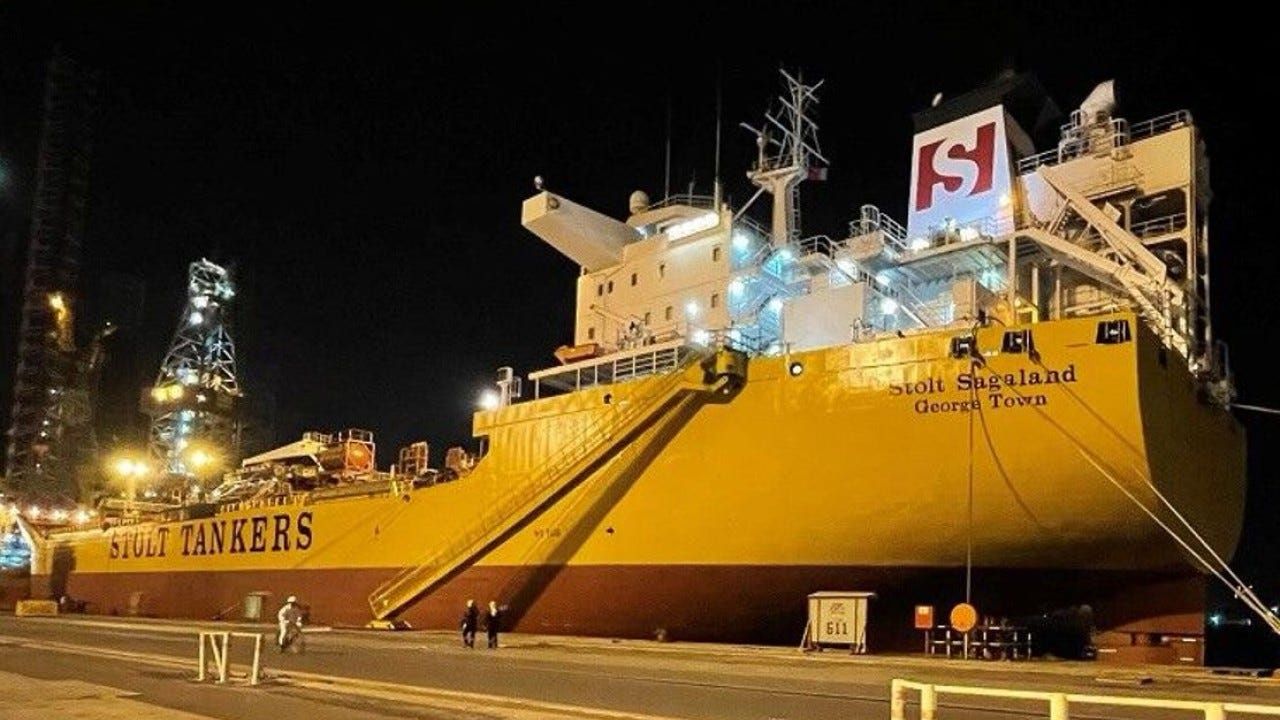
A chemical tanker operated by Stolt Tankers, the Stolt Sagaland, came under fire in the early hours of 3 November 2025 during an attempted hijacking by Somali pirates some 332 nautical miles east of Mogadishu. The incident marks one of the most serious pirate attacks in the western Indian Ocean in recent months, reigniting fears of a resurgence in Somali maritime crime.
According to a UK Maritime Trade Operations (UKMTO) alert issued at 0220 UTC, four armed assailants in a small grey-and-white-hulled skiff approached the vessel and attempted to board. The skiff was reportedly launched from a larger mother vessel approximately five nautical miles east of the tanker’s position, indicating the attackers were operating as part of a Pirate Action Group (PAG) with extended offshore capability.
Attack and Response
Maritime security company Vanguard Maritime Advisory Centre (MAC) identified the vessel as Stolt Sagaland, confirming that the pirates opened fire from the skiff while approaching the tanker’s starboard side. The onboard Armed Security Team (AST) immediately returned warning shots, effectively repelling the assault.
“The AST responded decisively, preventing any damage or injury,” Vanguard said in a statement. “The ship’s crew acted in full compliance with emergency procedures—raising the alarm, increasing speed, and executing evasive maneuvers that made boarding impossible.”
Following the failed attempt, the attackers retreated to their mother vessel and fled the area. The Stolt Sagaland sustained no damage, and all crew members were reported safe. The vessel has since resumed its voyage toward its next port of call.
Heightened Threat Levels
The incident prompted EU NAVFOR Operation ATALANTA to raise its regional threat level to the highest category. The naval task force, which oversees counter-piracy operations in the western Indian Ocean and Gulf of Aden, deployed aerial reconnaissance assets to locate the suspected mother vessel.
UKMTO has advised all merchant ships transiting near the Somali Basin to maintain heightened vigilance, reinforce security watch rotations, and report any suspicious activity.
“Recent hijackings of dhows by Somali nationals suggest renewed pirate activity, possibly driven by regional instability and economic hardship,” said Vanguard MAC in its briefing. “These dhows are often used as mother ships, allowing pirates to extend their operational reach hundreds of miles from shore.”
Background: A Resurgent Threat
The failed attack comes amid growing concerns that Somali piracy—once largely suppressed—may be re-emerging after nearly a decade of relative calm. Earlier this year, several Iranian and Yemeni dhows were hijacked and later repurposed as staging platforms for piracy operations in the Arabian Sea.
Between 2008 and 2011, Somali pirates carried out hundreds of hijackings, costing the global shipping industry billions of dollars in ransom payments, increased insurance premiums, and route diversions. The combined efforts of international naval patrols, onboard armed guards, and improved vessel hardening drastically reduced incidents after 2012.
However, experts now warn that the waning presence of naval assets and the complex security environment in the Horn of Africa could embolden new pirate groups.
Industry Reaction
A spokesperson for Stolt Tankers commended the swift response of the crew and the armed security team, noting that “the safety of our people remains our top priority.” The company also reaffirmed its commitment to following BMP5 (Best Management Practices) for vessels transiting high-risk areas.
Maritime security analyst Linus Opondo, a marine surveyor at Observater Surveys and Services Limited in Mombasa, noted that “this incident underscores the continued importance of onboard security personnel and coordinated naval patrols. Without deterrence, the western Indian Ocean could again see the kind of organized piracy networks that once disrupted global trade.”
Looking Ahead
While no vessel has been successfully hijacked in the region in recent months, the Stolt Sagaland incident serves as a stark reminder that Somali piracy remains a latent threat. With regional instability persisting in Somalia and Yemen, maritime experts stress the need for continued vigilance, intelligence sharing, and naval cooperation among regional and international stakeholders.
EU NAVFOR and coalition partners are expected to increase aerial patrols over key shipping lanes, particularly east of Mogadishu and south of Socotra Island, as they monitor the suspected Pirate Action Group behind the failed attack.
Summary:
- Vessel: Stolt Sagaland (chemical tanker, Stolt Tankers)
- Date: 3 November 2025
- Location: 332 nm east of Mogadishu, Somalia
- Attackers: Four armed pirates on a skiff launched from a mother vessel
- Outcome: Attack repelled by armed guards; no casualties or damage
- Authorities involved: UKMTO, Vanguard MAC, EU NAVFOR ATALANTA
- Threat Level: Raised; suspected Pirate Action Group active in region
Tell us What is Happening in Your Area: Contact Maritime Context at: news@maritimecontext.com
