

Quito, Ecuador — Ecuador is signaling growing alignment with the International Maritime Organization’s (IMO) environmental agenda, even as its marine biofuel sector remains in the early stages of development. The South American nation, long known for its environmental stewardship and biodiversity, is now positioning itself within the broader global movement toward cleaner, low-carbon shipping.
Although Ecuador has not yet unveiled a dedicated national policy for marine biofuels, its engagement in IMO-led sustainability programs and renewable fuel initiatives reflects an increasing commitment to greener maritime operations.
Legal Foundations for Biofuels
Ecuador’s legal framework for biofuel promotion dates back nearly two decades. The government’s Decree No. 2332 of 2004 declared biofuel production and use a matter of national interest. This led to the establishment of the National Programme on Biofuels, which introduced pilot blending projects — a 5% ethanol mix in gasoline in Guayaquil and a similar biodiesel blend in Quito.
The nation’s 2008 Constitution further reinforced this direction, mandating the promotion of renewable technologies and energy diversification. Despite these steps, large-scale biofuel deployment has been slow, hindered by limited financing, institutional challenges, and an absence of specific regulations for marine applications.
Sustainable Energy in Fragile Ecosystems
Ecuador has gained international recognition for renewable energy projects in ecologically sensitive regions. On the Galápagos Islands, where fossil fuel dependence poses environmental risks, the government partnered with Germany’s GIZ to develop renewable energy systems powered by Jatropha curcas oil — a locally grown, non-edible plant. The project, aligned with the “Zero Fossil Fuels on the Galápagos” policy, demonstrates Ecuador’s capacity to pilot bio-based energy solutions in remote maritime zones.
Additionally, private sector initiatives such as Terpel Ecuador’s introduction of biodegradable lubricants for marine and mining operations highlight growing corporate interest in bio-based alternatives to traditional fossil derivatives.
Steps Toward IMO Alignment
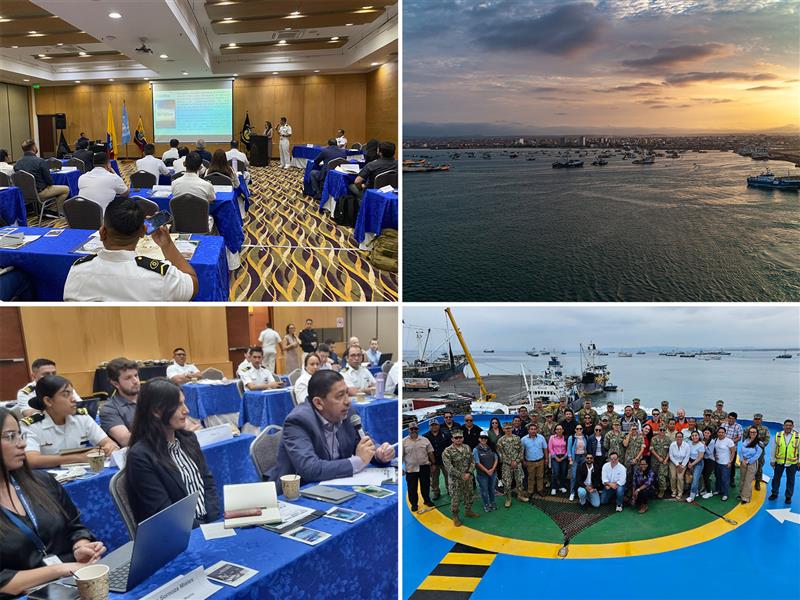
Ecuador’s participation in several IMO-led initiatives underscores its intent to align with global maritime environmental goals. In October, representatives from the Ecuadorian Navy (Armada del Ecuador) joined an IMO and MTCC-Caribbean workshop in Manta, focusing on marine biofouling management and greenhouse gas (GHG) reduction. The outcome included an agreement to establish a national information network to connect ports, ship operators, and environmental authorities for coordinated action against biofouling — a step that directly supports IMO’s environmental objectives.
Ecuador was also listed among the Member States present at the IMO’s 2023 Working Group on Reduction of GHG Emissions from Ships, confirming its ongoing participation in discussions that shape global decarbonization strategies.
Supportive but Cautious Approach
While Ecuador supports IMO’s broader environmental framework — including efforts to cut GHG emissions, prevent invasive species transfer, and reduce pollution from ships — it has not yet issued a clear public statement endorsing all aspects of the IMO’s 2023 revised GHG strategy. The strategy calls for net-zero emissions “by or around 2050,” with interim goals of 20–30% reduction by 2030 and 70–80% by 2040.
Experts suggest Ecuador’s measured approach reflects national circumstances. As a country with a modest commercial fleet and a developing maritime infrastructure, its priorities remain focused on incremental compliance, capacity-building, and pilot-scale renewable fuel programs rather than immediate large-scale implementation.
Outlook: A Potential Pathway to Marine Biofuels
Analysts believe Ecuador’s environmental policies and renewable energy experience make it a strong candidate for marine biofuel adoption in the medium term. The nation’s commitment to biodiversity conservation, combined with its existing biofuel legal framework and coastal port infrastructure, provides a foundation for eventual transition toward low-carbon marine fuels.
However, achieving this would require updated regulations for marine bunkering, investment in biofuel refining capacity, and integration of international fuel standards — areas where Ecuador is still catching up.
Conclusion
Ecuador’s evolving relationship with the IMO’s agenda suggests a nation in transition — one that is environmentally aware and politically supportive of decarbonization, yet still building the industrial and regulatory groundwork to act on those ambitions.
As global shipping accelerates toward a low-carbon future, Ecuador’s next steps — particularly in the marine biofuel sector — will determine how prominently it features in the IMO’s vision for sustainable maritime trade.
Tell us What is Happening in Your Area: Contact Maritime Context at: news@maritimecontext.com
