

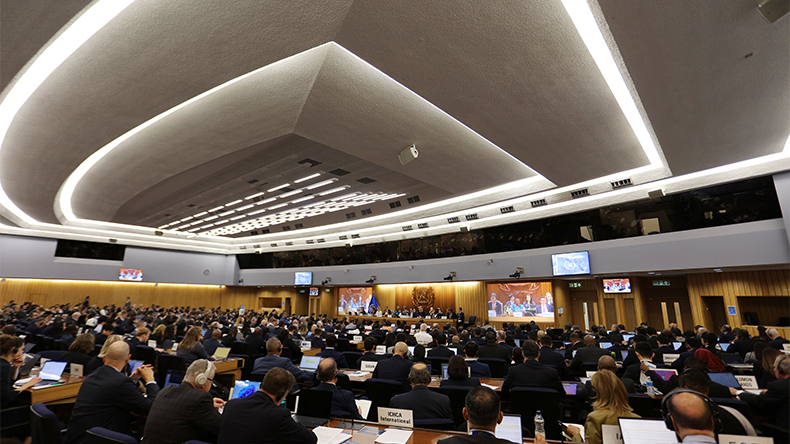
As the International Maritime Organization’s (IMO) Marine Environment Protection Committee (MEPC) convenes this week to consider adoption of the Net-Zero Framework (NZF), the contest over procedural rules has become nearly as contentious as the content of the regulation itself. The United States, Saudi Arabia, and a number of other states and industry blocs are actively pushing to alter voting thresholds and procedural safeguards in order to make it more difficult for the NZF to enter into force—even if a majority of member states support it.
What’s at Stake
The NZF, initially passed in principle at MEPC 83 in April 2025, sets out a global scheme to reduce greenhouse gas intensity for the shipping sector over time and to impose remedial payments for ships exceeding targets. Its implementation would require amendments to MARPOL Annex VI and a two-thirds majority vote of IMO’s contracting parties.
Critics argue that the NZF amounts to a de facto carbon tax on shipping and exceeds the IMO’s traditional technical remit. They have therefore proposed putting in place rule changes that would raise the bar for adoption or delay enforcement, even if the framework wins majority support.
Positions of Key Opponents
United States
The U.S. delegation has been vocally opposed to the NZF in its present form, labeling it a “global carbon tax” on American shipping and warning that it would unfairly burden U.S. operators. Ahead of the meeting, U.S. leaders threatened retaliatory actions—including port bans, visa restrictions, punitive fees on vessels, and sanctions on government officials from states that vote in favor of the NZF. The U.S. also questions the legal basis for an IMO-administered fund collecting contributions from shipping operators.
Saudi Arabia and Oil-Producing States
In a joint submission with Bahrain, Kuwait, Iran, Sierra Leone, and Venezuela, Saudi Arabia has challenged the legal scope of the NZF, arguing that MARPOL’s mandate is technical and does not extend to economic instruments like collecting funds or imposing financial penalties. Riyadh also contends that the NZF would raise costs for consumers, particularly in developing countries, and benefit only certain regions. The Saudi interlocutors have insisted the framework be delayed or substantially restructured.
Other states sympathetic to the oil sector—including the UAE, Venezuela, Iraq, and Russia—have voiced concerns about equity, flexibility, and transitional fairness.
Proposed Procedural Tweaks & Their Effect
Opponents are pushing several technical and procedural changes intended to erect obstacles to the NZF’s entry into force:
- Raise vote thresholds — moving from a simple two-thirds of member states to a higher bar (e.g. two-thirds of a larger denominator, or a double majority)
- Delay activation periods — lengthening the time between adoption and enforcement
- Introduce opt-outs or exemptions — especially for certain vessel types, flag states, or developing countries
- Add additional ratification steps — requiring domestic or regional approval after the IMO vote
- Tighten amendment safeguards — making subsequent modifications harder to approve
These changes, if adopted, could neuter the NZF’s effect even if it passes, by making real implementation slow or optional.
The Counterarguments & Risks
Proponents of the NZF warn that weakening the rules would undermine global climate goals, lead to regulatory fragmentation, and encourage trade distortions. They argue that a robust, binding global standard is essential to prevent a patchwork of regional regimes and to deliver clarity and predictability for shipping operators.
Some also note that delaying climate regulation invites continued uncertainty, greater retrofit costs later, and reputational risks for detractors.
However, opponents point to capacity constraints in developing countries, doubts over fuel supply for alternative energy sources, and fears of inflated costs being passed to consumers as legitimate concerns that justify transitional flexibility.
Outlook & Implications
The MEPC session from 14 to 17 October 2025 is expected to be fiercely contested, not only on the substance of emissions rules but on procedural guardrails governing adoption. If consensus cannot be reached, the NZF would require a two-thirds vote to pass. Many believe the outcome may hinge on a handful of swing states from Southeast Asia, Latin America, and Africa.
Should procedural amendments succeed, they might delay implementation or dilute enforcement, giving opponents more leverage. But any overt effort to “stack the deck” is likely to draw strong backlash from climate advocates, IMO supporters, and states pushing ambitious decarbonization.
In the next few days, observers will be watching not only final votes on the NZF but also any late procedural amendments, last-minute diplomatic pressure, and alliance shifts behind the s
Tell us What is Happening in Your Area: Contact Maritime Context at: news@maritimecontext.com
