

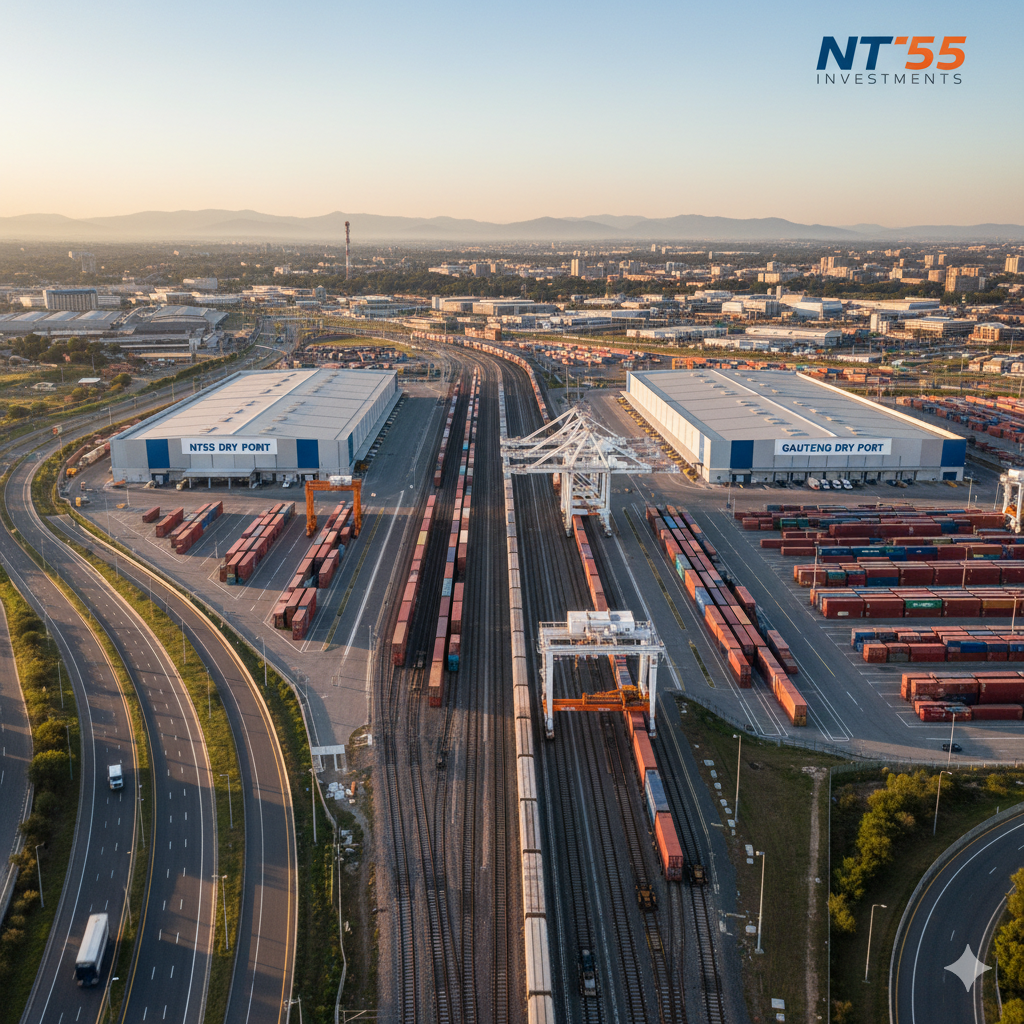
South African infrastructure developer NT55 Investments has announced plans to build a R50 billion ($2.9 billion) rail-integrated dry port in Gauteng, a transformative project aimed at relieving the country’s long-standing logistics and supply chain constraints.
The proposed inland logistics hub—designed to link seamlessly with South Africa’s rail corridors—seeks to address inefficiencies that have plagued the movement of goods through key gateways, particularly Durban and Richards Bay. With ports under pressure from congestion, equipment shortages, and security challenges, the dry port is being framed as a strategic response to one of the region’s most urgent economic bottlenecks.
The Project Vision
NT55’s planned facility will operate as a multi-modal hub, integrating road, rail, and warehousing infrastructure to streamline the transfer of goods inland. The site, strategically located in Gauteng, will function as both a staging ground for exports and a consolidation point for imports, easing pressure on South Africa’s overstretched coastal ports.
Developers highlight the project’s rail-first design, aiming to shift a significant share of cargo away from trucks and onto rail. This is expected to cut transit times, lower logistics costs, and reduce emissions across the supply chain.
Tackling South Africa’s Supply Chain Crisis
South Africa’s logistics backbone—especially the state-owned operator Transnet—has faced sustained criticism over rail underperformance, port congestion, and chronic inefficiencies. These issues have directly impacted mining exports, agricultural trade, and containerized goods, costing the economy billions of rand annually.
By creating a dedicated inland dry port with integrated customs, security, and warehousing facilities, NT55 hopes to bypass some of these constraints, providing exporters and importers with greater reliability and predictability in cargo handling.
Economic and Strategic Implications
The R50 billion investment represents one of the largest private sector-led logistics infrastructure projects in South Africa in recent years. Analysts suggest it could act as a catalyst for regional industrial growth, attracting manufacturers, distributors, and value-added logistics services to Gauteng.
The hub also aligns with broader African Union and Southern African Development Community (SADC) goals of strengthening intra-African trade corridors. By offering a more efficient inland gateway, the facility could enhance South Africa’s role as a continental logistics leader.
Global Comparisons: Learning from Other Dry Ports
South Africa is not alone in turning to inland dry ports as a solution to maritime congestion. Around the world, similar hubs have reshaped trade logistics:
- Ethiopia’s Modjo Dry Port, the country’s main inland gateway, has become central to its landlocked trade, linking directly to Djibouti’s port and handling more than 90% of Ethiopian imports and exports.
- Kenya’s Naivasha Inland Container Depot, connected by standard-gauge railway to Mombasa, has helped decongest East Africa’s busiest port and boost efficiency in cargo transfers.
- In India, the Tughlakabad Inland Container Depot near Delhi serves as a critical inland node, reducing reliance on Mumbai’s congested ports.
- China’s Xi’an Dry Port, part of the Belt and Road Initiative, has evolved into a major rail freight hub linking Asia to Europe, demonstrating how rail-integrated logistics hubs can drive regional trade growth.
By drawing on these models, NT55’s Gauteng project has the potential to integrate South Africa more deeply into continental and global supply chains. However, experts caution that sustained investment in rail infrastructure and regulatory alignment will be critical to achieving similar levels of success.
Environmental and Efficiency Gains
A key aspect of the project is its emphasis on sustainable logistics. By prioritizing rail over road transport, the hub is expected to cut carbon emissions while reducing wear and tear on South Africa’s highways. This aligns with national climate commitments and global supply chain sustainability targets increasingly demanded by international shippers.
Looking Ahead
While NT55’s plan has been welcomed by industry stakeholders, the project will require close coordination with Transnet, regulatory authorities, and international financiers. Market observers will be watching for details on construction timelines, rail access agreements, and partnerships with global shipping lines.
If successful, the Gauteng dry port could redefine South Africa’s logistics landscape, bringing it in line with global best practices and positioning the country as a competitive trade hub for Africa and beyond.
Tell us What is Happening in Your Area: Contact Maritime Context at: news@maritimecontext.com
