

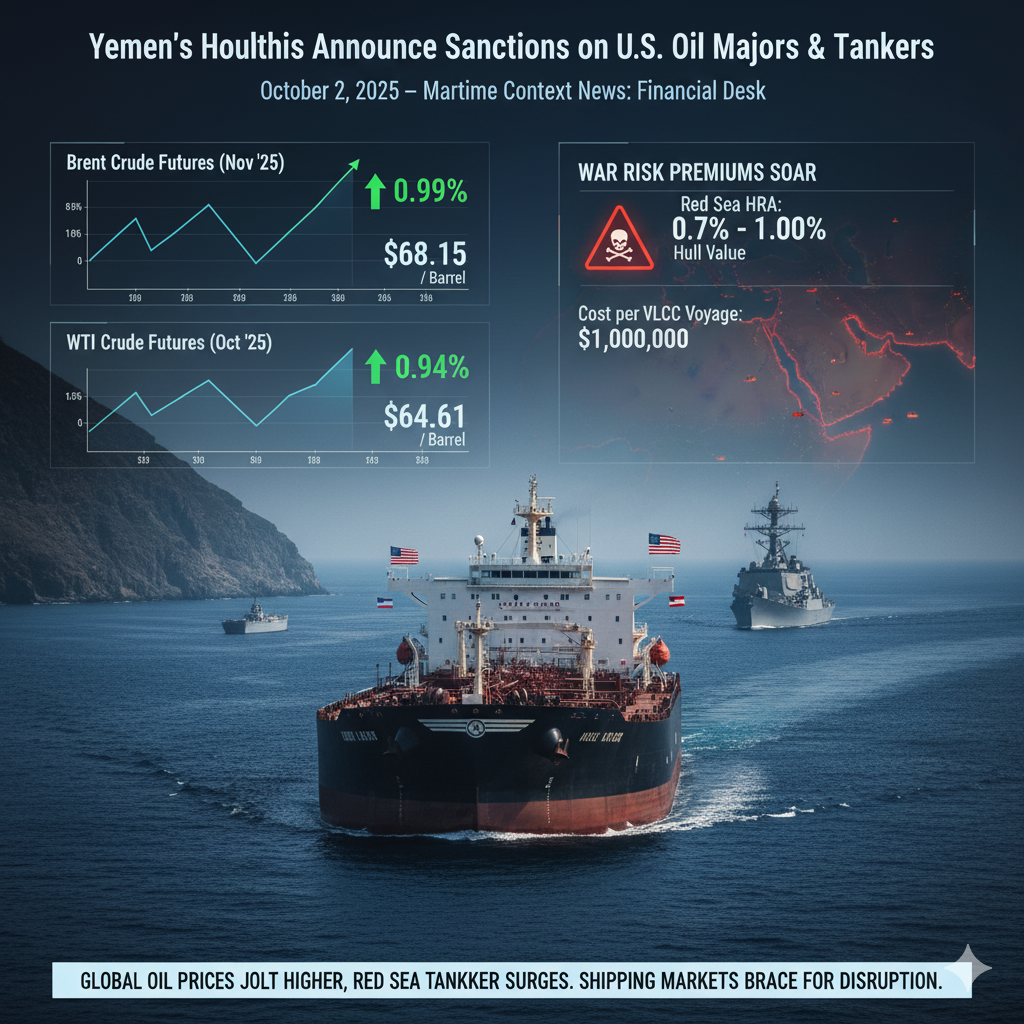
October 1, 2025 The Houthi movement in Yemen has escalated its confrontation with the United States by announcing sanctions against several major U.S. oil companies and crude tankers, in a move that underscores the widening geopolitical and maritime risks across the Middle East.
Details of the Announcement
In a televised statement from Sana’a, Houthi spokespersons declared that “American oil companies profiting from aggression in the region” would be subject to restrictions, along with tankers linked to their operations. The group claimed the measures were in response to U.S. military and economic support for Saudi-led coalition forces and Washington’s continued enforcement of sanctions against Iran and Yemen.
The Houthis did not specify the exact companies targeted, but industry sources suggest that ExxonMobil, Chevron, and ConocoPhillips could be among those on the list, along with U.S.-flagged or chartered vessels transporting crude through the Red Sea and Gulf of Aden.
Maritime and Energy Implications
The announcement raises concerns about the security of oil flows in one of the world’s most strategic shipping lanes. The Bab el-Mandeb Strait, which connects the Red Sea to the Gulf of Aden, is a chokepoint for roughly 10% of global seaborne oil trade. Any Houthi attempt to restrict tanker movement or impose unilateral “sanctions” through attacks could drive up insurance costs, disrupt routes, and increase global crude prices.
Shipping executives and insurers fear that this declaration may effectively translate into targeted harassment or attacks on vessels linked to U.S. oil firms, mirroring past incidents where Houthis launched missile and drone strikes on commercial shipping in the region.
U.S. and International Response
Washington has yet to issue an official response, but U.S. defense officials have previously warned that any threats to American tankers or energy companies would be met with “decisive measures.” The announcement also comes amid ongoing multinational naval patrols in the Red Sea under Operation Prosperity Guardian, which was launched to counter escalating attacks on merchant vessels.
Meanwhile, the International Chamber of Shipping (ICS) has called for restraint, urging that “commercial shipping must not be weaponized in geopolitical disputes,” warning of a broader ripple effect on global trade stability.
A Heightened Maritime Flashpoint
The Houthis’ sanctions declaration highlights how Yemen’s conflict is increasingly spilling into the maritime domain, where energy flows, naval deployments, and shipping security converge.
Analysts suggest the move is symbolic but dangerous: while the Houthis lack the legal authority to impose sanctions, their capacity for asymmetric attacks on tankers and infrastructure makes the threat credible.
“This is less about legal sanctions and more about a warning,” one Middle East energy analyst noted. “They are signaling that U.S. oil tankers and assets in regional waters could become fair game.”
As tensions mount, oil markets and shipping operators are bracing for possible further disruptions, with the Red Sea once again emerging as a critical fault line in the geopolitics of global energy.
Tell us What is Happening in Your Area: Contact Maritime Context at: news@maritimecontext.com
