

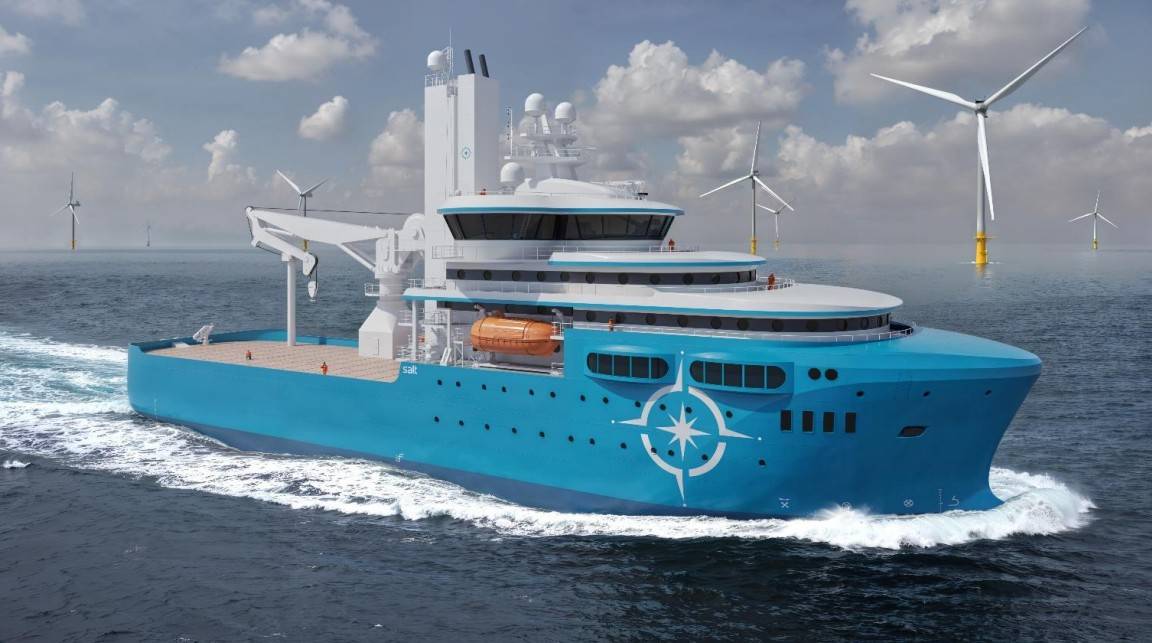
Marco Polo Marine’s selection of Norway’s Salt Ship Design to produce the “CSOV Plus” is more than a standard new-build announcement. It is a calculated strategic move that signals how mid-tier shipowners are positioning to capture accelerating demand across two adjacent markets — offshore wind and traditional oil & gas/subsea — while trying to squeeze more utilisation from each asset and meet rising sustainability and safety expectations. Below I unpack what the CSOV Plus is, why it matters, how it compares to recent industry trends, and the key commercial, technical and regulatory risks that will determine whether it becomes a market leader or just another spec vessel.
The headline facts (what Marco Polo announced)
- Marco Polo Marine has signed Salt Ship Design to develop the CSOV Plus concept; the design contract involves Marco Polo’s PKR Offshore subsidiary and Marco Polo Shipyard in Batam.
- The vessel is being marketed as a purpose-built Commissioning Service Operation Vessel (CSOV) designed from the keel-up for dual-use in offshore wind and oil & gas/subsea operations.
- Key technical highlights disclosed include a 100-tonne Active Heave Compensated (AHC) crane, a state-of-the-art walk-to-work system with 3-metre significant wave capability, large clear deck space and a battery-hybrid power arrangement with methanol fuel readiness.
- Construction is slated to start at Marco Polo’s Batam facility in Q2 2026 with delivery targeted in Q2 2028.
Why a dual-sector CSOV makes strategic sense now
- Market demand is bifurcating but overlapping.
Offshore wind is moving from pilot projects to large-scale build-outs in Europe, Asia and parts of the Americas, while oil & gas still requires subsea installation, maintenance and decommissioning services. Shipowners that can offer assets able to switch between O&M, commissioning and subsea tasks reduce idle days and increase charter options. - Charter economics favour versatility.
Traditional CSOVs confined to a narrow task window often face seasonal or regional demand troughs. A vessel that can undertake wind-farm commissioning one month and subsea handling or light construction support the next will command a premium in utilisation and lower day-rate volatility. - Clients prefer single-vendor lifecycle solutions.
Developers and OEMs increasingly value partners who can support a project from installation through commissioning and into O&M. A purpose-built CSOV that supports technicians, cable works, and some heavy lifts narrows the logistics chain for clients.
The technical profile: what Salt’s design appears to prioritise
From the public disclosures, Salt Ship Design and Marco Polo have focused on four engineering pillars:
- Weather-resilient personnel transfer (walk-to-work). The CSOV Plus is reported to support safe transfers in significant wave heights up to ~3.0 m. That widens operational weather windows compared with older designs and directly translates into more operational days per year.
- Heavy-lift and subsea handling capability. The inclusion of a 100-tonne AHC crane and a 3–10 tonne 3D compensated cargo lifting capability indicates the vessel is aiming to handle both wind-farm components and subsea tooling/frames — a key differentiator versus lighter CSOV designs.
- Green and fuel-flexible powerplant. Battery-hybrid systems combined with “methanol readiness” reflect the market push to lower emissions (and meet charterer demands) without committing to a single alternative fuel pathway. Hybrid systems also help reduce fuel burn during DP-holding and hoteling.
- Large clear deck and project modularity. The design emphasises configurable deck space to accept project-specific equipment and containerised tooling, making the ship adaptable to cable-lay, buoy installation, or subsea tool carriage.
Together, these elements suggest Salt’s brief was to deliver a genuinely multipurpose platform that sits between a pure CSOV and a light construction/subsea support vessel.
Where the CSOV Plus sits in the competitive landscape
Marco Polo is not alone in betting on hybrid CSOVs. Recent deliveries from Ulstein and other yards show the market is bifurcating into:
- High-end DP2/DP3 CSOVs with advanced motion compensation and crew comfort features.
- Multipurpose support vessels converted from platform supply or AHTS designs to fill capability gaps.
- Purpose-built “super-CSOVs” (like Marco Polo’s CSOV Plus intends to be) that bridge wind O&M and some subsea tasks.
Marco Polo’s competitive play is to offer a vessel that sits closer to the high-end bespoke CSOVs in capability, but built with cost and utilisation considerations in mind (local build in Batam, regional operator footprint). That combination could undercut European yards on price while providing capabilities competitive for APAC and emerging markets.
Commercial implications and business model considerations
- Shipyard & cost control. Building at Marco Polo’s Batam yard gives closer control of build schedule and costs, and potentially shorter lead times for regional clients. However, any local cost advantage must be weighed against component supply chains (e.g., cranes, motion compensation systems) that are specialised and often sourced from Europe.
- Charter market timing. The CSOV market is sensitive to waves of project awards. If global offshore wind projects accelerate, early movers with modern, fuel-efficient CSOVs stand to obtain attractive multi-year charters. But if renewables capex slows, owners will need to pivot to oil & gas and subsea work — exactly the scenario the CSOV Plus seeks to accommodate.
- Capex vs opex trade-offs. Hybrid propulsion and advanced systems raise upfront capex; success depends on securing higher charter rates or guaranteed back-to-back charters that amortise the premium. Marco Polo’s stated aim to maximise uptime is consistent with an economic model that relies on utilisation rather than the lowest build cost.
Regulatory, technical and operational risks
- Equipment and integration risk. Installing a large 100-tonne AHC crane, a robust walk-to-work gangway and battery-hybrid systems on one hull involves integration risk. Sub-system incompatibilities or delayed delivery of critical components can push timelines and inflate costs.
- Certification and insurance. New systems (battery energy storage, methanol fuel systems, big AHC cranes) will require approvals from class societies and flag states; insurers will scrutinise operations, especially crew transfer safety and battery fire mitigation.
- Market timing risk. If construction begins in Q2 2026 and delivery is 2028, the market environment at delivery will determine early charters. Longer permitting times for wind farms or a downturn in project awards could leave the vessel chasing work in a competitive subsea market.
- Crew transfer limits vs gangway expectations. Walk-to-work capability “up to 3.0 m significant wave height” is a marketing-friendly metric — real-world operability depends on wind, wave period, current and relative motion between vessel and turbine platform. Operators will still face strict weather-window discipline.
What the announcements reveal about Marco Polo’s strategy
- Vertical integration and capability ownership. Marco Polo is building in Batam and designing the vessel to be a core asset in its regional fleet — a sign it wants to own capability rather than long-term bareboat or spot charter exposure.
- Client diversification. The CSOV Plus is an instrument to win work from both wind developers and oil & gas contractors — lowering market concentration risk.
- Sustainability signalling. Battery-hybrid and methanol readiness are increasingly non-negotiable in pitch books for major developers and financiers. The design therefore helps address ESG criteria for tenders and project financing.
Voices from the deal
Marco Polo’s CEO framed the collaboration as a response to market demand for a more versatile asset; Salt Ship Design’s leadership emphasised their long-term input into the concept and the design’s ambition to set new standards for safety and comfort.
Bottom line — will the CSOV Plus matter?
Yes — but with caveats. The CSOV Plus ticks many of the boxes charterers are asking for: multipurpose capability, improved weather tolerance for transfers, green propulsion readiness, and heavy handling capacity. If Marco Polo can:
- execute the build on schedule in Batam;
- reliably integrate the high-spec sub-systems (AHC crane, W2W gangway, battery and methanol systems); and
- secure multi-year charters or framework agreements before or soon after delivery,
then the ship will likely command strong utilisation and help Marco Polo establish a differentiated offering in APAC and beyond.
However, delivery timing, supply-chain hurdles for specialist equipment, and market demand at the point of handover remain the biggest single variables. The industry will be watching whether Marco Polo can translate a well-worked design brief into a commercially successful, technically robust platform — a test that many ambitious shipowners have faced before.
Stay with us for verified, expert, and on-the-ground maritime journalism.
Contact: news@allinmaritime.com
Tel: +27 063 069 1191
Offices: Durban | Lagos | Abidjan | Dakar
All in Maritime News — Your Source for Maritime Intelligence
