

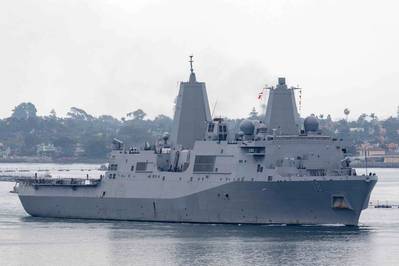
The U.S. Navy amphibious transport dock USS New Orleans (LPD-18) suffered a fire outbreak on Wednesday while operating off the coast of Okinawa, Japan. The incident prompted a swift multinational emergency response involving U.S. sailors, the Japan Coast Guard, and the Japan Self-Defense Forces.
Authorities confirmed that no injuries or oil spills were reported, and that firefighting efforts successfully contained the blaze, though work was still ongoing to fully extinguish it at the latest update.
Timeline of the Incident
At approximately 5:00 p.m. local time, smoke was reported aboard the San Antonio-class vessel while it was operating near the White Beach Naval Facility in Uruma City. U.S. Navy personnel quickly initiated onboard firefighting measures, while Japanese responders were called in to provide additional support.
The Japan Coast Guard deployed multiple vessels equipped with water cannons, while the Japan Maritime Self-Defense Force contributed tugboats and support ships. Together, they helped stabilize the situation and prevent the fire from spreading further.
Although the cause of the blaze remains under investigation, naval officials confirmed that the fire was contained to specific compartments. Damage assessment teams are currently evaluating the extent of structural and systems impact.
About USS New Orleans
The USS New Orleans, commissioned in 2007, is a San Antonio-class amphibious transport dock designed to carry Marines, landing craft, and aircraft, including the MV-22 Osprey tiltrotor and CH-46 helicopters. The vessel is part of the U.S. Navy’s 7th Fleet, which is headquartered in Japan and plays a central role in maintaining U.S. forward presence across the Indo-Pacific.
The ship is home-ported at Sasebo Naval Base and routinely operates throughout the Western Pacific. Its versatility allows it to support amphibious assaults, humanitarian relief operations, and crisis response missions.
Strategic Significance
The fire aboard USS New Orleans raises questions about potential disruptions to U.S. naval readiness in the region. Amphibious transport docks are critical assets for the deployment of Marines and rapid-response operations. Any prolonged repair or downtime could impact the Marine Expeditionary Unit’s deployment cycle and reduce amphibious operational capacity in the Indo-Pacific, an area marked by increasing geopolitical tensions.
Naval analysts note that although the incident did not result in injuries or environmental damage, it highlights the inherent risks of operating complex warships. The U.S. Navy has previously faced high-profile shipboard fires, such as the USS Bonhomme Richard blaze in 2020, which led to the vessel’s decommissioning. While no parallels are currently being drawn, the event underscores the Navy’s ongoing challenge of shipboard fire safety.
Official Statements
A Navy spokesperson assured that “all personnel are accounted for, and the fire is under control.” The Japan Coast Guard also confirmed that “no oil leaks or hazardous discharges have been observed,” easing concerns of an environmental impact near Okinawa’s busy maritime zone.
Japanese authorities praised the coordination between allied forces, noting that the response demonstrated the strength of U.S.-Japan defense cooperation in times of crisis.
At a Glance
| Detail | Summary |
|---|---|
| What happened | Fire aboard USS New Orleans, San Antonio-class amphibious ship |
| Where | Offshore Okinawa, near White Beach Naval Facility |
| When | August 20, 2025, around 5:00 p.m. local time |
| Casualties | None reported |
| Environmental impact | None reported; no oil spills |
| Response | U.S. Navy, Japan Coast Guard, and Self-Defense Forces |
| Status | Fire contained; investigation and damage assessment ongoing |
| Strategic impact | Potential temporary reduction in U.S. amphibious readiness |
Conclusion
The incident aboard USS New Orleans ended without casualties, but it has placed the spotlight on naval operational risks and U.S. military preparedness in the Indo-Pacific. With the fire now contained and no reported pollution, attention has shifted to identifying the cause, assessing damages, and determining how soon the vessel can return to active service.
Stay with us for verified, expert, and on-the-ground maritime journalism.
Contact: news@allinmaritime.com
Tel: +27 063 069 1191
Offices: Durban | Lagos | Abidjan | Dakar
All in Maritime News — Your Source for Maritime Intelligence
