

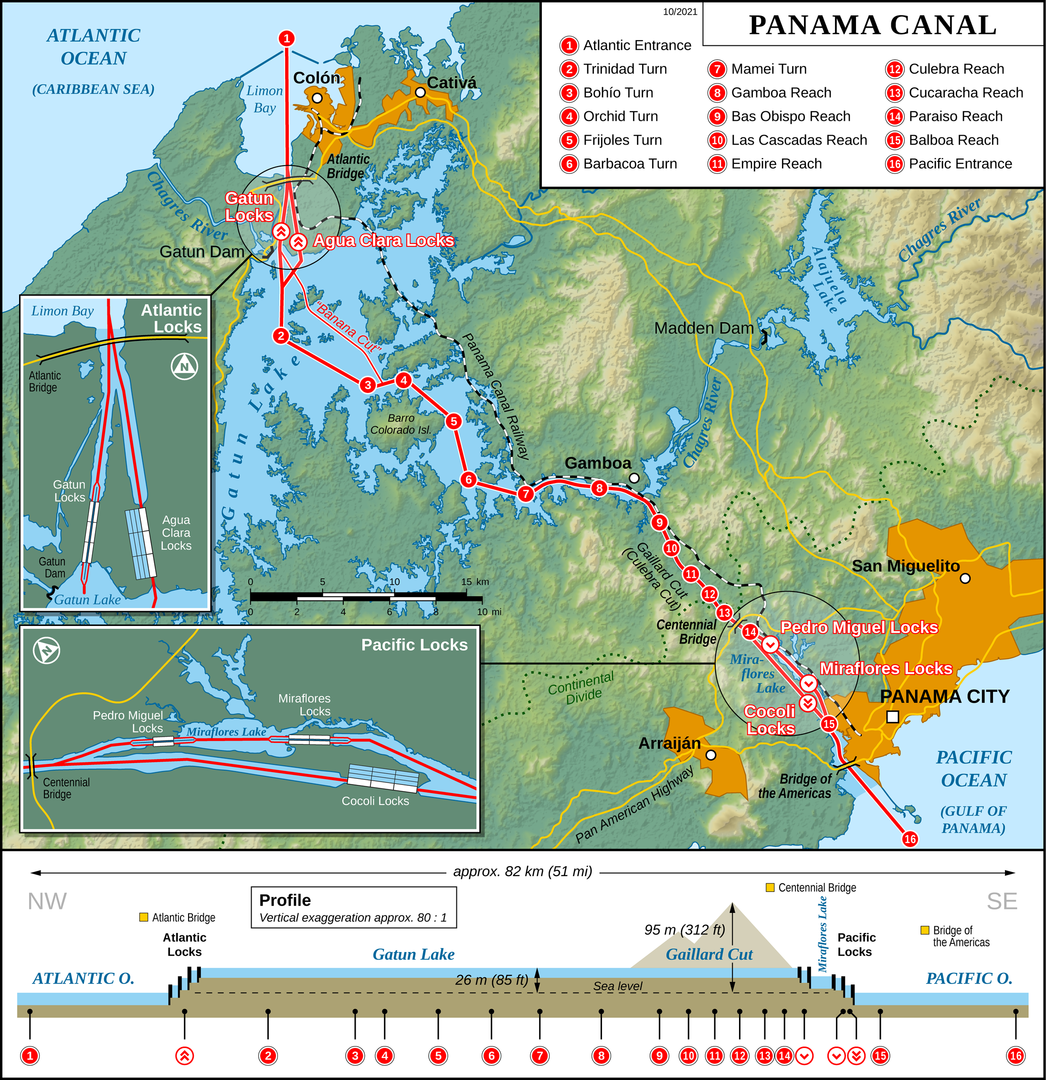
The Panama Canal, one of the most vital maritime trade routes in the world, has celebrated its 111th anniversary, marking more than a century since its official inauguration on August 15, 1914. The historic waterway was opened to traffic with the passage of the SS Ancon, an event that transformed global shipping by providing a faster and safer route between the Atlantic and Pacific Oceans.
Since that first transit, the canal has served as a cornerstone of international trade, facilitating over one million vessel passages and handling close to six percent of global commerce. More than 140 maritime routes across 160 countries depend on the canal, which continues to connect major economies and drive efficiency in world trade. Its significance grew further in 2016 with the completion of the Panama Canal Expansion Project, which introduced new locks capable of handling larger “New Panamax” vessels. This development dramatically increased capacity, allowing the canal to accommodate some of the largest container ships and LNG carriers in service today.
While its contribution to global trade remains undisputed, the waterway has faced mounting challenges in recent years. Severe drought conditions, linked to climate variability, have strained operations by reducing water levels in Gatun Lake, the canal’s primary source of transit water. This forced the Panama Canal Authority (ACP) to impose draft restrictions and limit the number of daily transits, measures that disrupted shipping schedules and led to concerns among carriers and global supply chain operators. Despite these difficulties, the ACP has reaffirmed its commitment to long-term resilience.
Administrator Ricaurte Vásquez Morales emphasized during the anniversary commemoration that the canal must adapt to new environmental realities while safeguarding its role as a global logistics hub. He noted that water management projects and investments in sustainable infrastructure are underway to ensure reliable operations in the decades ahead.
The 111th anniversary also highlights the canal’s enduring role as an engineering marvel and a driver of economic growth for Panama. Revenues from canal operations account for a significant portion of the country’s GDP and support thousands of jobs both directly and indirectly. Internationally, the waterway continues to serve as a key artery for trade between Asia, the Americas, and Europe, especially as shipping patterns shift in response to evolving global demand.
Looking forward, the Panama Canal Authority has outlined plans to expand its logistical services, strengthen digital capabilities, and explore further infrastructure improvements to accommodate growth in maritime trade. Despite the operational pressures it faces, the canal remains one of the most reliable and strategic shipping routes in the world.
As the waterway enters its 112th year, it stands as both a symbol of human ingenuity and a reminder of the ongoing need to balance economic efficiency with environmental sustainability. More than a century after its opening, the Panama Canal continues to bridge oceans, facilitate commerce, and connect nations in ways that remain as vital today as they were in 1914.
Stay with us for verified, expert, and on-the-ground maritime journalism.
Contact: news@allinmaritime.com
Tel: +27 063 069 1191
Offices: Durban | Lagos | Abidjan | Dakar
All in Maritime News — Your Source for Maritime Intelligence
