

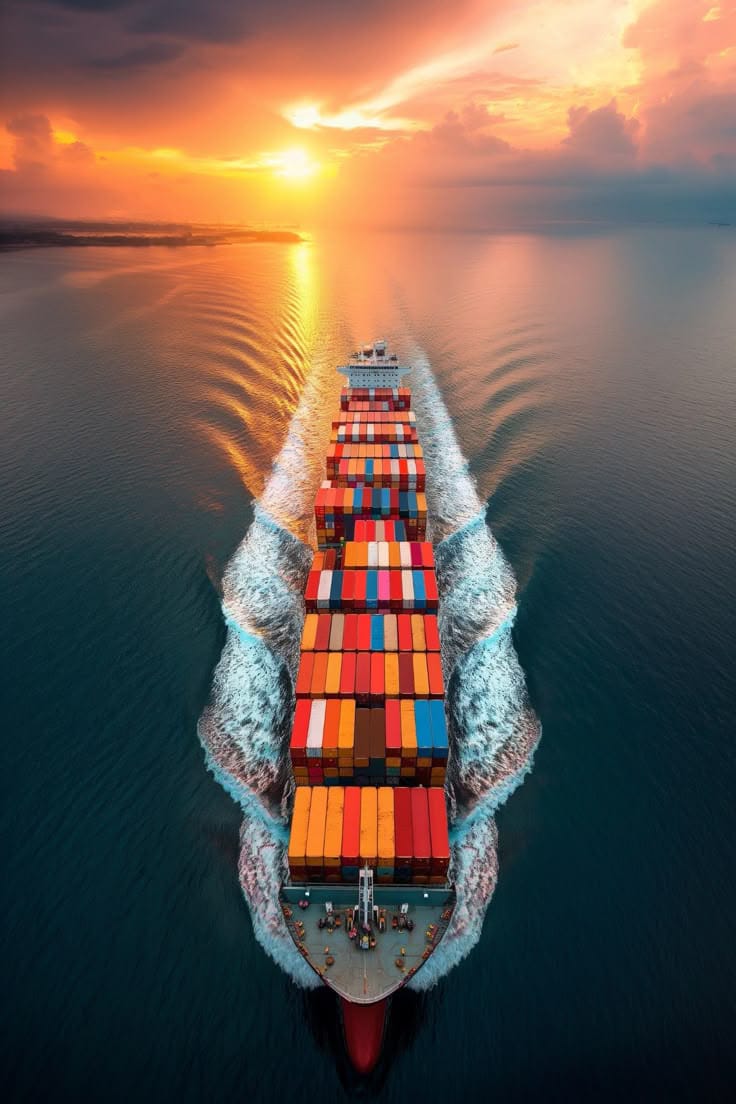
July 23, 2025 – Container ships, the floating skyscrapers of the sea, continue to dominate global trade routes, carrying over 90% of the world’s non-bulk cargo. As global supply chains evolve and shipping technology advances, these vessels remain central to maritime logistics and international commerce.
From the bustling ports of Shanghai and Rotterdam to East African hubs like Mombasa and Dar es Salaam, container ships are the primary vehicles behind the efficient, high-volume movement of manufactured goods across continents.
What Are Container Ships?
Container ships are cargo vessels specifically designed to transport intermodal containers — standardized steel boxes typically measuring either 20 or 40 feet in length. These containers can be transferred seamlessly between ships, trucks, and trains, streamlining the global supply chain.
Each container ship has a carrying capacity measured in TEUs (Twenty-foot Equivalent Units). A standard 40-foot container equals 2 TEUs. Large container vessels can carry anywhere from 1,000 to over 24,000 TEUs depending on their class.
Types and Sizes
Container ships come in several categories, each suited for specific trade routes and port capabilities:
- Feeder Vessels (under 3,000 TEUs) operate in coastal and regional routes.
- Panamax Ships (approx. 5,000 TEUs) were once the largest size able to transit the original Panama Canal.
- Post-Panamax and Neo-Panamax Ships (up to 14,000 TEUs) are now common on trans-Pacific and trans-Atlantic routes.
- Ultra-Large Container Vessels (ULCVs), like the MSC Irina and Ever Alot, can carry over 24,000 TEUs, mainly on Asia–Europe lanes.
These vessels stretch more than 400 meters in length — longer than four football fields — and are serviced by some of the most advanced terminals in the world.
Key Innovations and Design Features
Modern container ships incorporate several technological advancements to improve performance and reduce emissions:
- Advanced Hull Design: To reduce drag and improve fuel efficiency.
- Efficient Engines: Low-speed diesel engines optimized for long-distance travel.
- Emission Reduction Systems: Many are equipped with scrubbers and now use low-sulphur fuel in compliance with IMO 2020 regulations.
- Digital Navigation Tools: Automated voyage planning, container tracking, and real-time weather routing are now standard.
Larger ships may also feature air lubrication systems, energy-saving rudders, and shore power compatibility for zero emissions at berth.
Economic Impact and Trade Role
Container shipping revolutionized global trade after its rise in the 1960s. The standardization of cargo handling dramatically reduced the cost of shipping and time at ports. According to the International Chamber of Shipping, more than 200 million containers are moved annually, linking every major economy.
Global players like MSC, Maersk, and CMA CGM operate some of the world’s largest fleets. Ports such as Singapore, Shanghai, and Antwerp handle tens of millions of TEUs each year.
Even in East Africa, ports like Mombasa and Dar es Salaam have significantly upgraded infrastructure to accommodate container ships of increasing size, supporting trade across the continent.
Challenges Ahead
While container ships are essential to global commerce, the industry faces several growing challenges:
- Port Congestion: Larger ships mean longer docking times and increased strain on terminal capacity.
- Environmental Pressures: Maritime emissions remain under scrutiny, with the IMO aiming for net-zero emissions by 2050.
- Security Threats: Piracy, geopolitical tensions, and cyberattacks are ongoing risks, especially in sensitive areas like the Red Sea and Gulf of Guinea.
- Economic Uncertainty: Fluctuations in trade demand, fuel prices, and canal tolls continue to impact profitability.
Looking Ahead
With trade volumes expected to grow in emerging markets, container ships are set to play an even more critical role in global development. Advances in green shipping, including ammonia- and methanol-fueled vessels, are also being explored as part of the sector’s shift toward sustainability.
As maritime technology evolves, container ships will continue to adapt — growing larger, cleaner, and smarter — reaffirming their place as the linchpin of modern trade.
