

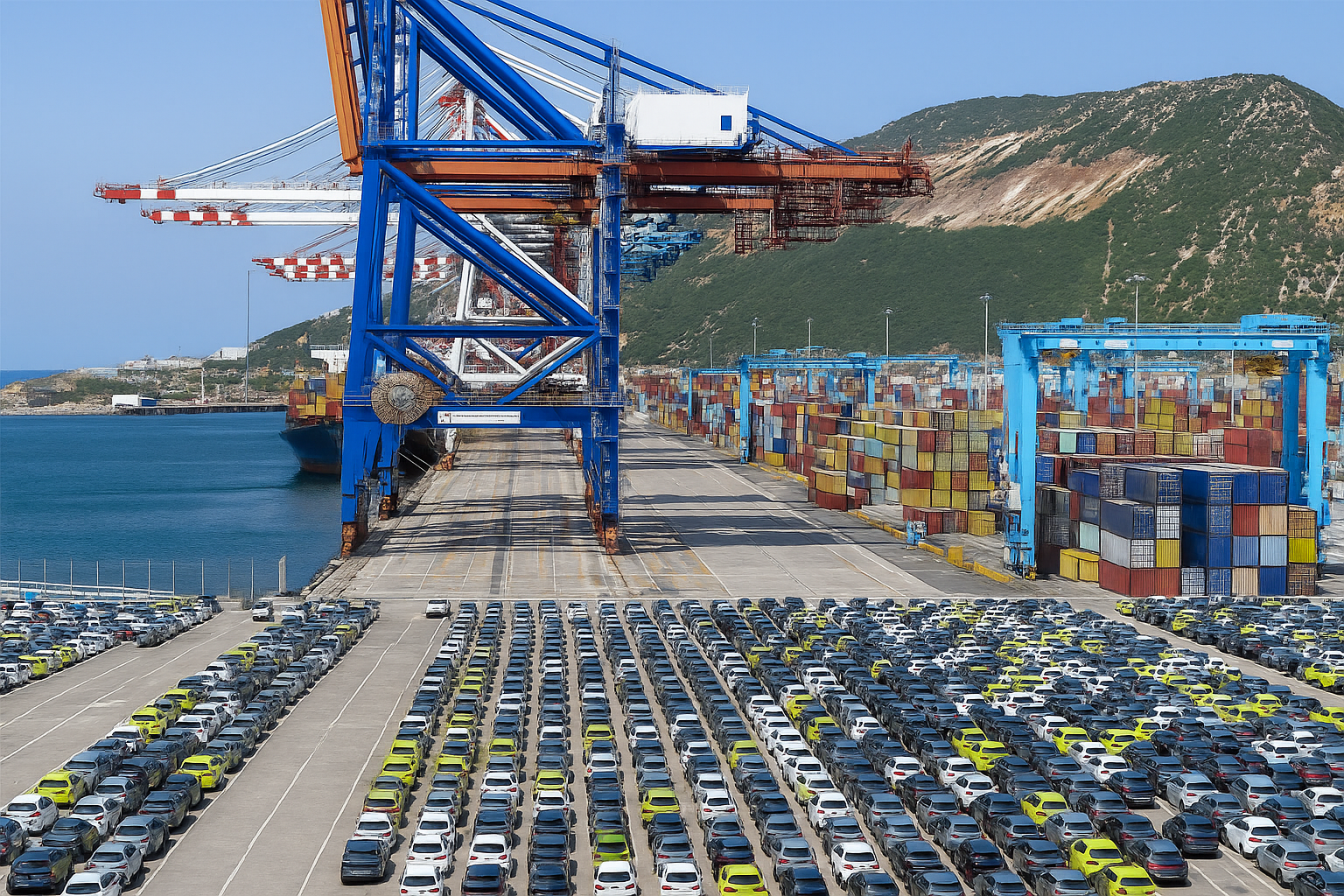
Over the last decade, Morocco has transitioned from a regional player to a commanding force in global maritime trade. At the core of this transformation lies a triad strategy: bold port infrastructure investments, a thriving industrial export engine, and deep integration of logistics and risk management services.
From the bustling terminals of Tanger Med, Africa’s largest port, to the rising development of Nador West Med, Morocco is reshaping shipping routes, redefining industrial competitiveness, and setting a new benchmark for port performance in the Global South.
Tanger Med: A Case Study in Maritime Scale and Efficiency
Strategically situated on the Strait of Gibraltar, Tanger Med Port has evolved into a global logistics powerhouse.
- In 2024, the port handled 142 million tonnes of cargo, marking a 16.2% year-over-year increase.
- Container throughput reached an impressive 10.24 million TEUs, positioning Tanger Med within the top 20 container ports globally.
- First quarter 2025 revenues hit 1.12 billion Moroccan dirhams (USD 110 million), with transshipment activity accounting for nearly 50% of total throughput.
The port’s high-performance terminals—operated by global leaders like APM Terminals, Marsa Maroc, CMA CGM, and TIL—have exceeded nominal capacity without compromising efficiency, setting standards that even Southern European ports now seek to match.
Industrial Integration: Manufacturing Within Port Zones
Beyond shipping volume, Tanger Med’s true strength lies in its industrial port complex.
- The Tanger Med Zones (TMZ) host over 1,300 companies in automotive, aerospace, textiles, electronics, and food processing.
- In 2023, Morocco became the top vehicle exporter to the European Union, overtaking China and Japan. Vehicle exports reached €15.1 billion, with over 600,000 units shipped.
- Adjacent to the port, companies benefit from immediate access to customs-free export processing zones, 24/7 logistics corridors, and intermodal connectivity to Europe, West Africa, and the Americas.
This model—where production, compliance, inspection, and logistics coexist in a single ecosystem—embodies Morocco’s transformation into a “make and move” economy.
Nador West Med: The Next Gateway to Africa
To alleviate pressure on Tanger Med and activate the eastern Mediterranean corridor, Morocco is fast-tracking the Nador West Med Port, a deep-water facility designed for high-capacity logistics and energy handling.
Key specifications for Phase 1 (operational by 2027):
- 3 million TEU container terminal, expandable to 5 million TEUs.
- Hydrocarbon terminal with 25 million tonnes capacity.
- Bulk terminal to handle 7 million tonnes annually.
Shipping giants MSC and CMA CGM have committed to joint ventures at the port, while the African Development Bank has extended €120 million to finance port infrastructure and associated industrial zones.
Nador West Med is not only a gateway to Eastern Morocco but a key node for trade between Europe, West Africa, and the Middle East—particularly for energy and bulk cargo.
Energy and Maintenance Infrastructure: LNG and Shipyards
Complementing container expansion, Morocco is diversifying its maritime service offering:
- A new LNG terminal is under design to support energy security and marine fuel transition.
- The government has launched a $300 million shipyard project in Casablanca, set to become Africa’s largest, offering full ship repair, newbuilding, and drydocking capabilities.
- Future plans include green hydrogen and ammonia bunkering, aligning Morocco with IMO 2030 decarbonization targets and positioning it as a renewable energy export hub.
Expert Insight: Mariclaim on Risk Management and Claims Complexity
As Morocco’s maritime ecosystem grows more sophisticated, so does the complexity of cargo risk, compliance, and insurance oversight.
Mariclaim Global Marine Surveyors & Adjusters Ltd, a renowned name in marine claims and surveying across Africa, shared its perspective:
“Morocco is showcasing how maritime infrastructure, when coupled with regulatory and industrial strength, can redefine Africa’s role in global trade,” noted the firm’s Technical Director.
“At Mariclaim, we’re supporting clients at Moroccan ports with a full suite of services—from cargo condition surveys and reefer inspections to draft surveys and claims investigations for containerized and breakbulk cargo. Morocco’s ports are fast becoming complex risk environments, and the need for trusted adjusters is growing.”
Mariclaim reports increasing demand for marine claims handling, pre-shipment loss prevention audits, and real-time cargo monitoring—especially in high-value vehicle, agricultural, and project cargo shipments routed via Morocco.
Observater’s Commentary: From East Africa to West, A Shared Vision
Observater Surveys & Services Ltd, headquartered in Kenya with operations across East and Southern Africa, provided complementary insight into how Morocco’s maritime rise is influencing pan-African logistics alignment.
“Morocco’s success is rooted in clarity of vision. They’ve integrated inspection, infrastructure, and policy—and that’s what we admire most,” said Daniel Esilaba, Managing Director of Observater Group.
“As an inspection and claims firm, we’re seeing growing demand from Moroccan exporters and insurers for East African expertise. From bunker surveys and cargo tallying to reefer compliance checks and warehouse inspections—we’re preparing to support both outbound Moroccan goods and inbound cargoes destined for the Indian Ocean corridor.”
Observater emphasized the need for technical continuity between regions, especially as Moroccan exporters increasingly ship goods to Mombasa, Dar es Salaam, Maputo, and Durban.
“We want to ensure that a shipment of Moroccan citrus or phosphate arrives in East Africa with the same inspection integrity it left with. That’s our mandate—bridging regions through verifiable, standards-based marine surveying.”
Regulatory, Geopolitical, and Climate Considerations
Morocco’s rapid growth hasn’t occurred in a vacuum. The National Ports Agency (ANP) has led regulatory modernization, while strategic funding from the EBRD and World Bank is improving climate resilience and shoreline sustainability.
Geopolitically, the Red Sea crisis and Houthi disruptions have rerouted container lines around the Cape, giving Moroccan ports more prominence in East–West transit lanes.
What Lies Ahead: A Continental Model in Motion
| Focus Area | Forecast |
|---|---|
| Tanger Med III | Expand to 12+ million TEUs by 2026 |
| Nador West Med | Operational Phase 1 by 2027 |
| Casablanca Shipyard | Fully operational by 2026 |
| LNG & Green Energy Terminals | Commissioned between 2026–2028 |
| Inspection Sector | Strong demand growth through 2030 |
| East–West Trade Synergy | High-value cargo corridors strengthening |
Conclusion: Morocco Is Building the Maritime Africa of Tomorrow
Morocco’s ports are not just sites of transit—they are platforms for production, engines of employment, and pillars of continental connectivity.
With leaders like Mariclaim and Observater anchoring risk management, inspection, and claims handling, the sustainability and credibility of this growth are ensured. Together, these firms are helping set new standards—not just in North Africa, but across the African continent.
From Tangier to Nador, Casablanca to Mombasa—Africa is sailing forward. Morocco is at the helm.
For coverage on shipping innovation, logistics transformation, and marine energy transition, stay with All in Maritime News.
Contact: news@allinmaritime.com | Tel: +27 063 069 1191
Offices: Durban | Dar es Salaam | Nairobi | Dubai
Website: www.allinmaritime.com
All in Maritime News – Your Source for Global Maritime Intelligence
