

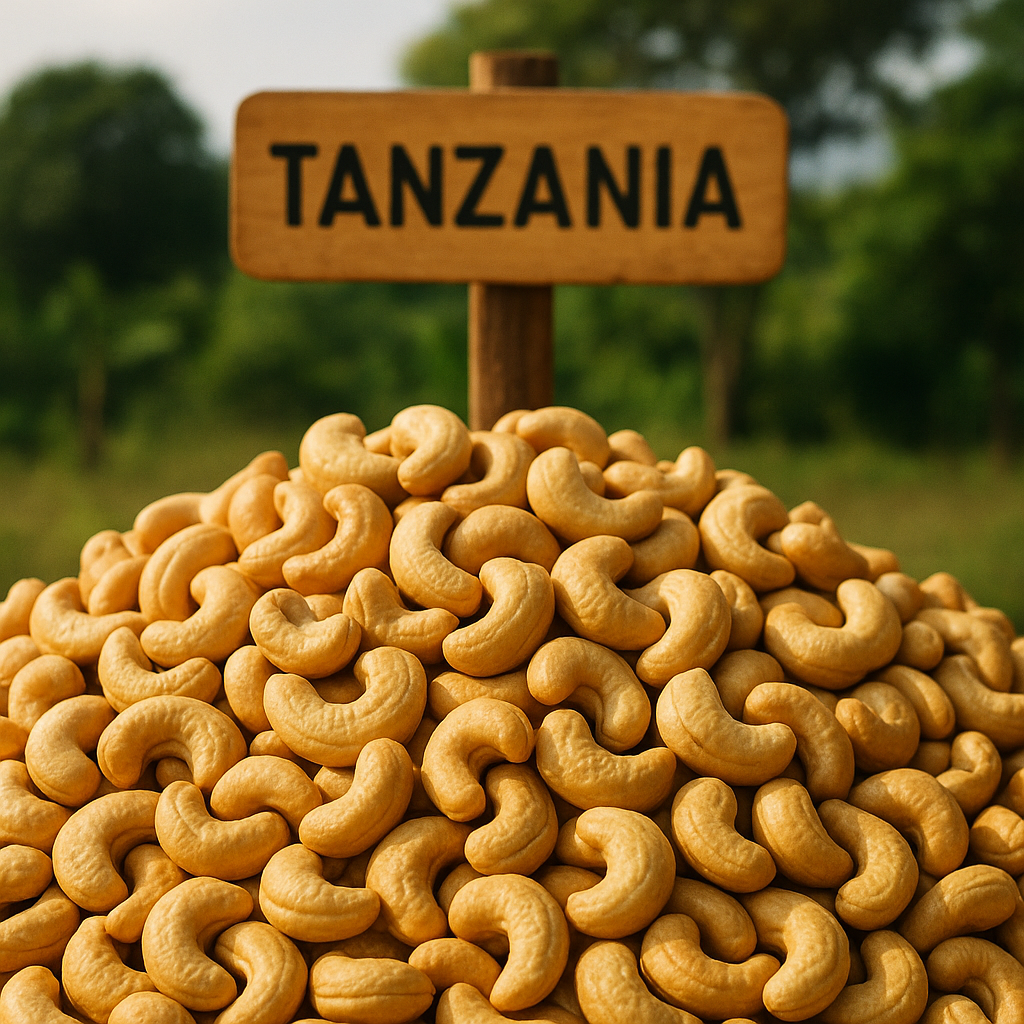
Dar es Salaam, Tanzania – Tanzania’s cashew sector has emerged as a model of agricultural transformation, trade competitiveness, and industrial vision. Bolstered by strategic state investment, robust export logistics, and global demand, the country’s 2024/2025 cashew season has not only broken historical records but repositioned Tanzania as a dominant force in the global edible nut industry.
This success is no accident. It is the result of coordinated agricultural policy, port modernization, private-sector engagement, and sustained leadership under President Samia Suluhu Hassan.
Historic Export Earnings Confirm Tanzania’s Global Cashew Standing
Provisional data released by the Bank of Tanzania confirms a meteoric rise in export earnings. As of February 2025, foreign exchange generated from cashew exports reached USD 626 million, nearly three times the USD 224 million earned in the same period the previous year. This surge makes cashews Tanzania’s top traditional export commodity, eclipsing tobacco, coffee, and tea.
The broader traditional export portfolio also grew by 60%, with cashews contributing the lion’s share of that growth.
Production Scaling: A Strategic Agricultural Triumph
The Cashew Board of Tanzania (CBT) announced an official harvest of 528,260 metric tons of raw cashew nuts, driven by nationwide input subsidies and improved extension services. Independent regional commodity analysts N’kalô confirmed 408,600 metric tons by February 2025—marking a 34% year-on-year increase.
These results were achieved through:
- Government-subsidized agricultural inputs, including Sulphur powder and liquid pesticides,
- Widespread farmer mobilization programs,
- Reinforced research and development efforts via public-sector agronomic institutes.
The production growth reflects more than quantity—it is a signal of systemic improvements in farm-level practices, post-harvest handling, and quality control.
Global Market Preference for Tanzanian Cashews
Tanzanian cashews command high esteem in global markets due to their creamy flavor, white kernel color, and large size—traits that position them competitively against counterparts from West Africa and India. The October to December harvest calendar also aligns advantageously with global processor procurement cycles, ensuring reliable off-season supply.
Auction prices in the opening weeks of the 2024/2025 season ranged between TZS 4,035 and TZS 4,120 per kilogram (USD 1.48–1.51), a notable increase reflecting high international demand, improved product quality, and streamlined export pathways.
Key export destinations remain India, Vietnam, and China, with emerging interest from the European Union and the Middle East.
President Samia Suluhu Hassan: Architect of Agricultural Industrialization
Under President Samia Suluhu Hassan, the Tanzanian government has redefined cashew nuts as a strategic crop for industrial growth and rural transformation. Her directives have catalyzed both upstream and downstream value chain expansion.
Presidential initiatives include:
- Directing all Southern Zone cashew exports through the Port of Mtwara, creating a cohesive maritime corridor,
- Allocating USD 26 million for free input distribution,
- Calling for increased domestic processing, with strong emphasis on value addition and industrial capacity building.
The President’s vision is not merely export growth—it is to turn Tanzania into a value-chain leader, processing its own produce and multiplying its economic returns through job creation, skills development, and manufacturing competitiveness.
Maritime Infrastructure: The Rise of Mtwara Port
Strategically located at the heart of Tanzania’s cashew belt, Mtwara Port has been revitalized into a flagship agro-export hub under the government’s port modernization agenda.
As reported by Plasduce Mbossa, Director General of the Tanzania Ports Authority (TPA):
- Over TZS 157.8 billion (USD 60.7 million) has been invested into port upgrades,
- The port handled 133,000 tonnes of raw cashews by November 2024, a record high,
- Major global shipping lines such as MSC, CMA CGM, COSCO, PIL, ESL, and ECSL have increased their service frequency at Mtwara.
These logistics developments have eliminated historic bottlenecks such as vessel delays and container shortages, significantly improving Tanzania’s export competitiveness.
Maersk’s ‘Korosho Express’: A Dedicated Trade Enabler
In October 2024, Maersk unveiled the ‘Korosho Express’, a bi-weekly ocean freight service designed specifically for Tanzanian cashew exporters. The route connects Mtwara directly to India, Vietnam, and China, aligning precisely with the country’s peak shipping window.
Babafemi Jay Aderounmu, Head of East African Markets at Maersk, remarked:
“We’ve launched the Korosho Express to support Tanzania’s cashew sector at a crucial inflection point. Our goal is to provide direct, reliable, and predictable access to key global markets.”
This development marks a strategic shift in logistics—from reactive to pre-scheduled export certainty.
Policy Reinforcement: Government Ministers Driving Sectoral Change
Hon. Hussein Bashe, Minister for Agriculture, continues to champion transformative policy reforms. His stewardship has seen:
- The export levy reinvested directly into the cashew sector (for pesticides, extension services, and farmer tools),
- The introduction of a national target to reach 700,000 tonnes of production by 2025/26,
- Plans for an industrial processing park in Mtwara, featuring 30 new factories to expand domestic processing capacity.
Bashe has stated emphatically:
“We are no longer content with exporting raw commodities. Tanzania must evolve into a processor, value adder, and global brand.”
Stakeholder Testimonies: Industry Leaders React to the Boom
Rodgers Musyoka – Observater Surveys & Services Ltd
“The trajectory of Tanzania’s cashew sector is truly inspiring,” said Rodgers Musyoka, Tanzania Operations Lead at Observater Surveys and Services Ltd.
“Our firm plays a pivotal role in maintaining Tanzania’s reputation for quality by executing a full suite of independent inspection services throughout the export chain. This includes inspections of raw cashew nuts at the point of origin, container loading supervision, pre-shipment assessments, sampling for laboratory analysis, weight and quality tally surveys, and all related cashew nut surveys at ports, warehouses, and transit depots.”
He emphasized:
“As volumes rise and global standards tighten, conformance and traceability are non-negotiable. At Observater, we offer more than surveys—we deliver risk mitigation, logistics insights, and quality assurance that underpin sustainable trade.”
Musyoka also praised the shift toward processing:
“President Samia’s strategy to localize value addition is visionary. With industrial processing comes job creation, knowledge transfer, and stronger control over pricing. Tanzania is preparing not just to export cashews—but to lead the global cashew value chain.”
Hussein Ahmed – Leading Cashew Exporter
“This season has been exceptional,” said Mr. Hussein Ahmed, a veteran exporter. “The logistics efficiency, stable auction prices, and government-supplied inputs have all aligned to make Tanzanian cashews more competitive. Direct shipping from Mtwara to Asia has slashed our operational costs and improved time-to-market.”
Evans Mwalu – Port Clearing Agent
“The improvements at Mtwara Port have completely changed the game,” said Mr. Evans Mwalu.
“Vessel turnaround is faster, customs processes are more synchronized, and shipping companies are now customizing services for the cashew industry. That speaks volumes about how far we’ve come in just one season.”
Conclusion: Tanzania’s Cashew Era Has Arrived
What began as a seasonal crop has become a national growth engine. Tanzania’s cashew industry now symbolizes a model for how agricultural value chains can drive economic diversification, regional development, and export-led growth.
With leadership from the highest level of government, tangible improvements in maritime infrastructure, active global partnerships, and expanding local processing capabilities, Tanzania is no longer a raw commodity exporter—it is a global stakeholder in a billion-dollar industry.
The golden harvest has cracked open a future of enduring prosperity.
Byline: All in Maritime News – Special Coverage from Dar es Salaam, Mtwara, and International Trade Corridors
All in Maritime News — Your Source for Global Maritime Intelligence
Tel: +27 063 069 1191
Offices: Durban | Dar es Salaam | Nairobi | Dubai
Email: news@allinmaritime.com
