

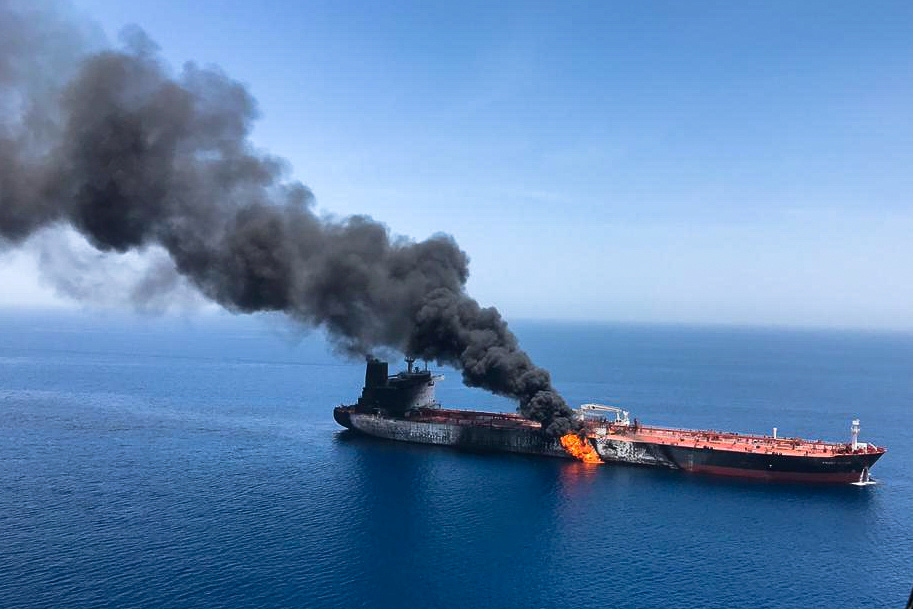
Ongoing geopolitical volatility in the Middle East—now intensified by the Iran–Israel war—is producing serious consequences for international shipping. The latest incident, a high-profile tanker collision near the Strait of Hormuz, has not only ignited environmental and operational concerns but also raised fresh alarms over navigational interference and maritime security risks.
Strait of Hormuz: A Collision that Signals Broader Risk
On June 17, 2025, two oil tankers—the Liberian-flagged Front Eagle and the Russia-linked MV Adalynn—collided off the UAE coast near Fujairah. Both vessels caught fire, prompting swift emergency response and temporary disruption of vessel traffic in one of the world’s most critical maritime arteries.
Although no casualties were reported and firefighting teams brought the blaze under control, satellite imagery and coast guard reports suggest limited oil sheening in the vicinity, triggering precautionary environmental monitoring.
Maritime authorities confirmed that preliminary investigations indicate the collision was linked to suspected GPS interference, with analysts noting erratic movements by both vessels prior to the crash. This reinforces mounting concerns about AIS spoofing and signal distortion near the Strait of Hormuz.
Geopolitical Heat and Electronic Warfare in Maritime Zones
Iranian officials have recently reiterated that closure of the Strait remains a strategic option should military tensions with Israel and Western allies escalate further. The incident has occurred amid increasing evidence of electronic navigation disruption in the Gulf of Oman and Strait of Hormuz.
The Joint Maritime Information Centre (JMIC) has issued an “ELEVATED” advisory for the region, warning of persistent navigation anomalies, radar ghosting, and unexplained satellite blackouts. Naval security teams have urged shipmasters to minimize reliance on automated systems and increase visual watchkeeping.
Red Sea, Subsea Cables and the New Battlefield
Meanwhile, unexplained damage to subsea data cables in the Red Sea and Eastern Mediterranean has raised the specter of undersea sabotage. Such disruptions threaten not just energy flows but also global internet traffic and financial data exchanges.
Concurrent reports of vessel detentions, suspicious boardings, and illegal interference near the Bab el-Mandeb Strait and Gulf of Aden have deepened fears that maritime security threats are widening in scope and geography.
Expert Insight from the Field
Michael Robin, Senior Surveyor at Observater Surveys and Services Ltd, offered on-the-ground perspective from current port operations:
“Surveying conditions have become exceptionally complex. We’re witnessing rerouted tankers arriving at unexpected ports with minimal notice. Crews are anxious, documents need tighter scrutiny, and inspections must now include additional risk verification related to electronic tampering.”
He added that East African ports—particularly Mombasa, Dar es Salaam, and Djibouti—are receiving a surge in diverted traffic, requiring enhanced coordination and rapid deployment of trained marine inspectors.
Legal Implications for Global Shipping
Maritime legal strategist Mr. Jamal emphasized that the collision and surrounding conflict create a perfect storm for legal disputes:
“We’re entering territory where contractual definitions are no longer black and white. Charter party clauses related to force majeure, deviation, and cargo liability are being tested in real-time. It’s imperative for stakeholders to revisit their terms, especially with regards to war-risk coverage and rerouting protocols.”
African Readiness in Focus
Rtd. Gen. Bramwel Oladejo, former Nigerian Navy Commander, warned of potential spillover into African maritime zones:
“This is no longer a Middle Eastern issue. African nations must act now. The influx of rerouted vessels to East, West, and Southern Africa puts our coastlines and ports under immense pressure. Surveillance must be tightened. Naval response units should be on alert, and intelligence networks activated across the continent.”
He called on African nations to leverage frameworks like the Yaoundé Code of Conduct and strengthen port security systems before threats evolve into regional crises.
Wider Industry Impact
| Stakeholder | Impact |
|---|---|
| Shipowners | Rising war-risk premiums, fuel costs, and operational delays |
| Charterers | Route volatility, delay penalties, and legal uncertainty |
| Insurers | Increased claims, redrafted policies, and elevated risk exposure |
| Port Authorities | Congestion pressures, documentation scrutiny, and security coordination |
| Surveyors | Expanded scope, faster deployments, and real-time verification requirements |
| Shippers/Forwarders | Contractual ambiguity and disruption in supply chain scheduling |
Outlook: Caution into Q3 2025
With no immediate signs of de-escalation in the Iran–Israel conflict, maritime stakeholders are urged to:
- Integrate buffer times into voyage planning
- Reassess insurance terms, especially war-risk clauses
- Coordinate closely with port authorities
- Enhance onboard vigilance amid persistent electronic interference
The evolving nature of maritime conflict now includes GPS warfare, legal ambiguity, and undersea sabotage—signaling that modern shipping must treat security as a core operational function, not a passive afterthought.
For continued updates, risk alerts, and expert maritime intelligence:
📧 Contact: news@allinmaritime.com
📞 Tel: +27 063 069 1191
🏢 Offices: Durban | Dar es Salaam | Nairobi | Dubai
🌐 Website: www.allinmaritime.com
All in Maritime News — Your Source for Global Maritime Intelligence
