

2 December 2025 — Helsinki, Tokyo, London
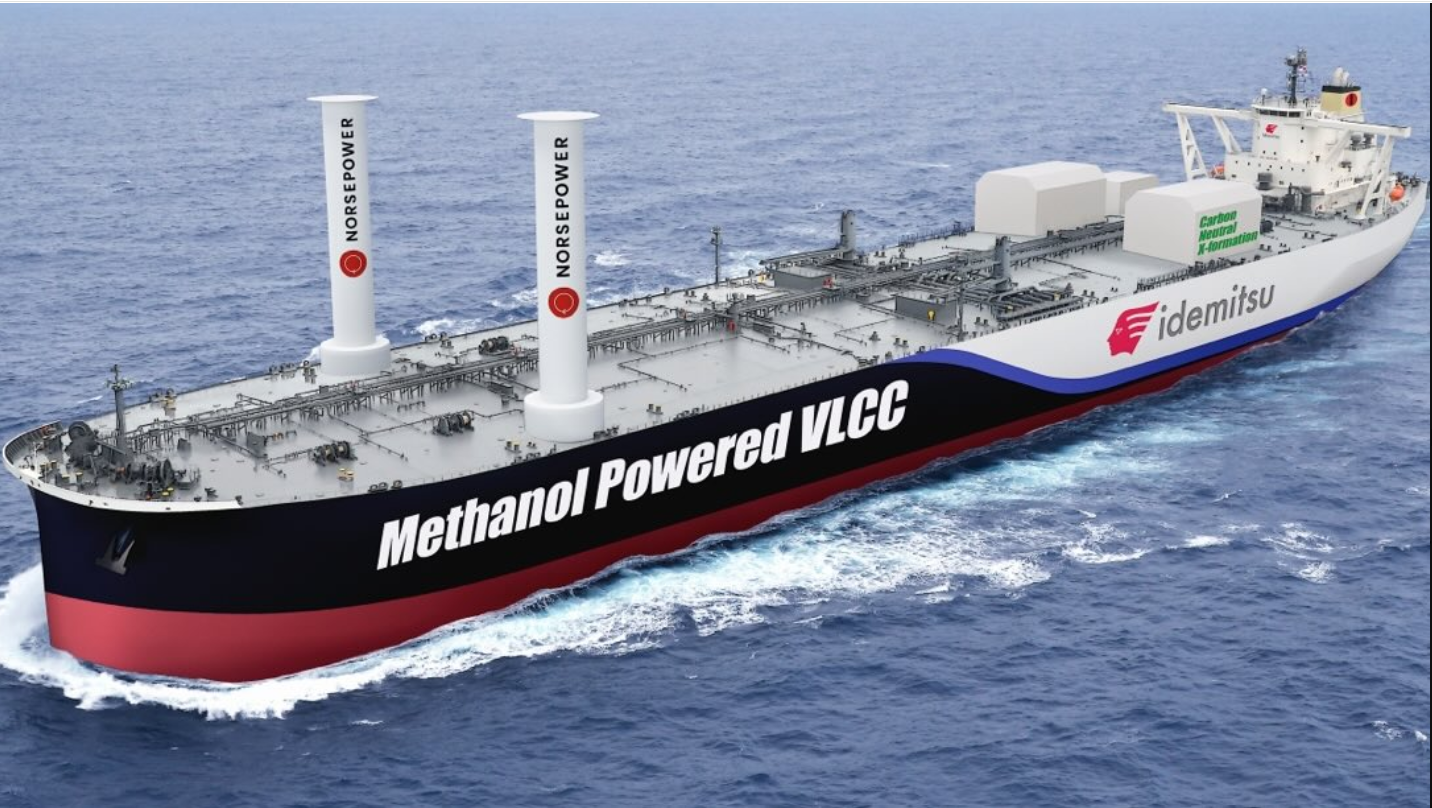
In a landmark development for wind-assisted propulsion, Norsepower has signed a breakthrough agreement with Idemitsu Tanker Co., Ltd. to equip two next-generation Very Large Crude Carriers (VLCCs) with the Norsepower Rotor Sail™ — marking the first time in global shipping history that VLCCs will be delivered with mechanical sails installed.
The newbuild vessels, to be constructed by Japan Marine United Corporation (JMU) and Nihon Shipyard Co., Ltd. (NSY), will each feature two explosion-proof 35m x 5m rotor sails, with the first VLCC scheduled for delivery by the end of 2028.
Pushing the Boundaries of Green Tanker Design
The project is part of Idemitsu’s broader plan to advance sustainable energy transport and accelerate its commitment to a carbon-neutral (CN) society. The VLCCs have been purpose-designed with an array of energy-saving technologies and prepared for future low-carbon fuels such as methanol.
By integrating Norsepower’s intelligent, data-driven rotor sails into the design phase, the carriers are expected to deliver significant fuel savings and meaningful reductions in greenhouse-gas emissions, especially over long-haul routes where wind conditions amplify efficiency gains.
Idemitsu Tanker Co., Ltd. noted:
“By equipping our new VLCCs with the Norsepower Rotor Sail™, we are taking a decisive step toward the decarbonisation of long-haul shipping while maintaining a stable and reliable energy transportation system. This reflects our philosophy of combining operational reliability with innovation to serve global energy needs responsibly.”
Wind Propulsion Reaches Full Maturity
The contract underscores both the rapid maturation of wind-assisted propulsion and Norsepower’s leadership across the tanker market. To date, the company has deployed 22 rotor sail units across tanker types ranging from chemical carriers and LC02 carriers to MR, LR, VLGC, and now, for the first time, VLCCs.
For Norsepower, the deal is also strategically significant: it is the company’s first newbuild project in Japan, now the largest market for its technology.
Heikki Pöntynen, CEO of Norsepower, described the agreement as a pivotal milestone:
“This is a defining moment for Norsepower and for wind propulsion in global shipping. Partnering with Idemitsu Tanker and JMU on the world’s first VLCCs equipped with rotor sails demonstrates both the trust in our technology and its universal relevance across the tanker segment.”
How the Technology Works
The Norsepower Rotor Sail™ is a modernised evolution of the classic Flettner rotor, using the Magnus Effect to generate thrust as the rotor spins. Each system is paired with:
- Automated digital control systems
- Real-time wind optimisation features
- Minimal power requirements compared to the thrust gained
According to Norsepower, the sails typically deliver 5–25% fuel-use reduction, depending on route, wind conditions, and operational profiles. Under favourable conditions, the savings may exceed these ranges.
A Defining Step in the Global Decarbonisation Push
As international regulations tighten and oil majors demand cleaner logistics chains, the adoption of rotor sails on VLCCs — some of the largest and most fuel-intensive ships afloat — represents a major step forward.
The Idemitsu–Norsepower project demonstrates that wind-assisted propulsion has graduated from niche applications to mainstream, deep-sea tanker operations, paving the way for broader deployment across the crude-oil, products, and gas-carrier fleets.
With the first of the two VLCCs expected to enter service in 2028, the maritime industry will be watching closely to measure the scale of real-world energy savings and the impact on future fleet design philosophies.
Tell us What is Happening in Your Area: Contact Maritime Context at: news@maritimecontext.com
