

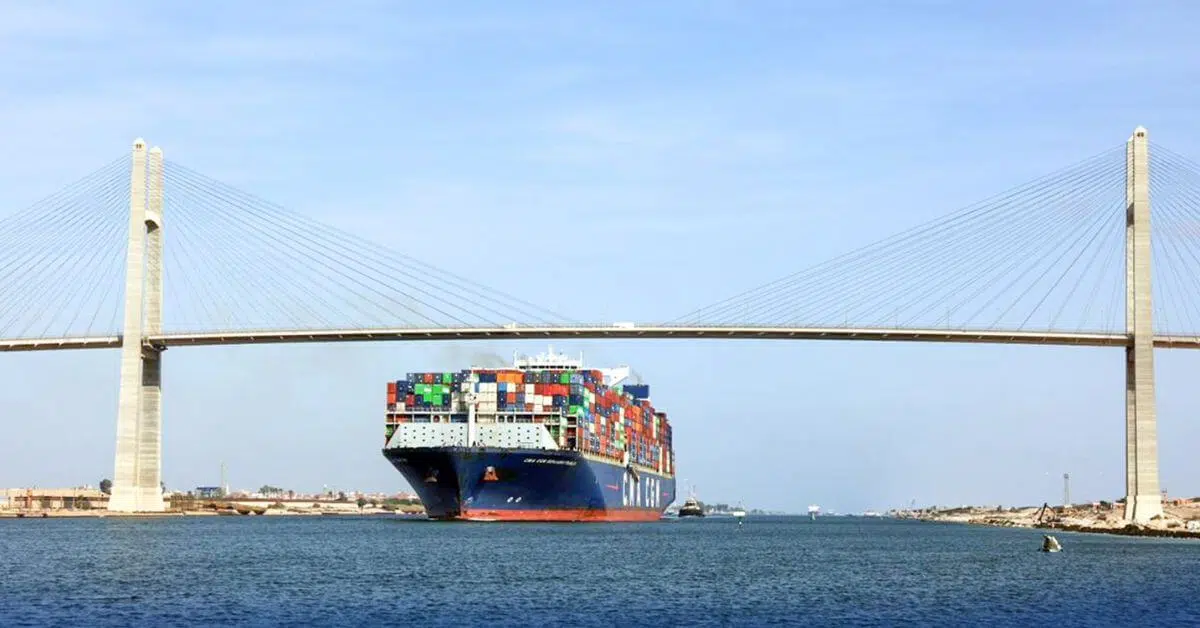
The CMA CGM Benjamin Franklin, one of the world’s largest container ships, has become the biggest vessel to transit Egypt’s Suez Canal in the past two years — a symbolic event that marks the return of ultra-large container vessels to the strategic waterway after a period of disruptions and regional instability.
The 399-metre-long and 54-metre-wide ship, operated by French liner giant CMA CGM, made its northbound passage through the canal on November 8, 2025. According to the Suez Canal Authority (SCA), the vessel carried a total capacity of 17,859 TEUs and had a draft of 13.5 metres. It sailed as part of a routine convoy under the SCA’s enhanced navigation and escort measures designed for mega-ships.
A Symbolic Return For Ultra-Large Vessels
The successful transit of the Benjamin Franklin comes after a two-year lull during which security threats in the Red Sea region and Bab el-Mandeb Strait had forced several shipping lines to divert their fleets around the Cape of Good Hope. The return of such a massive ship through the Suez route now signals renewed confidence in the safety and operational readiness of the canal.
“The safe passage of CMA CGM Benjamin Franklin demonstrates the Suez Canal’s continued capacity to handle the world’s largest vessels safely and efficiently,” said a senior SCA official. “It also reflects the improved security conditions in the southern approaches to the canal.”
Industry observers note that this marks the first voyage of the Benjamin Franklin through the Suez and Bab el-Mandeb since October 2023, when heightened maritime risks prompted rerouting of container traffic.
Boost To Global Maritime Trade
The transit is expected to restore momentum to East–West trade flows, particularly between Asia and Europe. Using the Suez Canal shortens voyages by roughly 10 days compared to the Cape of Good Hope route, significantly reducing fuel costs and emissions.
With global carriers gradually reinstating Suez transits, shipping analysts expect a rise in container throughput at key Mediterranean and African ports, including transshipment hubs in the Red Sea and the Horn of Africa region.
For global supply chains still recovering from volatility, the event provides a signal of stabilisation and renewed logistical efficiency.
Strategic Implications
The Suez Canal remains one of the most critical arteries of world trade, carrying approximately 12% of global commerce. The passage of a vessel of this scale underscores Egypt’s ongoing efforts to maintain competitiveness through dredging, widening projects, and dynamic toll adjustments to attract major carriers.
For maritime service providers — including port surveyors, vessel inspectors, and marine risk consultants — the return of ultra-large ships highlights the importance of continuous readiness in infrastructure and safety assurance. Companies like Observater Surveys and Services Limited are expected to see rising demand for port suitability surveys, under-keel clearance assessments, and channel capacity evaluations as larger vessels resume calling at regional ports.
Looking Ahead
CMA CGM’s decision to route the Benjamin Franklin through the Suez is being seen as both a vote of confidence in the canal’s capabilities and a signal to the wider industry that the Red Sea corridor is regaining its role as the preferred East–West trade route.
If more carriers follow suit, the canal could soon return to pre-2023 capacity levels, reviving its position as a cornerstone of global maritime commerce.
Key Facts
- Vessel: CMA CGM Benjamin Franklin
- Length: 399 metres
- Beam: 54 metres
- Draft: 13.5 metres
- Capacity: 17,859 TEUs
- Transit date: November 8, 2025
- Route: Northbound convoy through Suez Canal
The passage of CMA CGM Benjamin Franklin is more than a technical achievement — it is a statement of resilience for global shipping and a testament to the Suez Canal’s enduring role as the world’s maritime crossroads.
Tell us What is Happening in Your Area: Contact Maritime Context at: news@maritimecontext.com
