

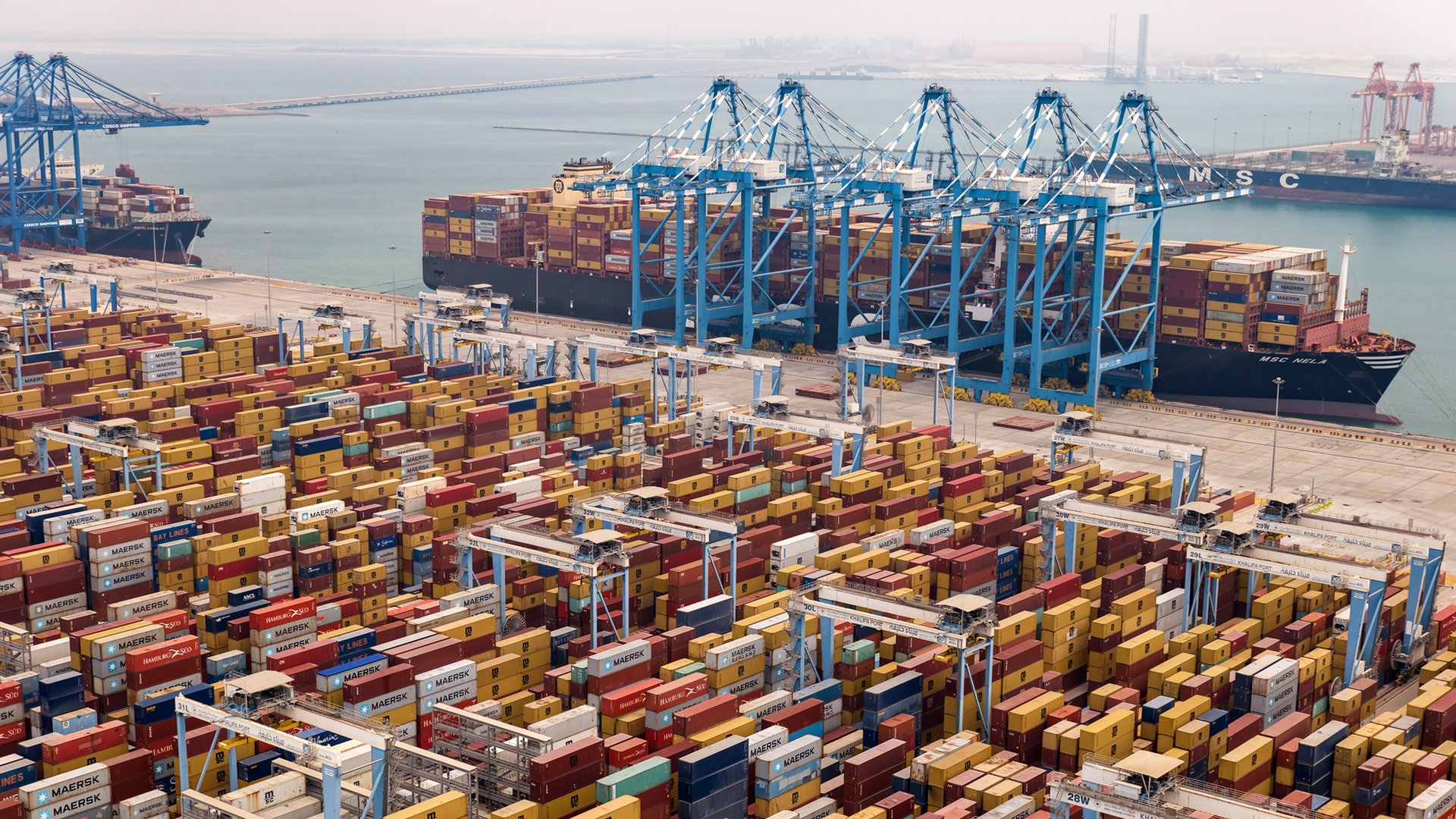
Dubai’s steady ascent as a maritime powerhouse has long been anticipated — but few expected the pace of growth to accelerate quite this fast. The latest Lloyd’s List Top 100 Ports 2025 rankings and performance figures from across the UAE paint a compelling picture: the Gulf’s ports are not merely holding their ground amid global headwinds — they are surging ahead.
A Region Rising, Led by Dubai and Abu Dhabi
Khalifa Port’s remarkable climb to 39th position, up from 95th just six years ago, is more than a success story for Abu Dhabi; it underscores a broader transformation across the UAE’s maritime ecosystem. Once considered a regional trans-shipment node, the country’s ports now anchor a globally integrated logistics corridor linking Asia, Africa, and Europe.
Dubai’s Jebel Ali Port, operated by DP World, remains the undisputed heavyweight. Throughput reached 88.3 million TEUs in 2024, an 8.3 percent year-on-year rise — comfortably above industry forecasts. This growth has propelled Dubai into the ranks of the world’s top five maritime hubs, and first in the Arab world, according to the 2025 Global Shipping Centre Index.
Such figures defy earlier projections, which had anticipated modest single-digit growth amid slowing global trade and geopolitical uncertainty. Instead, Dubai’s port performance has outpaced nearly every major comparator in the region — a reflection of resilience, diversification, and foresight in infrastructure investment.
The Engine Behind the Growth
What’s driving this acceleration? Several converging factors stand out.
First, massive investment in digitalisation and automation has redefined efficiency standards at both Khalifa and Jebel Ali ports. Smart gate systems, AI-driven yard management, and paperless clearance processes are cutting dwell times and boosting turnaround speeds — the kind of incremental gains that compound into global competitiveness.
Second, multimodal integration is paying off. Dubai’s port operations are increasingly linked with logistics parks, rail corridors, and air freight facilities, forming a seamless supply chain that attracts global manufacturers and re-exporters. The synergy between AD Ports Group’s Khalifa Port and DP World’s network has created what industry observers describe as a “UAE Maritime Super Corridor” — an ecosystem where competition and cooperation co-exist to amplify collective growth.
Third, strategic geography meets policy ambition. As the Red Sea crisis continues to reshape shipping routes, the Gulf’s centrality to east–west trade flows has become more pronounced. Dubai, long a transit hub, now benefits from sustained cargo re-routing as ship operators seek stable, well-equipped alternatives.
Growth Beyond Expectation — But for How Long?
While Dubai’s growth trajectory is outpacing expectations, analysts caution that the current momentum may soften in the coming year. Lloyd’s List notes that global container throughput growth could moderate to around 3 percent in 2025, following the strong rebound of 2024.
Nevertheless, Dubai’s port operators appear less concerned about cyclical slowdowns. Their focus is squarely on future-proofing the maritime economy — through green port initiatives, AI-driven planning, and decarbonisation-linked investments. DP World’s push for shore-power infrastructure and Khalifa Port’s continued expansion into renewable-energy-supported operations both signal a long-term strategic view.
A New Gulf Narrative
For decades, global shipping narratives were dominated by East Asian giants — Shanghai, Singapore, and Ningbo-Zhoushan. Yet, the UAE’s maritime rise is subtly altering that story. Dubai’s and Abu Dhabi’s ports are not only facilitating trade but also reshaping supply-chain geography across the Indian Ocean and beyond.
What’s remarkable isn’t just the scale of growth, but the consistency of performance amid global volatility. The UAE’s ports have transformed from passive recipients of trade flows into active enablers of industrial and economic diversification.
The message is clear: Dubai’s maritime sector is not merely keeping pace — it’s setting the pace.
Opinion:
The surge in port rankings and throughput should not be read as a one-off achievement, but as a strategic inflection point. Dubai’s rapid expansion — alongside Khalifa Port’s meteoric rise — reflects a deliberate national vision: to make the UAE not just a stopover, but a strategic heartbeat of global trade. If current momentum is sustained, the conversation about the world’s leading maritime capitals may soon require a significant rewrite.
Tell us What is Happening in Your Area: Contact Maritime Context at: news@maritimecontext.com
