

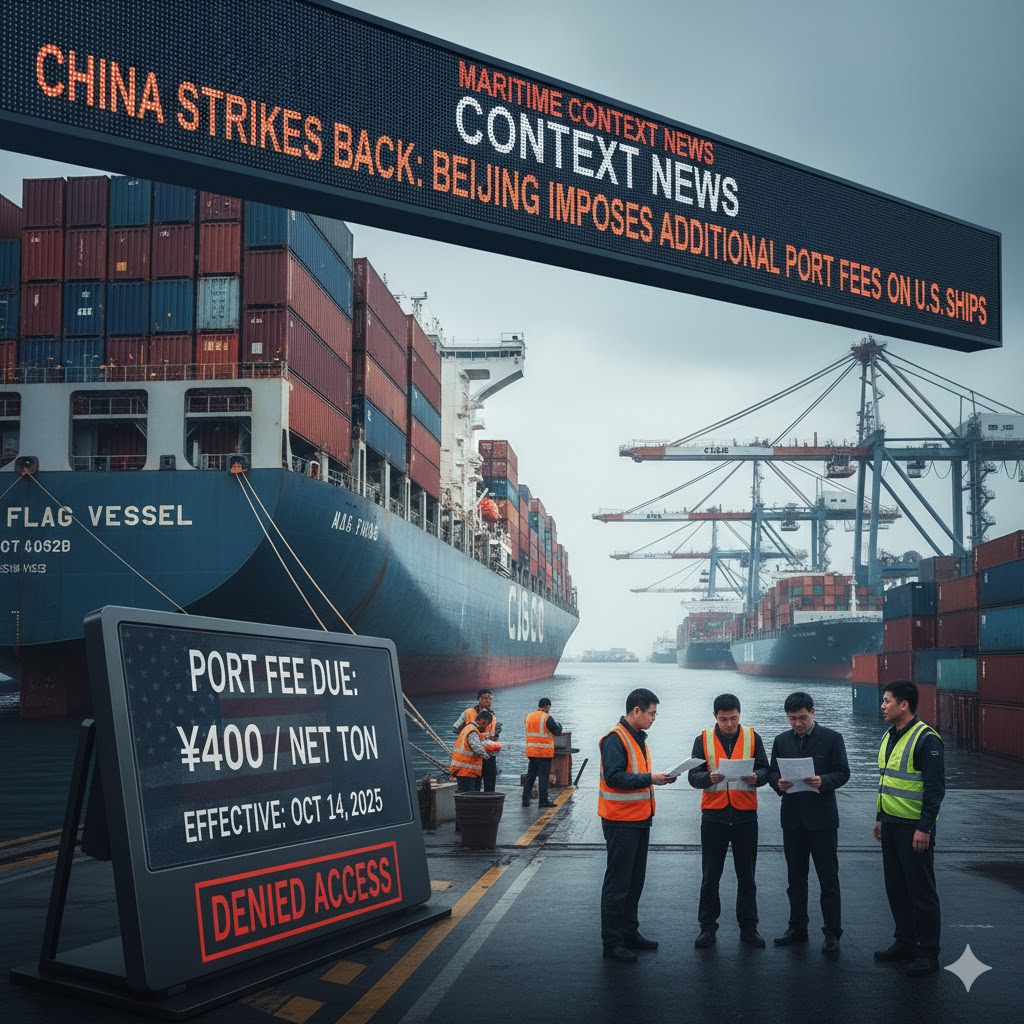
China has announced a sweeping retaliatory measure against the United States, introducing new port fees targeting U.S.-linked vessels in a move that signals a sharp escalation in the ongoing maritime trade standoff between the two economic giants.
Effective October 14, 2025, all vessels owned, operated, built in, or registered under the U.S. flag will be subject to a special port fee of 400 yuan (approximately USD 56) per net ton when docking at Chinese ports. According to China’s Ministry of Transport, the charges will increase annually—to 640 yuan in April 2026, 880 yuan in 2027, and 1,120 yuan in 2028—and will apply up to five times per year per vessel, only at the first port of call.
The move is a direct countermeasure to the U.S. government’s recently implemented port fee regime, which imposes charges on Chinese-built or Chinese-owned ships entering American ports. That policy, set to begin on the same date, aims to address what Washington has described as an “imbalance in maritime cost structures.”
A New Front in the Trade War
Beijing’s action underscores growing friction in the global shipping sector, which has increasingly become a battleground for trade and geopolitical influence. The Chinese government described the measure as “a legitimate and proportional response” to Washington’s maritime restrictions, warning that further provocation could invite additional countermeasures.
“The principle of reciprocity is clear—China will not remain passive while its vessels face discriminatory treatment abroad,” a spokesperson for the Ministry of Transport said in a press statement.
Analysts see the move as a strategic show of resolve that extends the U.S.–China trade dispute beyond tariffs, semiconductors, and technology into the logistics arteries that sustain global commerce.
“This is no longer about cargo tariffs; it’s about who controls the sea lanes and the costs of global trade,” said Dr. Mei Zhang, a senior researcher at the Shanghai Institute for International Shipping. “Port fees may appear technical, but they represent a deeper signal of economic deterrence.”
Rising Costs and Disrupted Routes
The implications for shipping companies are significant. The new fees could add millions of dollars in annual operating costs for U.S.-affiliated shipping firms, forcing them to either absorb the expenses or pass them on to cargo owners through higher freight rates.
Industry observers expect some carriers to reroute vessels or limit port calls in China to avoid excessive costs. Others may seek to reflag ships under neutral registries or restructure ownership to obscure U.S. ties—a practice that could complicate international maritime governance.
“The global fleet is deeply intertwined,” said London-based maritime economist Philip Warren. “Even a ship built in China but leased through a U.S. financial entity could fall under these definitions. The compliance burden alone will be immense.”
Meanwhile, U.S. exporters and importers could face higher transportation costs, further straining trade flows already weakened by inflation, shipping disruptions, and energy price volatility.
Impacts Beyond the U.S. and China
Although the measures primarily target bilateral shipping, ripple effects are expected across global trade routes. Asian transshipment hubs such as Singapore, Busan, and Port Klang may see a rise in vessel traffic as carriers attempt to bypass Chinese ports. Similarly, emerging African ports—including those in Kenya, Djibouti, and Tanzania—could attract more trans-Pacific cargo diversions seeking neutral gateways.
“The new fee regime could indirectly boost the competitiveness of ports outside the immediate conflict zone,” said Nairobi-based logistics consultant James Mugo. “But for global supply chains, this adds another layer of cost and uncertainty.”
Legal and Diplomatic Fallout
The U.S. maritime industry has criticized China’s decision, calling it a “politically motivated toll” that undermines the principle of free and fair navigation. In response, the Chinese Shipowners’ Association defended the measure as compliant with World Trade Organization (WTO) norms and international maritime conventions.
Legal experts anticipate that both sides may soon bring complaints before global trade bodies, though enforcement or arbitration in such complex maritime matters could take years.
“This tit-for-tat exchange risks creating a precedent where maritime access becomes a geopolitical weapon,” warned Professor Elena Ruiz, a trade law expert at the University of Rotterdam. “If unchecked, it could fracture the global shipping framework that has underpinned world trade for decades.”
What Comes Next
The timing of China’s announcement—just days before scheduled bilateral trade talks—suggests a hardening stance in Beijing’s negotiations with Washington. While both governments insist they remain open to dialogue, few analysts expect a swift resolution.
For now, global shippers are bracing for higher costs, longer routes, and greater uncertainty, as the world’s two largest economies turn their maritime rivalry into a full-fledged trade confrontation.
“This is a signal that trade tensions have entered the port gates,” said Warren. “What began with tariffs has now reached the docks.”
Tell us What is Happening in Your Area: Contact Maritime Context at: news@maritimecontext.com
