

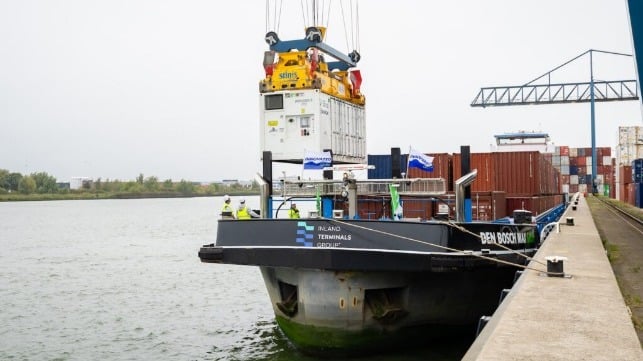
The Netherlands is scaling up its ambition to decarbonize inland shipping with the introduction of swappable battery packs, a flexible energy solution designed to accelerate the transition to emission-free waterways. The initiative represents a major step forward in the Dutch government’s broader climate strategy, which seeks to achieve fully sustainable inland navigation by 2050.
A Modular Approach to Electrification
At the heart of the project is a modular, containerized battery system. These battery packs, roughly the size of standard shipping containers, can be quickly installed and removed from vessels at designated swapping stations. Instead of waiting hours for traditional charging, ship operators simply exchange depleted packs for fully charged ones, enabling vessels to remain operational with minimal downtime.
Industry experts highlight that this system solves one of the critical barriers to electrification—time. “Battery swapping allows ships to operate almost continuously without sacrificing efficiency, while also drastically cutting emissions,” explained a senior maritime energy consultant in Rotterdam.
Role of Ports and Infrastructure Development
Several Dutch ports, including Rotterdam, Amsterdam, and Nijmegen, are spearheading the rollout by investing in specialized infrastructure to support the battery-swapping network. Charging stations capable of servicing multiple packs simultaneously are being installed along key inland routes such as the Rhine and Meuse corridors, which handle a large share of European inland freight traffic.
The infrastructure rollout is being supported through public-private partnerships, combining government funding with private sector innovation. Dutch logistics companies and ship operators are collaborating with energy providers and battery manufacturers to create an integrated ecosystem that can handle the scale of inland shipping demand.
Policy Alignment and Climate Goals
The move is closely aligned with the Netherlands’ National Climate Agreement, which mandates sharp reductions in greenhouse gas emissions from the transport sector. Inland shipping, which accounts for about 40 percent of all domestic freight transport in the country, is a critical focus area. By introducing scalable electrification solutions, the government is signaling its intent to keep inland waterways at the forefront of sustainable logistics.
The initiative also dovetails with the European Union’s Green Deal, which emphasizes the decarbonization of transport networks across the continent. EU funding mechanisms, including the Connecting Europe Facility (CEF) and Horizon Europe, are expected to play a role in scaling up the Dutch model to other inland waterways in Belgium, Germany, and beyond.
Industry Uptake and Early Trials
Early adopters of the technology include both cargo operators and passenger vessel companies navigating the Netherlands’ extensive canal network. Trials have demonstrated that vessels equipped with swappable packs can maintain consistent operations without sacrificing cargo capacity, as the containerized batteries are designed to integrate seamlessly into ship layouts.
One inland shipping company, operating primarily between Rotterdam and Antwerp, reported fuel savings of up to 30 percent in its hybrid vessels when integrating swappable packs alongside existing propulsion systems. Full electrification is expected to bring even greater benefits.
Challenges and Considerations
Despite its promise, the system faces several challenges. The initial investment cost for infrastructure and battery manufacturing remains high, requiring strong public support to make adoption attractive for smaller operators. Battery lifecycle management and recycling also remain under scrutiny, as large-scale deployment could raise sustainability questions if end-of-life handling is not properly addressed.
Another concern is interoperability—ensuring that battery packs are standardized across different ship types and ports to avoid fragmentation. Dutch regulators are already working with industry players to establish technical guidelines that will allow for consistent deployment across the sector.
A Model for Europe
Analysts believe the Dutch approach could set a precedent for inland shipping across Europe, where reliance on fossil fuels continues to weigh heavily on carbon reduction targets. With its dense network of rivers and canals, the Netherlands provides an ideal testing ground for scalable solutions.
If successfully replicated, the battery-swapping model could form the backbone of a new era in inland shipping—one that complements parallel efforts in hydrogen fuel development and shore power expansion.
Outlook
The adoption of swappable battery packs marks a significant milestone in the Netherlands’ quest for emission-free inland shipping. By combining technological innovation with strong policy backing, the Dutch are positioning themselves as frontrunners in maritime decarbonization.
While challenges remain, the integration of modular battery swapping is already reshaping operational models and setting new benchmarks for efficiency. As more operators and ports come on board, the system could prove pivotal not just for the Netherlands, but for the future of sustainable inland shipping across Europe.
Tell us What is Happening in Your Area: Contact Maritime Context at: news@maritimecontext.com
