

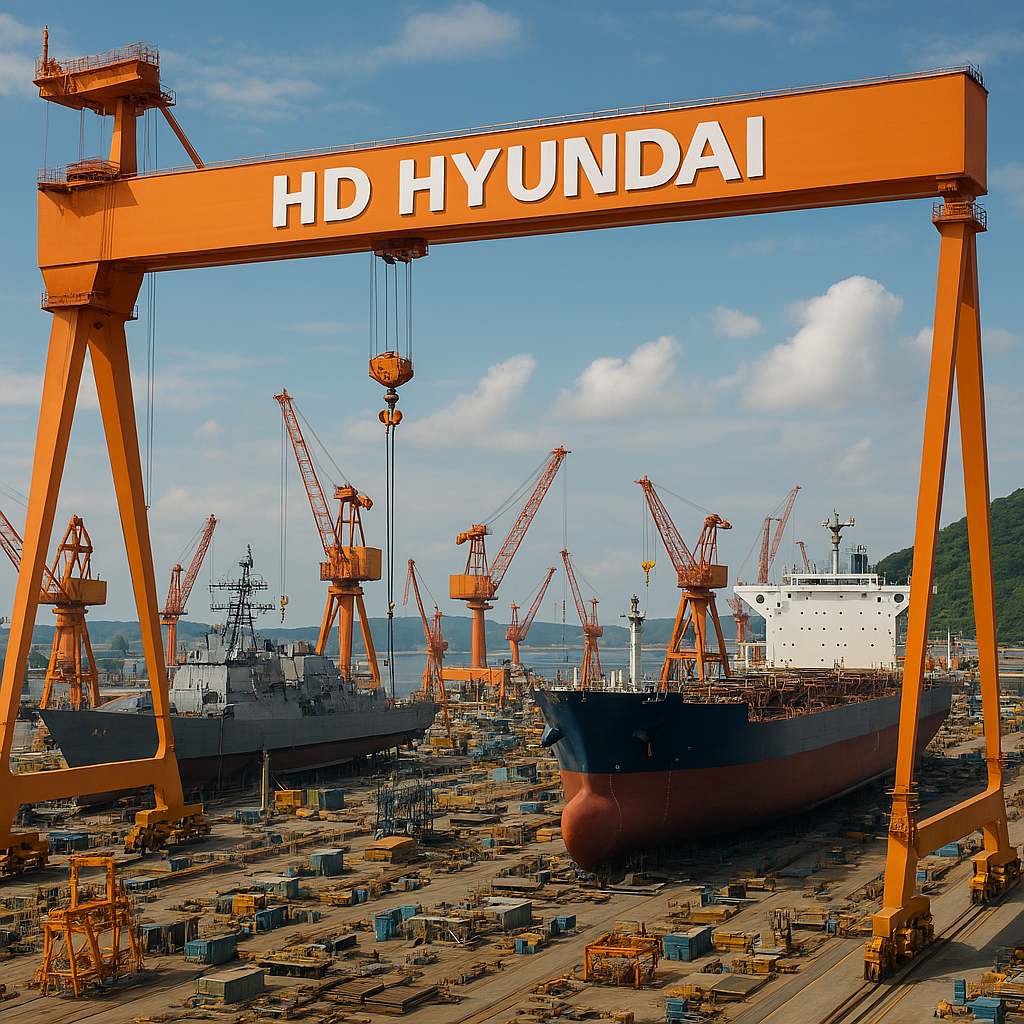
HD Hyundai, together with key South Korean and U.S. partners, is spearheading a new era of cooperation aimed at reviving dormant shipbuilding capacities in the United States and the Philippines. These moves—part of the “Make America Shipbuilding Great Again” (MASGA) initiative and a parallel venture in Subic Bay—carry significant implications for naval, commercial, and offshore industries worldwide.
Reinvigorating America’s Shipbuilding Sector
By 2024, the United States’ contribution to global shipbuilding had dwindled to just 0.04%, a striking decline for a country once considered a maritime superpower. The MASGA initiative, driven by non-binding agreements with South Korean giants HD Hyundai, Hanwha, and Samsung Heavy Industries, aims to reverse that trajectory.
1. Naval Strengthening through HII Partnership
The Memorandum of Understanding (MoU) between HD Hyundai and Huntington Ingalls Industries (HII), signed in April 2025, signals a bold step toward modernizing U.S. naval shipyards.
- Impact on the marine industry:
- Introduction of robotics, AI, and digital shipyard solutions could accelerate naval ship production cycles and lower costs.
- Strengthened naval infrastructure will ripple outward, benefiting supply chains, subcontractors, and marine equipment manufacturers.
- It may also push European and Asian naval shipbuilders to match technological innovations to remain competitive.
2. Commercial Shipbuilding with ECO
The June 2025 partnership with Edison Chouest Offshore (ECO) focuses on dual-fuel LNG containerships, blending eco-friendly propulsion with mid-sized vessel demand.
- Impact on the marine industry:
- Reinforces the shift toward LNG and alternative fuels in line with decarbonization mandates.
- Establishes the U.S. Gulf region as a new hub for green containership development.
- Could trigger renewed competition with Asian shipyards—traditionally the stronghold of LNG vessel construction.
3. U.S. Navy MRO Expansion
Securing its first Maintenance, Repair, and Overhaul (MRO) contract for the USNS Alan Shepard illustrates Hyundai’s growing foothold in U.S. defense logistics.
- Impact on the marine industry:
- Opens the door for South Korean expertise to shape U.S. naval fleet readiness.
- Expands MRO outsourcing, reducing strain on existing American yards.
- Sets a precedent for hybrid MRO arrangements that balance domestic and overseas servicing.
Subic Shipyard Revival: A Second Front in the Philippines
In parallel, HD Hyundai is teaming up with Cerberus Capital Management to rejuvenate the Agila Subic Shipyard in the Philippines. Once one of the world’s largest yards under Hanjin, the site’s revival represents both a strategic and symbolic return of heavy industry to Southeast Asia.
- Key focus areas:
- Offshore wind platform manufacturing.
- Ship block fabrication and assembly.
- Tanker construction and vessel repair services.
- Impacts on the marine industry:
- Industrial diversification: By adding offshore wind platforms to its portfolio, Subic positions itself at the crossroads of shipping and renewable energy.
- Regional competition: Philippine yards could compete directly with Vietnamese, Indonesian, and Chinese yards for mid-sized vessel contracts.
- Employment surge: The expected 10,000 jobs will strengthen local labor supply and contribute to training a new generation of Filipino shipbuilders.
- Geopolitical dimension: The involvement of both the Philippine Navy and global players like SubCom and V2X underscores Subic’s strategic importance in both security and subsea cable logistics.
Strategic Global Effects
- Rebalancing Shipbuilding Geography
- These developments dilute the overwhelming dominance of China, South Korea, and Japan in global shipbuilding by reintroducing competitive capacity in the U.S. and Southeast Asia.
- Decarbonization and Dual-Fuel Adoption
- The LNG containership initiative aligns with global efforts to reduce shipping’s carbon footprint, potentially setting new benchmarks for compliance with IMO 2030 and 2050 targets.
- Technology Transfer and Workforce Development
- U.S. and Filipino workers stand to benefit from direct exposure to South Korean digital shipbuilding practices—reshaping local expertise and raising quality standards.
- Defense and Security Implications
- For the U.S., stronger naval industrial capability is a hedge against maritime security challenges in the Indo-Pacific.
- For the Philippines, the Subic project strengthens local naval readiness and reduces reliance on foreign repairs.
Conclusion
HD Hyundai’s dual strategy—modernizing U.S. shipyards and reviving the Philippines’ Subic Shipyard—goes beyond corporate expansion. It represents a recalibration of global shipbuilding dynamics, with ripple effects across defense, commercial shipping, offshore energy, and workforce development.
For the marine industry, the stakes are clear: a reshaped competitive landscape, accelerated adoption of green technologies, and the re-emergence of long-dormant industrial regions as critical players in global shipbuilding.
Stay with us for verified, expert, and on-the-ground maritime journalism.
Contact: news@allinmaritime.com
Tel: +27 063 069 1191
Offices: Durban | Lagos | Abidjan | Dakar
All in Maritime News — Your Source for Maritime Intelligence
