

Mumbai – September 6, 2025
India has officially unveiled its largest container terminal at the Jawaharlal Nehru Port Authority (JNPA) in Navi Mumbai—a landmark development in the nation’s ambitious port-led global strategy.
A Milestone Achievement
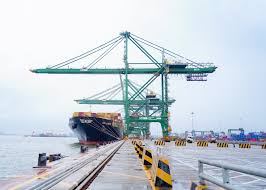
On September 4, the second phase of the Bharat Mumbai Container Terminal (BMCT), operated by Singapore’s PSA International, was inaugurated virtually by Indian Prime Minister Narendra Modi and Singapore Prime Minister Lawrence Wong. The expansion doubles the terminal’s annual handling capacity from 2.4 million TEUs to 4.8 million TEUs, making BMCT the largest standalone container terminal in India.
Strategic Infrastructure and Investment
The terminal spans 200 hectares with a two-kilometre quay capable of berthing multiple ultra-large container vessels simultaneously. It is equipped with 24 ship-to-shore cranes, 72 rubber-tyred gantry cranes, and six dedicated rail sidings, ensuring multimodal efficiency.
The expansion represents Singapore’s largest foreign direct investment (FDI) in India—worth approximately USD 1.3 billion—highlighting strong bilateral cooperation in maritime infrastructure.
Enhancing Connectivity and Sustainability
The terminal integrates six rail tracks connected to India’s Dedicated Freight Corridor (DFC), enabling seamless access to over 60 inland depots. It also incorporates renewable-powered equipment and aims for further electrification of port assets, positioning JNPA as a sustainability leader in South Asia.
Economic and Strategic Significance
With BMCT Phase II operational, JNPA’s total handling capacity has surpassed 10 million TEUs annually, elevating Maharashtra as India’s leading cargo-handling state. Once Vadhavan Port becomes operational, the state is projected to join the ranks of the world’s top ten global ports.
PSA International’s Group CEO Ong Kim Pong called the development “a catalyst for advancing India’s trade ambitions,” while local authorities stressed its importance in reducing congestion and cutting logistics costs.
Impact on India’s Economy
The expansion is expected to significantly lower logistics costs, which currently account for nearly 14% of India’s GDP—higher than the global average of 8–10%. By offering faster turnaround times and improved multimodal access, BMCT will help India increase export competitiveness, attract more foreign investment, and support its ambition to become a $5 trillion economy.
Sectors such as automotive, pharmaceuticals, textiles, and electronics are likely to benefit, as manufacturers gain access to faster and more reliable shipping routes. The boost in trade volumes will also generate thousands of direct and indirect jobs in Maharashtra and across India’s supply chain ecosystem.
Global Industry Implications
For the global maritime industry, BMCT’s expansion increases capacity on key East-West shipping routes, easing congestion at South Asian ports and providing carriers with a new high-capacity hub for transshipment. As shipping lines continue to deploy ultra-large container vessels, BMCT’s ability to handle these giants enhances efficiency across the Asia–Europe and Asia–Middle East trades.
The development also reinforces India’s role as a balancing force in global supply chains, particularly as companies seek to diversify manufacturing bases away from China under “China+1” strategies. This makes India not only a key export hub but also an increasingly vital link in the global logistics network.
Looking Ahead
The inauguration of BMCT Phase II marks more than a capacity boost—it symbolizes India’s determination to modernize its maritime sector, anchor itself in global trade, and emerge as a competitive alternative hub in the evolving architecture of international shipping.
