

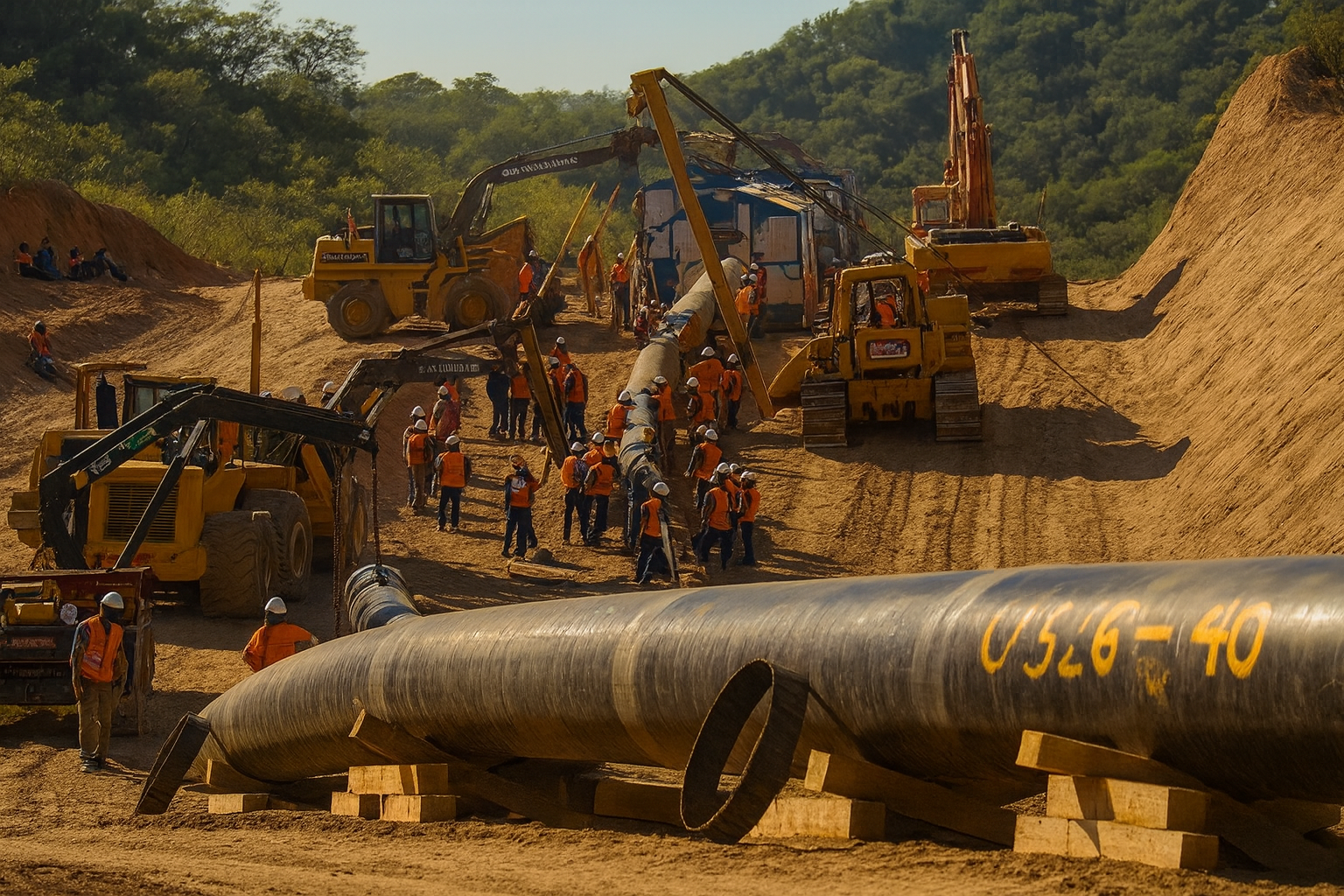
Dar es Salaam, September 4, 2025 — The East Africa Crude Oil Pipeline (EACOP), a project set to transform the region’s energy logistics, has surged past the halfway mark with 66.5% completion recorded in Q2 2025. Stretching 1,443 kilometers from Uganda’s oil fields in Hoima to the Tanzanian coast at Tanga, EACOP is billed as the world’s longest heated crude oil pipeline — and a strategic game-changer for maritime trade across the Indian Ocean corridor.
Engineering Milestones on Track
Recent updates confirm rapid progress: over 760 kilometers of pipe welded, 325 kilometers coated, and more than 100 kilometers lowered into trenches. Work on pumping stations, storage tanks, and the Tanga export jetty is advancing, bringing the long-anticipated “first oil” closer to reality, with projections now pointing to mid-2026.
Maritime Implications: Tanga Port Rising
The pipeline’s coastal terminus at Chongoleani, Tanga is being engineered as a crude export hub, where tankers will load East Africa’s first significant crude flows for the global market. Analysts forecast a sharp rise in tanker traffic at Tanga, potentially reshaping competition with established ports such as Mombasa and Dar es Salaam, while positioning Tanzania as a frontline player in global energy shipping.
Economic Promise vs. Environmental Protest
For host nations, the economic impact is already tangible. Tanzania has earned nearly US$20 million in revenue from taxes and fees during the construction phase, while Uganda prepares to unlock billions in annual oil export earnings once operations commence.
Yet, the project is not without controversy. Environmental groups warn of the pipeline’s potential to generate 34 million tonnes of CO₂ emissions annually, alongside risks to wildlife corridors, water sources, and communities along the route. Protests and legal challenges continue, with critics arguing that East Africa is locking itself into a high-carbon future just as the world pivots to renewable energy.
Strategic Partnerships and Stakeholders
The US$5 billion venture is led by TotalEnergies (62%), alongside Uganda National Oil Company (15%), Tanzania Petroleum Development Corporation (15%), and China National Offshore Oil Corporation (8%). These partnerships highlight a complex balance of regional sovereignty and global investment in Africa’s energy infrastructure.
Expert Insight: Observater Tanzania Project Cargo Commentary
Asked to comment on the project’s maritime and logistics implications, Mr. Rodgers, a Surveyor with Observater Surveys & Services Co., Ltd. in Tanzania, emphasized the importance of professional oversight as EACOP nears commissioning.
“The East Africa Crude Oil Pipeline is more than steel and welds — it is a living supply chain that must connect safely from inland Uganda to tankers at Tanga,” Rodgers noted. “Independent compliance assessments and meticulous cargo handling inspections will be crucial to keep the project on track, prevent costly errors, and assure stakeholders that international standards are being met.”
He went further, underscoring Observater’s credentials:
“At Observater, we have developed deep expertise in petroleum inspections across Africa — from quantity assessments and loss control to petroleum equipment damage surveys. These are not services to be treated as an afterthought. For stakeholders, engaging independent inspectors ensures transparency, protects investments, and guarantees that every litre and every component is accounted for. That is the foundation of long-term trust in projects of this scale.”
Looking Forward
As the project pushes toward completion, maritime and energy stakeholders are closely watching:
- Tanker operators anticipate new long-term contracts out of Tanga.
- Insurers and surveyors are preparing frameworks for environmental and cargo risk management.
- Port authorities across East Africa are recalibrating strategies to align with the expected traffic surge.
For East Africa, EACOP is more than a pipeline. It is a maritime pivot point, a geopolitical asset, and a litmus test for how the region balances economic ambition with environmental responsibility.
Stay with us for verified, expert, and on-the-ground maritime journalism.
Contact: news@allinmaritime.com
Tel: +27 063 069 1191
Offices: Durban | Lagos | Abidjan | Dakar
All in Maritime News — Your Source for Maritime Intelligence
