

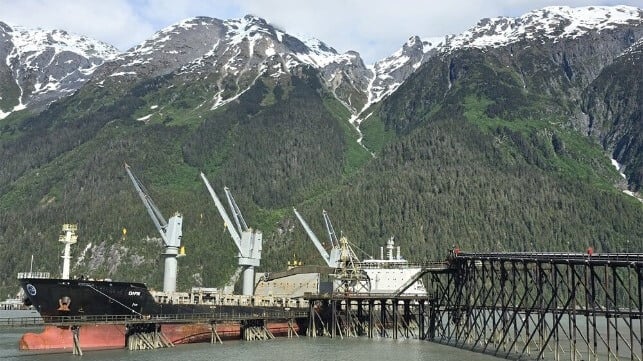
Two prominent First Nations, the Nisga’a Nation and the Tahltan Nation Development Limited Partnership, have entered a historic joint venture with Arrow Transportation Systems to acquire the Port of Stewart Bulk Terminal in northwestern British Columbia. The deal, expected to close in coming months, marks the first Indigenous majority-owned port in British Columbia’s history.
The newly formed partnership, called Portland Canal Holdings Limited Partnership, will consolidate the terminal operations with regional trucking activities, including Arrow’s Stewart Trucking Division and Tahltan-Arrow Transport, to enhance bulk logistics services.
The port is a fully permitted, deep-sea terminal strategically located on the Portland Canal near the Pacific Ocean, Canada’s northernmost ice-free port. It handles ore and logging products, notably copper and gold concentrates, from Newmont’s Brucejack and Red Chris mines, situated within the territories of the Nisga’a and Tahltan Nations. The terminal currently operates at about half its capacity, processing around 260,000 metric tons annually.
The Government of British Columbia has endorsed the acquisition by providing a grant of C$5 million (approximately US$3.6 million) under its Northwest Strategy, which aims to spur critical minerals development while advancing economic reconciliation.
Officials underscore the economic and symbolic significance of the acquisition. Nisga’a CEO Andrew Robinson described it as a step toward economic sovereignty and generational benefit. Tahltan President Kerry Carlick called the move “making history,” while Premier David Eby praised the venture for advancing reconciliation and generating regional jobs.
Global Maritime Industry Implications
The acquisition of the Port of Stewart Bulk Terminal by Indigenous partners carries considerable weight for the global maritime and critical mineral supply chains.
Improved access to critical minerals is one key outcome. The terminal sits uniquely poised to link mineral-rich regions of Canada’s Golden Triangle with global markets, especially across the Pacific Rim. Its close proximity to Asia offers companies faster, cost-effective shipping routes toward major markets in Japan, Korea, China, and India.
By combining port and trucking operations, the partnership enables more streamlined, end-to-end delivery of materials. This approach models an integrated logistics framework, potentially reducing bottlenecks and improving transport reliability.
Activating a previously underused terminal through Indigenous-led ownership could also increase port throughput capacity. Moving from 50 percent toward full utilization may shift regional shipping volumes, reducing congestion at other Pacific gateways while expanding global shipping options.
The acquisition aligns with broader trends in socially responsible and inclusive infrastructure ownership. International shipping companies and investors are increasingly attentive to ESG (environmental, social, governance) factors. This milestone could attract ESG-aligned partners and prompt similar infrastructure-led initiatives elsewhere.
As the market for critical minerals, essential for electrification, renewable energy, and defense—continues to expand, port terminals like Stewart become strategically significant nodes. Control over such assets by Indigenous groups with industry relationships could influence market dynamics and strengthen ethical sourcing credentials.
Finally, the move exemplifies how port infrastructure can serve as a platform for economic reconciliation, empowering Indigenous communities both economically and institutionally within global supply chains.
Stay with us for verified, expert, and on-the-ground maritime journalism.
Contact: news@allinmaritime.com
Tel: +27 063 069 1191
Offices: Durban | Lagos | Abidjan | Dakar
All in Maritime News — Your Source for Maritime Intelligence
