

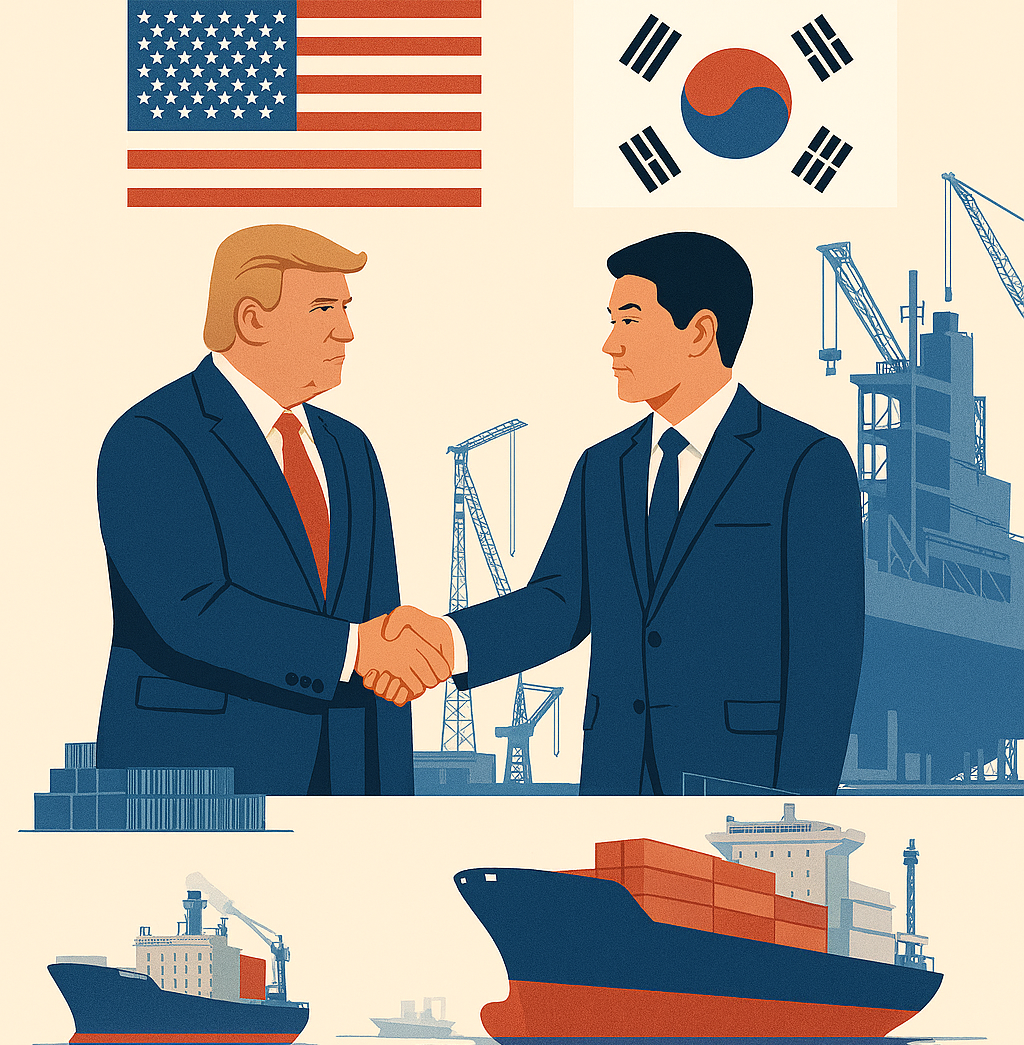
The recent announcement that U.S. President Donald Trump and South Korean President Lee Jae Myung reached a landmark agreement on shipbuilding marks more than just another trade deal, it could reshape the future of the maritime industry. The decision carries major implications for shipbuilding capacity, global competitiveness, and the evolving strategic role of maritime logistics.
Reviving U.S. Shipbuilding Through Korean Capital
For decades, America’s shipbuilding industry has been in decline, overshadowed by Asian giants like South Korea, China, and Japan. The injection of $150 billion in Korean investment, combined with U.S. political will to revive the industry, could represent the most serious attempt to re-establish American competitiveness in decades. If executed properly, this partnership could rebuild the U.S. industrial base, generate thousands of skilled jobs, and reintroduce America as a serious player in global commercial and naval shipbuilding.
Trump’s rhetoric of “Make American Shipbuilding Great Again” (MASGA) may sound like a campaign slogan, but paired with real capital and proven Korean shipbuilding expertise, it could translate into tangible capacity on U.S. soil. The long-term aim, having Korean firms build vessels in the U.S. with American workers, signals an industrial policy shift that blends foreign expertise with domestic manufacturing revival.
Tariff Concessions: A Double-Edged Sword
Korea’s successful push for tariff reductions on its auto and semiconductor exports underscores the transactional nature of the agreement. By tying industrial concessions to shipbuilding promises, Korea has secured a trade lifeline for its core industries while boosting its shipyards’ export potential. On the U.S. side, lower tariffs could benefit consumers and keep inflationary pressures in check, but they also highlight how maritime investment is increasingly entangled with wider economic diplomacy.
Cerberus–HD Hyundai Partnership: A Financial Engine for Change
The parallel announcement of the Cerberus–HD Hyundai “maritime investment strategy” adds a financial backbone to the deal. By targeting not only shipbuilding but also ports, logistics, and maritime technology, this initiative hints at an integrated ecosystem approach. The inclusion of Korea Development Bank further emphasizes Seoul’s recognition of shipbuilding as a strategic national industry, one worth underwriting with public funds even in foreign markets.
This kind of financial-industrial partnership could accelerate the modernization of U.S. shipyards, similar to the transformation seen at Subic Bay under Cerberus and HD Hyundai’s stewardship. If replicated in the U.S., it would mean not just new shipyards but a broader maritime infrastructure upgrade—an area where America has long lagged.
Strategic and Security Implications
The geopolitical undertones cannot be ignored. Revitalizing U.S. shipbuilding has implications beyond commerce—it strengthens the industrial base necessary for naval construction and maritime defense. For allies like South Korea, embedding their industry within U.S. supply chains ensures long-term market access and deeper security alignment. For rivals, particularly China, this move signals a recalibration of industrial capacity in a sector with both civilian and military dimensions.
Risks and Challenges
Despite the optimism, the road ahead is not without obstacles. U.S. shipyards face high labor costs, a shortage of skilled workers, and regulatory complexities. Scaling up capacity “from scratch,” even with Korean expertise, will take time. Moreover, domestic U.S. shipyards may push back against what could be perceived as foreign domination of a revived sector. The sustainability of Korean investment will also depend on political continuity in Washington—trade-friendly rhetoric could change with shifting administrations.
A Potential Turning Point
If successful, this U.S.–Korea shipbuilding pact could reset the balance of global maritime competition. It might spark similar initiatives from Europe and Japan, where shipyards also face Chinese dominance. It could also accelerate innovation in green shipping, automation, and digitalized logistics, as capital and know-how flow into modernized U.S. facilities.
In the wider marine industry, the agreement signals that shipbuilding is no longer just about yards and steel—it is about strategic partnerships, state-backed finance, and geopolitical leverage. The coming years will reveal whether “MASGA” becomes a slogan of substance or another missed opportunity in America’s long quest to rebuild its maritime power.
Stay with us for verified, expert, and on-the-ground maritime journalism.
Contact: news@allinmaritime.com
Tel: +27 063 069 1191
Offices: Durban | Lagos | Abidjan | Dakar
All in Maritime News — Your Source for Maritime Intelligence
