

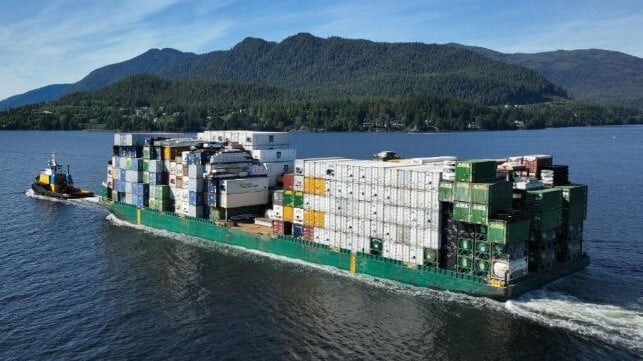
The decision by Alaska Marine Lines (AML) to suspend the transportation of electric vehicles (EVs) and plug-in hybrids on its barge services has sparked debate about whether it is a measured act of caution or an overreaction driven by fear. What is clear is that the issue goes far beyond one company’s choice. It cuts to the heart of the maritime industry’s readiness—or lack thereof—for the realities of transporting new technology in an environment where a single mistake can escalate into catastrophe.
When AML announced that it would no longer carry EVs to Central and Western Alaska and Hawaii, with a suspension for Southeast routes set to follow, it joined a growing list of operators taking similar measures. In July, Matson made the same decision, citing the hazards of lithium-ion batteries. These moves are not happening in isolation. They follow a troubling series of high-profile shipboard fires, many involving car carriers laden with electric vehicles. Incidents such as the Felicity Ace and the Fremantle Highway demonstrated how quickly a blaze can overwhelm crews and force evacuations, sometimes leading to total vessel loss.
Lithium-ion battery fires present a challenge that traditional firefighting techniques are poorly equipped to handle. Unlike gasoline fires, which can usually be smothered with foam or suppressed with water, battery fires burn at extreme temperatures, release toxic gases, and are notoriously difficult to extinguish. Even when flames appear controlled, batteries can enter a state of thermal runaway, reigniting hours or even days later. On land, this is already a formidable challenge. At sea—where evacuation is slow, resources are limited, and help may be hundreds of miles away—the risk multiplies.
Critics of AML’s decision point out that EVs are not statistically more likely to catch fire than their gasoline counterparts. That is true. However, this framing misses the point. The issue is not the frequency of fires, but their intensity and consequences. One burning EV on a vessel packed with cars is enough to trigger a chain reaction that endangers the ship, the crew, the cargo, and potentially the environment. The sea has no tolerance for slow responses or inadequate containment.
In this light, AML’s ban is less an overreaction than a sober recognition of operational limits. The maritime industry has long managed hazardous cargoes—oil, gas, chemicals—through strict regulation, specialized equipment, and crew training. With EVs, however, global safety standards remain incomplete. The International Maritime Organization is working toward new regulations, but these are not expected until 2027. That leaves carriers to make their own judgments about risk. Some choose to impose restrictions, such as limiting the number of EVs per voyage or requiring special stowage conditions. Others, like AML, have concluded that the safest course for now is a temporary halt.
For Alaska, the stakes are unique. The state’s geography makes it dependent on marine transport for goods, vehicles, and equipment. Barges carry cars and trucks to communities with no road access, and AML has been a lifeline for decades. The suspension of EV transport will undoubtedly frustrate consumers, particularly as demand for electric cars grows in remote regions seeking cleaner and more affordable transport. Yet the inconvenience must be weighed against the far greater cost of a potential disaster. Imagine a fire breaking out aboard a barge serving isolated coastal towns, with limited firefighting capacity and no immediate external assistance. The consequences could be devastating, not just for the company but for the communities that depend on its services.
This decision should also be seen as a challenge to the maritime industry to move faster in addressing the risks associated with EVs. Solutions exist. Thermal insulation blankets, fireproof containers, improved ventilation systems, and advanced fire suppression technologies are being tested. Some ferry operators already transport EVs safely under strict controls, such as spacing vehicles apart and carrying specialized extinguishing agents. But these measures remain patchwork, and without international standards, adoption is uneven.
AML has emphasized that its suspension is not permanent. The company intends to resume EV shipments once adequate safety systems are available. That commitment is important. The transition to cleaner vehicles is inevitable, and maritime shipping cannot be a bottleneck that slows adoption. At the same time, the shipping industry cannot afford to treat EVs as if they were the same as traditional cargo. They are not. They require new thinking, new infrastructure, and new regulations.
In the end, AML’s move is a reminder that the path to a greener future is rarely straightforward. Technology introduces new risks even as it promises solutions to old ones. The decision to temporarily stop transporting EVs may frustrate advocates of electrification, but it also buys time for regulators, manufacturers, and operators to align on how to handle these vehicles safely at sea.
This incident should not be viewed as a setback for electric mobility, but as a wake-up call for the maritime sector. Just as aviation transformed safety through regulation after early disasters, shipping must do the same with EVs. Waiting until after the next tragedy is not an option.
The suspension of EV transport by Alaska Marine Lines, like Matson before it, may appear disruptive in the short term. But in the long run, it could accelerate the development of robust, enforceable safety measures that ensure electric vehicles can travel the world’s oceans without endangering the ships that carry them. For now, caution is not cowardice. It is the only responsible course in uncharted waters.
Stay with us for verified, expert, and on-the-ground maritime journalism.
Contact: news@allinmaritime.com
Tel: +27 063 069 1191
Offices: Durban | Lagos | Abidjan | Dakar
All in Maritime News — Your Source for Maritime Intelligence
