

Yokohama / Kawasaki, Japan — August 13, 2025
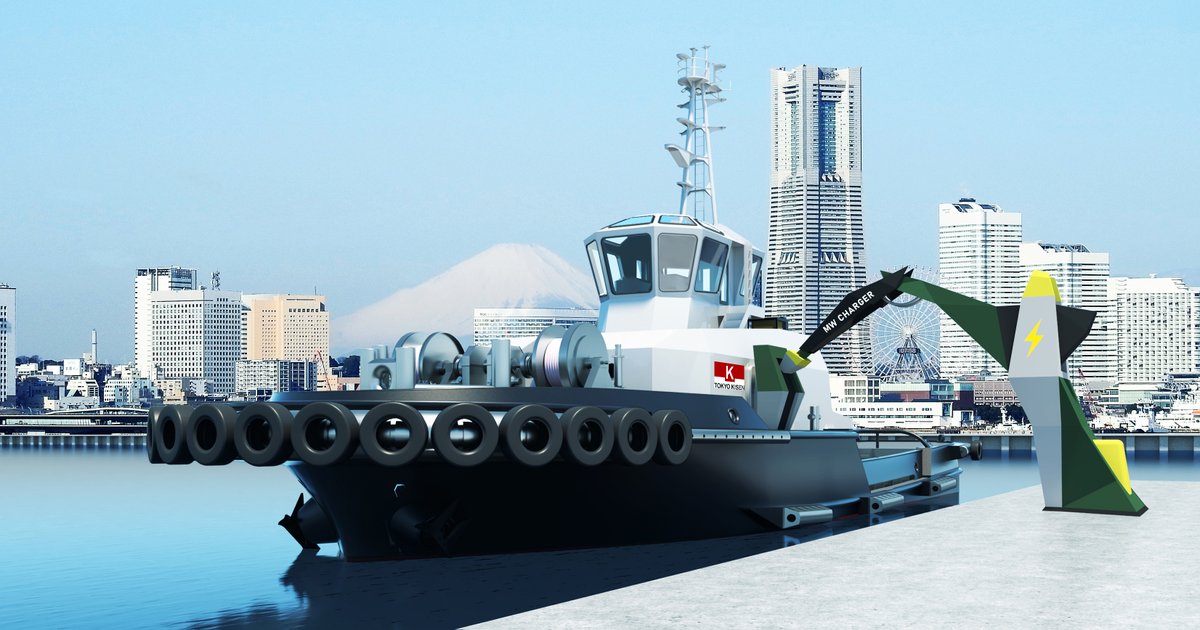
Tokyo Kisen Co., Ltd., in collaboration with maritime tech firm Marindows Inc., has officially launched Japan’s first-ever pure battery-powered electric harbor tugboat development project, marking a milestone for zero-emission maritime operations in the nation.
Project Overview
- The new electric tug design builds upon the experience gained from the hybrid-electric tug TAIGA, introduced in January 2023 and equipped with a 2,486 kWh battery.
- This new initiative advances toward truly zero-emission operations, leveraging a large-capacity 6.66 MWh onboard battery system, combined with powerful 1,000 kW shore-to-ship fast chargers.
- Key specifications include:
- Propulsion power: 2 × 1,500 kW units (totaling 3 MW)
- Bollard pull: up to 53 tons
- Maximum speed: around 14 knots (26 km/h)
- Development is managed by Tokyo Kisen with technical coordination from Marindows and support from e5 Lab Inc.
- Timeline:
- 2025: Feasibility studies and conceptual design
- 2026–2027: Basic and detailed vessel design
- 2028: Construction starts
- 2030: Commercial operations begin in Yokohama and Kawasaki ports.
Significance and Industry Context
This initiative signifies a decisive shift from hybrid solutions—such as TAIGA—toward fully electrical tugboats capable of carbon-free operation. The target ports, Yokohama and Kawasaki, are strategically important for Japan’s commercial maritime activities and will benefit from reduced local air pollution and lower noise emissions.
Broader Green Shipping Ecosystem
- NYK Group’s parallel efforts: In May 2025, NYK introduced e-Crea, Japan’s first fully battery-driven work vessel, designed for shipyard support tasks. This compact 9-meter vessel operates entirely on shore-charged batteries and is intended as a precursor to a full-scale electric tug slated for completion by December 2026.
- e5 Lab’s design contributions: As a prominent consortium in Japanese green maritime innovation, e5 Lab has conceptualized both fully electric tankers and tugboats, including early designs with hybrid battery–hydrogen systems. These projects underline the sector’s long-term shift toward electrification and sustainability.
Why This Matters
- Environmental Impact: By eliminating on-board diesel engines entirely, the project promises substantial reductions in CO₂ and particulate emissions, directly supporting Japan’s 2050 carbon-neutral ambition.
- Operational Efficiency: The combination of large battery capacity and fast-charging infrastructure ensures high power output and quick turnaround—critical for harbor operations.
- Scaling Potential: Successful deployment may pave the way for broader adoption of pure-electric tugboats across Japan’s major ports and potentially influence international maritime decarbonization strategies.
Stay with us for verified, expert, and on-the-ground maritime journalism.
Contact: news@allinmaritime.com
Tel: +27 063 069 1191
Offices: Durban | Lagos | Abidjan | Dakar
All in Maritime News — Your Source for Maritime Intelligence
