

Geneva — April 2025
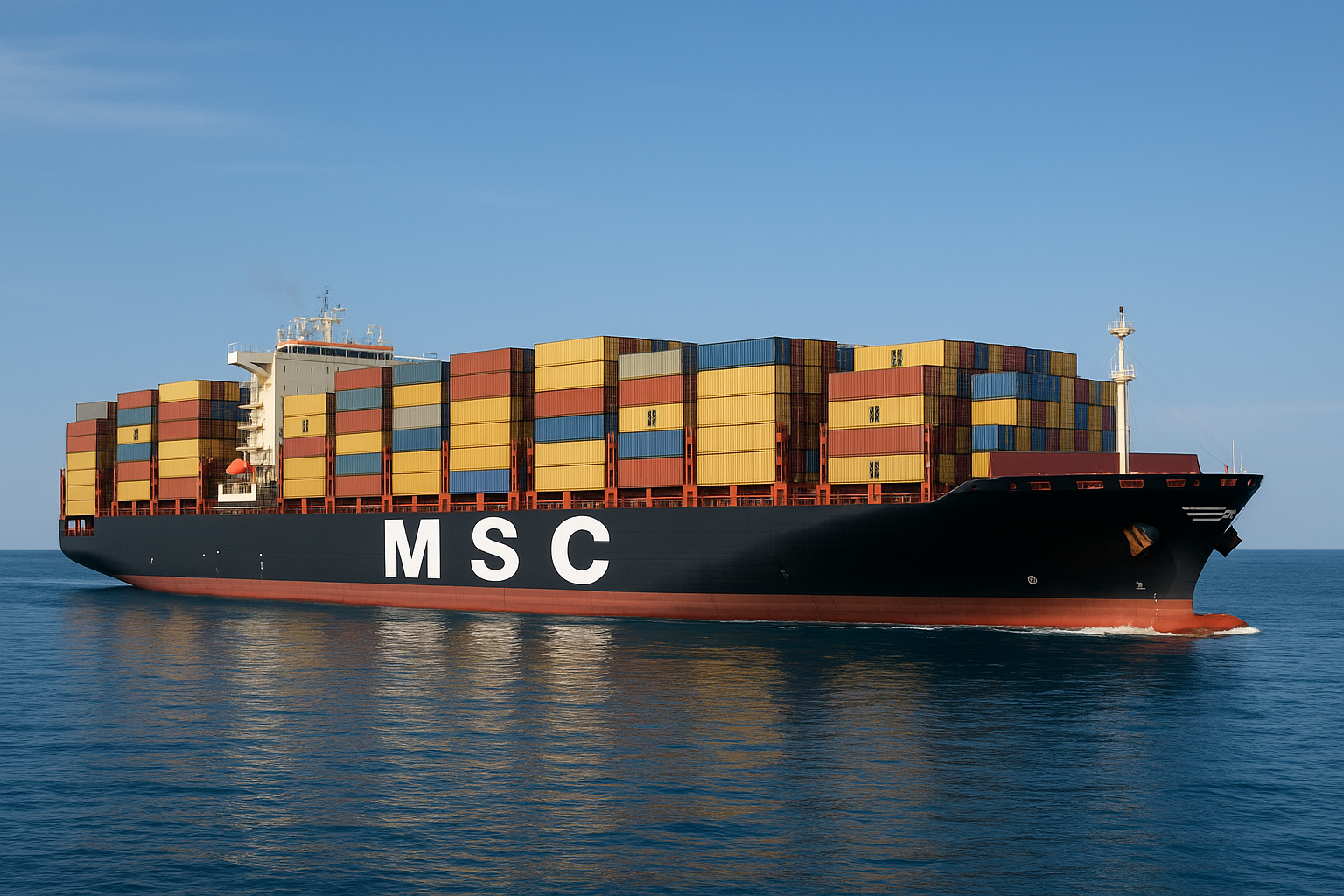
Mediterranean Shipping Company (MSC), the privately held Geneva-based shipping giant, has officially become the first container carrier in maritime history to operate a fleet of 900 active vessels. This momentous milestone not only reaffirms MSC’s dominance in global container shipping but also positions the company as a decisive force shaping the industry’s future across scale, efficiency, and environmental leadership.
Strategic Milestone Reached
According to verified vessel data collated in April 2025, the entry of the LNG-powered vessel MSC Germany into active service marked the symbolic 900th vessel in MSC’s operating fleet. This vessel, with a nominal capacity of approximately 16,000 TEU, was the fifth of a 12-ship series ordered from China’s Yangzijiang Shipbuilding in 2022.
MSC’s current fleet now comprises:
- 609 owned vessels
- 291 chartered vessels
- Total carrying capacity: 6.47 million TEU
- Global market share: 20.3% of total container fleet capacity
This growth cements MSC’s position far ahead of its closest competitor, Maersk, by an estimated margin of nearly one million TEU in total capacity.
A Decade of Aggressive Expansion
MSC’s rise to the top of the container shipping league has been a result of deliberate long-term planning, complemented by swift opportunism during the pandemic-driven supply chain boom. Since 2020, the company has aggressively acquired over 400 secondhand container ships, targeting vessels across all size classes to strengthen its global network.
A senior fleet deployment executive at MSC noted, under anonymity:
“We capitalised on market conditions when freight rates surged. That gave us the capital to expand decisively—acquiring tonnage that offered instant scalability across feeder, regional, and deep-sea trades.”
At the same time, MSC placed substantial newbuilding orders with leading shipyards in South Korea and China. These included orders for LNG dual-fuel megamax ships, methanol-ready ultra-large container vessels, and digital twin-ready smart ships capable of real-time emissions and fuel analytics.
Fleet Diversification and Geographic Reach
MSC’s 900-vessel fleet spans all classes:
- Feeder vessels (1,000–3,000 TEU)
- Panamax and neo-panamax ships
- Ultra-large container vessels (ULCVs) exceeding 24,000 TEU
The company now serves over 500 ports across 155 countries, supported by more than 70,000 employees worldwide. Its intermodal logistics arm, MSC Logistics (Medlog), complements maritime operations with integrated inland, warehousing, and customs solutions, making MSC not just a carrier—but a full-spectrum logistics platform.
Environmental Strategy: LNG, Methanol, and Fleet Transition
A key highlight of MSC’s fleet expansion is its parallel focus on decarbonisation. The LNG-powered MSC Germany that pushed the fleet count to 900 is emblematic of this green shift. MSC has committed to deploying over 100 dual-fuel vessels—capable of operating on LNG, methanol, or ammonia—by 2030.
In 2023, the company launched its internal Green Horizon Initiative, a strategy aligned with the IMO’s GHG reduction targets. This initiative includes:
- Retrofitting older ships with energy-saving devices
- Installing shore power (cold ironing) systems on key vessels
- Switching to biofuel blends on pilot routes
- Digital optimisation tools for slow steaming and routing
An MSC spokesperson confirmed:
“We do not see sustainability and profitability as opposites. Our new builds are designed to ensure both compliance and competitive advantage. As regulatory frameworks evolve, our fleet will be ready.”
Financial Strength and Independent Operation
Unlike many global competitors, MSC remains privately owned by the Aponte family. This independence allows the company to make bold and long-term investment decisions without the short-term constraints often imposed by public shareholders.
While some analysts have questioned the risks associated with such rapid growth, others argue that MSC’s conservative financial management, strong cash flow, and diverse fleet have enabled sustainable expansion without overexposure to debt.
Shipping finance consultant Johan Fischer commented:
“MSC’s ownership model allows it to reinvest profits at scale, build for the future, and bypass the quarterly pressure of public markets. That flexibility has paid off handsomely.”
Market Implications and Industry Impact
The implications of MSC’s 900-vessel milestone are far-reaching:
- Carrier competition reshaped: MSC’s scale gives it dominant pricing power on major East–West routes, especially as alliances restructure post-pandemic.
- Charter market pressure: With more ships under ownership, MSC reduces dependency on volatile time-charter markets—allowing cost control and service reliability.
- Port strategy: Larger vessels require upgraded terminals. MSC is increasingly aligning with terminal operators for joint investments in hub development across Africa, Asia, and South America.
- Alliance disruption: With its recent departure from the 2M Alliance with Maersk, MSC is pursuing a standalone global service network, reshaping competitive dynamics on major trade lanes.
What Comes Next
With 132 new vessels on order—including megamax and low-emissions ships—MSC is well on course to surpass the 1,000-ship threshold by 2027, assuming no major fleet reductions.
Analysts believe the company is preparing for a future where digitalisation, decarbonisation, and end-to-end logistics integration define market leadership.
Conclusion
The 900-ship milestone is not merely a number—it’s a symbol of how MSC has redefined scale, strategy, and sustainability in container shipping. As competitors recalibrate and regulators tighten emissions oversight, MSC’s fleet evolution positions it not just to compete—but to lead.
All in Maritime News will continue tracking MSC’s path toward 1,000 ships, its impact on freight rates, and the next phase of global shipping transformation.
Contact: news@allinmaritime.com
Tel: +27 063 069 1191
Offices: Nairobi | Mombasa | Dar es Salaam | Durban
All in Maritime News — Your Source for Global Maritime Intelligence
